
Ohio Republicans have again introduced legislation designed to outlaw certain types of gender-affirming care.
Editor’s Note: A previous version of this story used the term “criminalized” as the language of the bill doesn’t make clear how violations of the prohibitions would be enforced. Representative Click has since provided The Buckeye Flame with an opinion from the Ohio Legislative Service Commission that “the bill does not establish any crimes; instead, it prohibits certain activities and classifies them as unprofessional conduct subject to discipline from the applicable licensing board.” That opinion can be viewed here. That said, the bill does make some of this behavior illegal, which fits the definition of “criminalize.”
Dubbed the Saving Adolescents from Experimentation (SAFE) Act, House Bill (HB) 68, is being sponsored by Rep. Gary Click (R-Vickery), a Baptist pastor from Sandusky County in north-central Ohio.
At a press conference on Wednesday, Click said that HB 68 has 40 co-sponsors and is a priority of Republican leadership.

Despite studies concluding that gender-affirming care can result in a decrease in both psychological distress and suicidal ideation, Click insisted that HB 68 would result in greater safety for Ohio’s vulnerable youth.

“We are trying to establish the highest standards of care for young people who identify as transgender,” Click said at the very start of the press conference.
What’s in the bill?
The bill is the newest iteration of legislative attempts to restrict gender-affirming care offered in Ohio.
HB 454, the SAFE Act introduced in 2022, received five hearings last year but did not advance out of the Families and Aging committee.
HB 68 has been assigned to the Public Health Policy committee. The bill would do the following:
- Prohibit physicians from prescribing cross-sex hormones or puberty blockers, and from performing any type of gender reassignment surgery on minors.
- The bill would prohibit healthcare providers from helping their patients get gender affirming care in other states, outlawing conduct that “aids and abets.” At the press conference, Click said that these cases would be referred to the attorney general and that the intent here would be penalties that are civil and not criminal.
- Prohibit mental health professionals from diagnosing or treating a minor with a gender-related condition without obtaining the consent of the patient’s legal guardian and screening the patient for comorbidities, physical, sexual, mental, and emotional abuse and other trauma.
- Prohibit courts from considering a parent’s refusal to accept a child’s trans identity in custody cases, including misgendering, deadnaming, and denying access to counseling for their child.
- Prevent any restriction on the practice of “watchful waiting,” an approach in which medical interventions are intentionally withheld.
- Mandate that mental health professionals report annually information regarding minors they have treated for gender-related conditions, including number of patients, demographic data on patients (age at diagnosis, sex assigned at birth, comorbidities), and the number of patients who resumed identification with their sex assigned at birth.
- Prohibit Medicaid from covering gender transition services.
The press conference
Wednesday’s press conference featured Click expounding on the bill and inviting two guests to condemn gender-affirming care being offered to minors.
Ronli Moses, the Columbus mother of a trans child, said that she felt healthcare providers pressured her family to pursue gender-affirming care that didn’t address some core issues her child was experiencing.
“His mental health was ignored in lieu of a quick fix that in reality, fixes nothing on the inside which is where the problem lives,” Moses said.
Click repeatedly insisted that the LGBTQ+ community supports HB 68. To illustrate his point, he brought forward Scott Newgent, a Texas-based trans lesbian who said he was tricked into transitioning his gender when he was 42.
Newgent took to podium at the press conference to angrily berate members of the media. He hurled “Shame on you!” literally nine times at the reporters present for not amplifying his voice enough in the press.
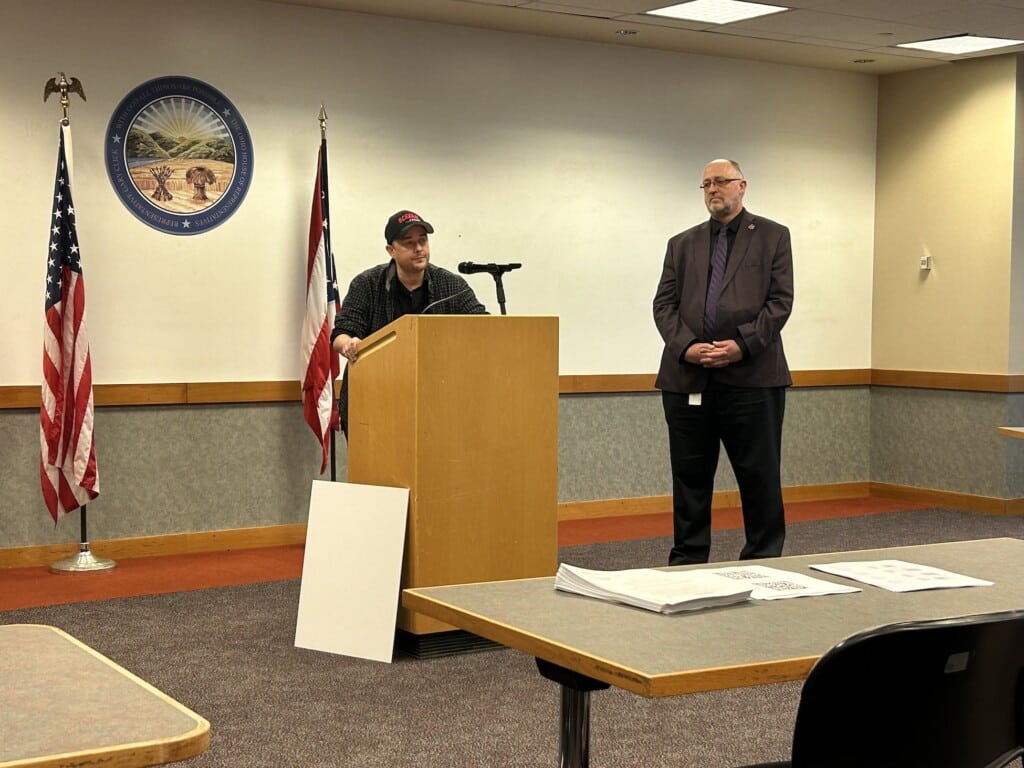
“You don’t ask to interview me like you do everybody else,” Newgent repeatedly complained, before mocking the voices of individuals who speak in support of gender-affirming care.
When reporters attempted to ask Click questions about specific parts of the bill, Click admonished them for not directing questions to Newgent who “poured his heart out.” Click then took it upon himself to ask Newgent a question in place of the reporters.
When asked about how he would respond to parents of LGBTQ+ youth who feel the HB 68 strips them of their right to determine the most appropriate care for their children, Click responded that parents do not have the right to abuse their children.
“If a child perceives themselves as being an amputee, can a parent authorize them to be able to cut off an arm? No,” Click said.
Click also said that HB 68 was brought to him by concerned Ohio parents. When asked about his past testimony that the bill was brought to him by the Center for Christian Virtue (CCV), he clarified that the CCV organized the families that were brought to him. He further said that CCV helped in brainstorming language, but that the resulting HB 68 Act was his own.
“This bill as you see it now was put together by Gary Click,” said Click, speaking in the third person.
Swift response from LGBTQ+ orgs
Ohio’s LGBTQ+ organizations were quick to denounce HB 68.
“Transgender youth and their families − people who are lifelong Ohioans − are living in constant fear of their rights getting stripped from them by politicians,” Equality Ohio Policy Director Maria Bruno told The Columbus Dispatch. “If this bill were to pass, every transgender kid in Ohio would be forced to detransition or flee the state. Politicians aren’t just inserting themselves into the private health decisions of families and the licensed professionals they work with. They are attempting to prohibit best medical practices. The absurdity of this is impossible to overstate.”
Though the introduction of the bill was expected, the actual wording introduced on Wednesday featured more prohibitions than were in last year’s version of the SAFE Act.
“We’re not surprised to see the bill, but we’re just really disappointed that all of the heart-wrenching testimony that came out last year seemed to not only go ignored but seems to have made them go the other direction altogether,” Bruno said.
This piece was updated on 3/1/23 with information on the bill number and committee assignment.
Ignite Action:
- HB 68 has been assigned to the Public Health Policy committee. Concerned Ohioans can contact their state representative and members of the Public Health Policy committee to make their stance known on HB 68.
Know an LGBTQ+ Ohio story we should cover? TELL US!
Submit a story!





Pingback: What Is Grooming? Ohio Republicans Know - Lily J Cunningham