
We have fought before and won: An Ohio Lavender Graduation Ceremony keynote address
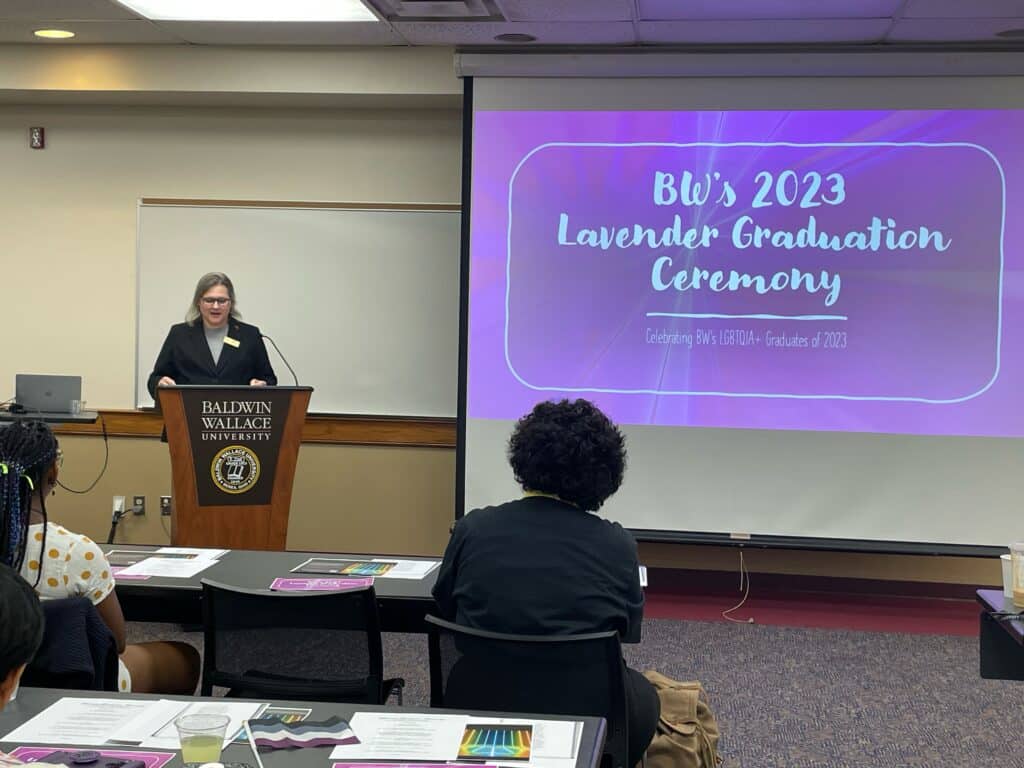
On April 20, Dr. Emilia Lombardi delivered the keynote address at the Baldwin Wallace Lavender Graduation ceremony. These are her words.
It’s graduation season. And that means it’s Lavender Graduation season too!
The Lavender Graduation Ceremony was created by Dr. Ronni Sanlo, an LGBTQ+ academic hero, who was denied the opportunity to attend the graduations of her biological children because of her sexual orientation. This inspired her to design the first Lavender Graduation Ceremony in 1995 at the University of Michigan. Now, these celebrations are held all across the world, including a host of Lavender Graduations here in Ohio.
Baldwin Wallace University in Berea held their Lavender Graduation Ceremony on April 20. The keynote address was delivered by Dr. Emilia Lombardi, associate professor and chair of the Department of Public Health and Prevention Science. Dr. Lombardi has been involved in HIV prevention research and examining health disparities among racial and ethnic, sexual and gender minorities for more than 15 years.
We present to you here Dr. Lombardi’s keynote address.
Good afternoon everyone.
I’m Emilia Lombardi, Professor, Trans-Daughter of Pete and Palma Lombardi, and wife of Jessi Strucaly.
Lavender Graduation was developed to highlight the academic achievement of sexual and gender minorities in the face of societal stigma as well as one’s own journey around sexuality and gender. My own journey began during the early years of my grad school life, and my trans identity is very much tied into my academic career.
Not having a community to connect to, I had to look to the stacks of my school library. As a budding academic, I was exposed to others who felt they knew me, like the sociologist Harold Garfinkel, who in the 1970’s didn’t know he was being played by Agnes who knew she had to go through him to receive the gender affirming services she needed.
The situation wasn’t much better during the 1990’s when trans adults still needed many permissions to access gender-affirming care: from weekly visits to therapists to show our persistence, to visits with the few physicians willing to prescribe hormones or provide any kind of gender-affirming care. At each step, one’s sexual and gender expression was scrutinized to make sure that only the deserving received care and the freaks were pushed out.
Freaks in this case were anyone who did not fit the typical heteronormative image held by clinicians.
I was one of those freaks who began to question the expectations and amount of control others had on my life.
Thankfully there were others who began to advocate for more autonomy in the process as well as for a public trans identity.
Sandy Stone in her 1987 essay “The Empire Strikes Back: A Posttranssexual Manifesto” spoke of the need to be visible as trans to fight against societal oppression along side of feminist and gay activists.
Susan Stryker’s 1994 essay “My Words To Victor Frankenstein Above The Village Of Shaa·muh·nee” echoed Sandy’s call for letting go of the privilege that passing allows in order to create a more authentic life and, in finding the strength, found the anger one feels toward those antagonistic to trans lives.
It’s important to note that what Sandy and Susan wrote about had already been enacted previously by trans women of color during 1966 Compton Cafeteria Riots in San Francisco and the 1969 Stonewall Riots in New York City. Marsha P. Johnson and Sylvia Rivera were both social and political advocates with the Street Transvestite Action Revolutionaries (STAR) during the 1970s and had already been doing the work that many white trans people, like myself, were beginning to do in the 1990s.
Once getting my PhD, I quickly took a post-doc in Los Angeles and was able to achieve that social space — if not the financial space — I needed. More importantly, I was able to integrate myself within a larger community of trans people, especially those who were working within HIV/AIDS services.
HIV/AIDS researchers and providers at the time did not see trans women as being distinct from the category of “men who have sex with men” and that meant that HIV/AIDS services were not being utilized with their needs in mind. Early studies have shown trans women being at great risk for infection and low chance for any service that would prevent that infection.
I joined a group of other trans women to advocate for better resources and recognition for trans lives within the public health profession. I was the only trans woman with a PhD and a research background in these talks, but I don’t think many people made that distinction. Still, it was the beginning of my work in trans health, a new and needed field of study.
My career can be best summarized in three versions of a chapter I co-wrote on LGBT Health with Talia Bettcher, one of the few other academic trans women around at the time as well as my friend and colleague.
- 2006: Things are getting better
- 2013: I’m actually getting optimistic
- 2019: Nevermind, changes weren’t sustainable
Which brings us to now where we see an attempt to turn back the clock on trans rights and trans health. Forces are trying to return us back to the point when we were invisible and more marginalized. But they tried this before and lost. People tried to keep us out of music festivals and bathrooms, get us fired from jobs, and prevented us from having a say in our medical treatment.
They all lost.
Those who are enacting the current round of legislation targeting trans lives are not large, but they are vocal and politically active. This same group will likely target the lives of lesbian, gay, and bisexual people if they are successful in overturning a few key Supreme Court cases, like they did for Roe v Wade.
This isn’t inevitable.
We have fought against this before and won. We fought against the Briggs initiative that would have prevented LGBT people from teaching in California schools and won. We fought to have gender identity and expression added to nondiscrimination laws and won. We fought to ease the financial and social barriers to gender affirming care and won.
We need to remember what made us successful in the first place. We need to remember that our strength lies in our visibility and the willingness to work together.
We need to reflect on the work of STAR and ACT-UP who fought during the time when no one wanted anything to do with gender and sexual minorities. And finally, we need to remember that we are stronger together than apart.
To conclude, I want to encourage you to connect to others and not disappear into your new lives. Be visible and together and focus your anger into action.
Thank you. 🔥
Know an LGBTQ+ Ohio story we should cover? TELL US!
Submit a story!
Author

Related Articles

Ohio gets a failing mark on sex education policy from national group
Ohio’s curriculum stresses abstinence as a general policy and requires only some instruction about sexually transmitted infections.

Sponsored Sponsored content HPV and Anal Cancer: What LGBTQ+ Ohioans need to know about risks, screening and prevention
Many people don’t know anal cancer screening is available and some healthcare providers may not bring it up during a visit.
HIV decriminalization supporters to hold first-ever Advocacy Day at Ohio Statehouse
Ohio still has six laws on the books that criminalize living with HIV. And the laws are actively enforced.
