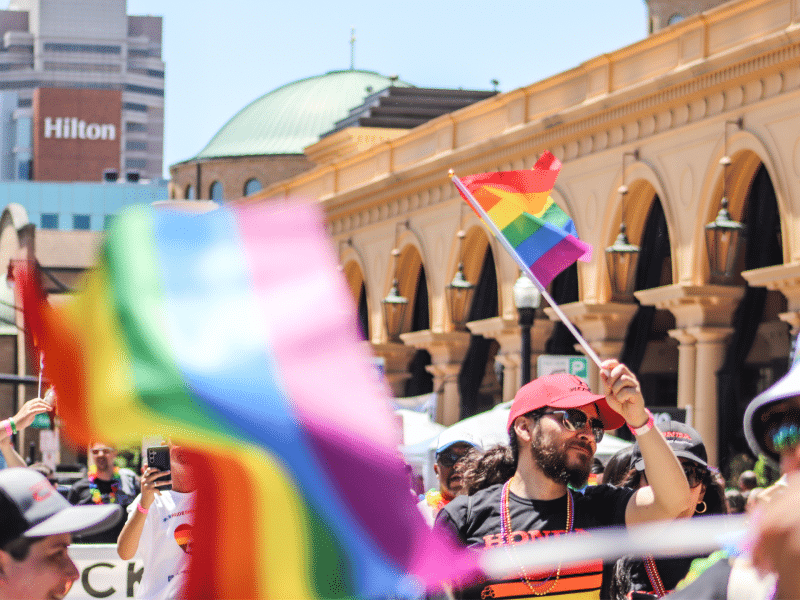
For the first time in the group’s history, NASA’s northeast Ohio queer employees and their allies marched in Pride in the CLE in 2023.
Marching in Pride was one small step for queer-kind, but LGBTQ+ employees at NASA’s Glenn Research Center are committed to supporting agency-wide change to make NASA– and outer space– a more diverse, inclusive and accessible place to work.
“This is for everybody. There is space for everyone here,” said Jen Pierce, an aerospace engineer and Chair of the Rainbow Alliance Advisory Group (RAAG) at the Glenn Center.
Despite identifying as a “big science nerd,” Pierce’s path to her current job at NASA wasn’t linear.
Pierce, a queer woman, originally started out as a social work major before re-focusing her attention on the stars.
“I saw a TED Talk of [Sandra Alba Caufman], a female engineer at NASA, and I looked at her and I thought, you know, if she can do it, I can do it too,” said Pierce.
The Buckeye Flame caught up with Pierce to learn more about being queer at NASA, her interstellar gay agenda and when we might expect queers on the moon. Click play directly below to listen to our chat or read our conversation underneath.
I’d love to hear from you about how you got involved in NASA and what exactly you do.
Jen Pierce: I work on the European Service Module, so that’s the power propulsion and life support for the Orion spacecraft, and that’s what’s carrying our astronauts in the Artemis program.
I got inspired to work for NASA cause I’m a big space nerd, but I think that’s true for all NASA employees. What really hooked me was getting involved with a program called the NASA Community College Aerospace Scholars. They brought me on-site and that gave me a window into what life was like for an engineer working at NASA. That really sparked an interest for me and got me hooked into it.
Would you describe the Artemis program?
The Artemis program is NASA’s program that’s sending the first woman and the first person of color to the surface of the moon. Now, our goal is to establish the first long-term presence on the lunar surface–and the reason why we’re doing that–it’s a stepping stone for us sending the first astronauts to Mars.
It sounds like Artemis is an exciting opportunity to diversify those who have landed on the moon. Will those same efforts carry over to the Mars expedition?
Yeah, absolutely. NASA is really dedicated to their Diversity, Equity, Inclusion, and Accessibility Initiative. We have an astronaut class, and those are the folks that are being trained to be astronauts. Even just taking a quick look through the folks that are in the class, you can see that we’re making a big effort to make sure that we have an inclusive and diverse class of astronauts.
Let’s talk a little bit about your inspiration to work for NASA. I mean, we all know Neil Armstrong and Buzz Aldrin– we know all these white men– was there a point in which you saw a woman or another queer person that inspired you?
That’s a really interesting question and it kind of hits me in the heart. I started school as a social work major– social work and community service is something I’ve always volunteered in and always done– but I’ve also always been a science nerd. While I was taking my social work classes, I was reading Scientific American and looking at physics journals and watching these TED Talks.
I saw a TED Talk of a person– a female engineer– they were a NASA employee. I looked at her and I looked at her age– being similar to my age– and I thought, you know, if she can do it, I can do it too.
That’s beautiful.
Thank you. It’s not something I get asked very often, but it really changed my life having that representation and to see that there are folks like me in the agency.
And speaking of representation and inclusion and diversity and all of these efforts… Can you describe what the Rainbow Alliance Advisory Group (RAAG) is?
RAAG is our LGBTQ+ and allies employee resource group. For folks that aren’t familiar, they act as advocates for folks in their communities by working with leadership on initiatives that help to improve the work life of people represented in the community.
I also understand that you all participated in Cleveland Pride for the first time ever.
So one of the things that was really, really beautiful about marching at Pride in the CLE with our LGBTQ+ employee resource group was that walking as a queer person in Pride, for one, is really emotionally charged, but being able to walk down the street and see the inspiration in people’s faces, especially people high school and college age looking at us, knowing there’s a queer person working at NASA.
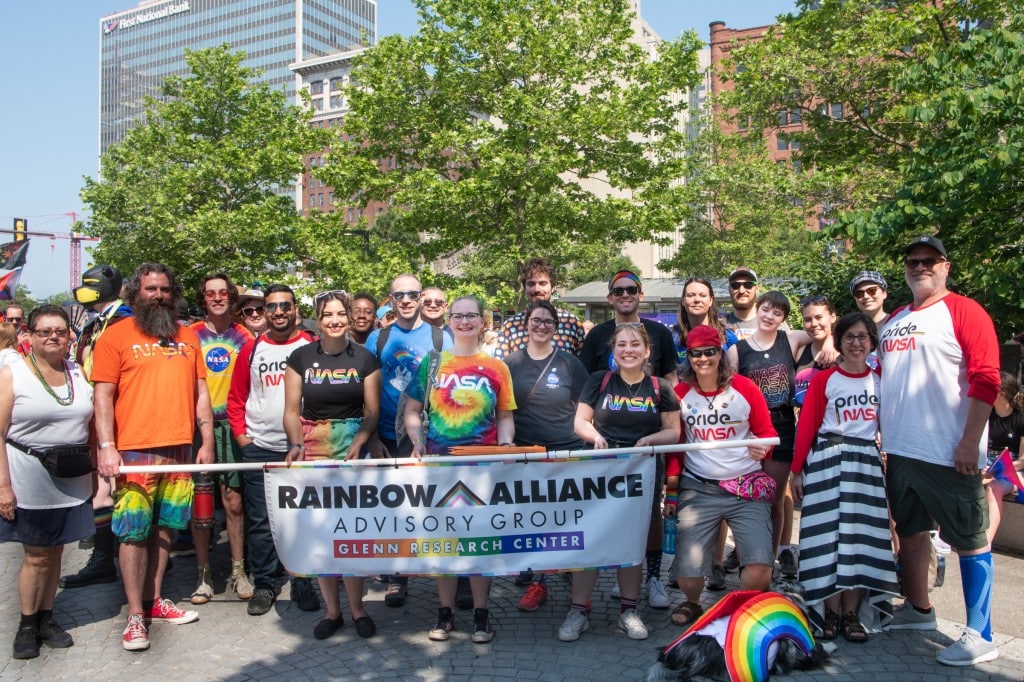
There are allies working at NASA, they are supported at NASA, and that puts that idea in their head that this is for them. This is for everybody. There is space for everybody here. And diverse teams are innovative teams and that’s what we need.
What’s next on your agenda?
We’re also continuing to work on agency-wide initiatives to improve the lives of the LGBTQ+ folks at NASA. We’re always dedicated to hearing our community and communicating those needs as they arise to agency leadership.
What’s an example of a policy that you all are working toward?
One of the things that we just accomplished was–I don’t know if you noticed in my email–but my email as it comes across has my pronouns included, and that’s an agency-wide initiative that RAAG was part of. This new initiative is supportive of inclusion by allowing you to use a name that’s not your legal name, but that is your identity.
Another thing that we’re working on right now is expanding the all-gender restrooms in the NASA facilities. We’re working to create guidelines agency-wide– not just at our center– to make sure that all-gender restrooms are available for everybody in every building.
What is your dream for NASA in terms of inclusion, accessibility, and awareness?
I think the most important thing for inclusion and accessibility is that every person can come to work and be their genuine selves. It takes a lot of mental toll on you to pretend to be somebody else while you’re at work or to pretend to be somebody else.
So, I think that my dream is just to continue to support initiatives that make people feel comfortable being who they are.
What advice do you have for people– particularly queer people–who want to join NASA? What words of wisdom do you have for them?
What I found is that all it really takes is reaching out. Everybody’s skills are valued and if you see somebody that looks like you and you say– “That person makes me feel like I also have a place there” – reach out to them. All of our email addresses are pretty easy to get to and especially, especially if somebody’s doing an outreach event– they’re doing outreach because they want to.
If we diversify our teams, then we have strength in the way that we see these problems. I am a woman in STEM and I am a queer person in STEM. We have a lot of role models and we have a lot of people that we can look up to. If we can follow those role models and just continue to be strong and move forward and blaze these trails, it makes us easier for the folks behind us.
I’d be remiss if I didn’t ask, when are we getting queer people on the moon or what planet are queer people going to?
We’re gonna launch Artemis-II next year and that’s gonna take astronauts around the moon. They’re gonna go further than they’ve ever been before. After that, we’re gonna be sending astronauts about once a year. So, we have a lot of opportunities to put a lot of diversity in space.
I look forward to seeing it.
Yes, me too. 🔥
Know an LGBTQ+ Ohio story we should cover? TELL US!
Submit a story!