

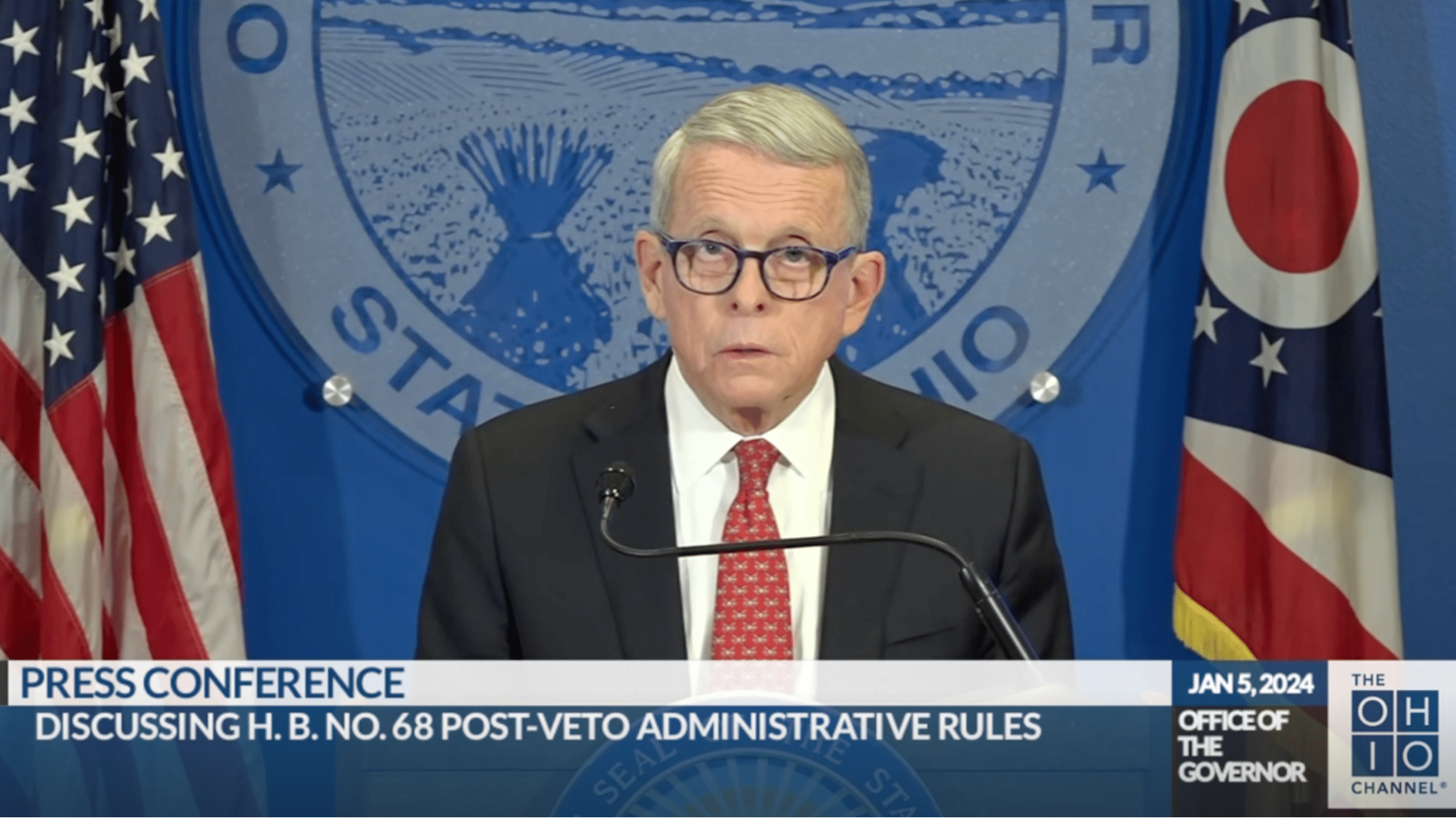
On Jan. 5, the DeWine administration released two administrative rules and an executive order restricting gender-affirming care for Ohioans. The executive order banning gender-affirming surgeries for minors went into immediate effect.
The two administrative rules would clear the way for the state, through the departments of Health and Mental Health and Addiction Services, to restrict access to healthcare for transgender adults.
The proposed rules would:
- Restrict the ability of hospitals and clinics to diagnose gender dysphoria in transgender adults.
- Require healthcare providers to document and report all transgender patients’ “deidentified” healthcare data to the state of Ohio every 30 days, including “any medical or surgical service (including physician services, inpatient and outpatient hospital services, or prescription drugs or hormones).”
- Require transgender adults to obtain a detailed care plan and medical consent from a psychiatrist, an endocrinologist and a bioethicist before the “prescription, initiation, or provision of treatment for a gender-related conditions” can take place, including access to hormone replacement therapy (HRT).
- Require transgender adults under the age of 21 to “receive a comprehensive mental health evaluation” over the course of “not less than six months” in order to access gender-affirming healthcare.
Restrictions on gender-affirming care for adults are still a rarity across the country — Oklahoma, Mississippi, and Missouri have attempted (and failed) to pass legislation with adult restrictions.
In Florida, restrictions on adult care have impacted people’s ability to get access to hormone replacement therapy. To follow updates on these laws across the country, you can find updates on MAP.
One thing is certain — these new rules are extremely complicated and await further legal analysis. Because of the vagueness and complexity of both rules, including the fact that they do not match in significant places, interpretations are incredibly varied, even among experts.
Experts all over the state are still working through the rules and what they mean. However, it’s clear that the rules will significantly impact care if they are put into place, particularly for small health providers. The devil will be in the details.
What’s also clear is that the administration’s new rules are incredibly unethical, despite the requirement for an ethicist to be involved in the creation of a care plan. As a bioethics graduate student, this request stood out to me.
Bioethics, or the study of the morals and ethical guidelines of medicine, isn’t a licensed field, but rather a highly interdisciplinary one that studies all aspects of medical care. Simply, bioethics asks whether we should do something as opposed to whether or not we can.
Many hospitals in Ohio have bioethicists on staff to work with physicians and families to make complex medical decisions. They are typically called on to facilitate life-or-death conversations around whether to continue care, mediate in disputes about cultural and spiritual beliefs or help a hospital allocate resources during a crisis.
There’s usually a central question of concern or disagreement, like whether or not someone’s care is being managed in the best way for a patient. But in this situation, there’s not really a disagreement — it’s pretty clear from both a medical and ethical perspective that gender-affirming care is safe, effective and best-practice medicine.
The four principles of ethics all apply: beneficence (to act in the benefit of the patient), nonmaleficence (to do no harm), autonomy (decision-making over oneself) and justice.
What opponents claim is a violation of do no harm is simply not harmful — it’s evidence-supported, patient-centered treatment. In fact, it’s against the physician’s duty not to act in a patient’s best interest when a patient is in distress.
The benefits are clear—LGBTQ+ people of all ages who are able to pursue treatment and live in affirming environments have improved outcomes, including strong long-term outcomes. When a patient, the family, all major medical associations and their doctor agree on the best course of action, there is no ethical issue at hand that requires a bioethicist’s approval. There’s no real ethical question here except, for “Why is the government involved in a patient’s care at all?”
The DeWine administration’s rules will complicate care for patients all over the state if passed into the administrative code, even for adults. That in itself will be a breach of the duty doctors, mental health providers, social workers, and other care professionals have to their patients — both adults and kids.
The complicated nature of the administrative code (including proposing two rules with different dates) is purposeful and built to block out normal folks. Submitting a public comment is the most important way to give feedback on these rules. 🔥
ignite action
- Comments on the Health Department rules draft should be submitted to ODHrules@odh.ohio.gov no later than Monday, Feb. 5.
- Comments on the proposed rules for the Mental Health and Addiction Services Department, please send them in an email to MH-SOT-rules@mha.ohio.gov no later than 5 pm on Friday, Jan. 19, 2024. In the subject matter line of the email, indicate “Comments on Gender Transition Care Rules.”
Know an LGBTQ+ Ohio story we should cover? TELL US!
Submit a story!





Pingback: What We Know: Newly Proposed Rules Could Restrict Health Care for Transgender Adults in Ohio | Cincinnati - US Global Health