Gender-affirming care is lifesaving.
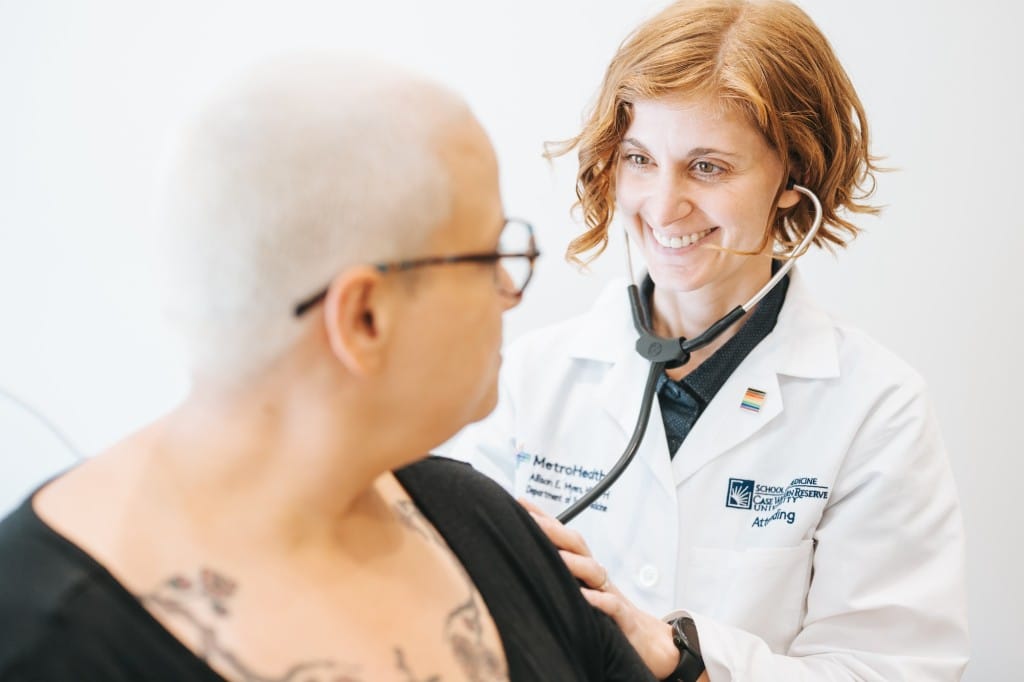
“When I think about being well and hormone therapy, it’s probably the most lifesaving care I provide as a doctor,” says Allison Myers, MD, MPH, a family medicine physician at the MetroHealth Pride Network. “Patients tell me that after they start, their depression and anxiety improve, and they feel like themselves. They feel better and safer in their bodies.”
This feeling of safety can combat high rates of suicidal ideations and suicide attempts among transgender people in the United States. According to a 2023 study from the Williams Institute at the UCLA School of Law, 81% of transgender adults have thoughts about suicide, with 42% of transgender adults attempting suicide.
“The rates of suicidal ideation and self-injury among transgender people are alarming—particularly for transgender nonbinary adults,” according to the study’s author Ilan H. Meyer, Distinguished Senior Scholar of Public Policy at the Williams Institute. “A lack of societal recognition and acceptance of gender identities outside of the binary of cisgender man or woman… contributes to the high rates of substance use and suicidality we see among transgender people.”
At the MetroHealth Pride Network, hormone therapy is available for people seeking to physically change their bodies to fit their gender identity. While not every transgender person has the same goals, hormone therapy can be a part of a pre-surgical plan or a stand-alone treatment to improve a person’s quality of life. At MetroHealth, hormone therapy is available to adults 18 years of age or older.
What to expect at your first appointment
At the MetroHealth Pride Network, your first appointment to discuss hormone therapy is centered around making sure you’re heard and seen. Your provider will get to know you, your medical history, your support system and your ideal timeline for treatment.
“At the MetroHealth Pride Network, we’re proud to have providers who are intentionally doing the work of LGBTQ+ care—with extra training to understand the nuances that come with serving specific communities,” says Dr. Myers. “We understand the struggles many people have with sharing your medical history—and we strive to do the little things that make your visit transinclusive.”
The MetroHealth Pride Network uses an informed consent model for adult hormonal care. No letters of recommendation or outside mental health assessments are required, though your provider will discuss any underlying mental health problems that might impede your ability to give informed consent.

“The informed consent process isn’t a short conversation,” says Dr. Myers, noting that hormones are typically not prescribed on a person’s first visit. “We talk about the reversable and irreversible effects of hormones, and how a person can expect their body and mood to change.”
The first visit also allows MetroHealth Pride Network providers to connect people to other healthcare providers—including mental health professionals—who might be able to support a person as they start hormone therapy. Recommendations for further care will be made based on a physical exam, a blood draw to determine your overall health and your medical history.
“Gender incongruence isn’t a mental health disorder,” says Dr. Myers. “But living in a world that is transphobic produces depression and anxiety. We want to make sure people have support.”
And, as a part of MetroHealth’s work to serve every person in our community, it’s not required that your primary care provider is within the MetroHealth network to see a MetroHealth Pride Network provider for hormone therapy. No referral is needed from another provider.
Understanding Hormone Therapy
At MetroHealth, people can consider three types of hormone therapy to align their body with their gender identity.
- Testosterone-based hormone therapy helps the body appear more masculine. Testosterone can stop menstruation, deepen the voice, cause facial and body hair growth, redistribute body fat, and increase muscle mass. A MetroHealth Pride Network provider can help you understand your choices for testosterone, including self-administered injectables, a topical gel, longer-acting shots administered by a nurse, long-acting suppository pellets and oral testosterone.
- Estrogen-based hormone therapy helps the body appear more feminine. Estrogen can develop breast tissue, soften the skin, increase body fat and reduce muscle mass, reduce facial and body hair, and shrink testicles. A MetroHealth Pride Network provider can help you understand your choices for estrogen, based on your medical history. Options include an oral pill, a patch that goes on your skin, and a self-administered injectable medication. Progesterone is also available as a feminizing hormone, often used for breast growth and improving libido and mood.
- Androgen-blocking medications block the effects of testosterone. Depending on your gender-affirming goals, androgen blockers may be used with or without estrogen. A MetroHealth Pride Network provider can help you understand your choices for androgen-blocking medication, including spironolactone, a pill to reduce body and facial hair and soften skin, or finasteride to prevent scalp hair loss.

Making Hormone Therapy Affordable
According to Dr. Myers, another thing that sets the MetroHealth Pride Network apart is access to the MetroHealth Pharmacy.
“MetroHealth has one of the best safety net pharmacy networks in the region,” says Dr. Myers. “We find you the best price, offer specialty mail order with free home delivery, and prepare all the prior authorization paperwork. I’m not aware of any other health systems offering this level of pharmacy services.”
Many hormone therapies are also covered by Medicaid.
“I’ve almost never identified cost as a barrier for a person to start hormone therapy,” says Dr. Myers.
At the MetroHealth Pride Network, your provider can consider cost when helping you understand your choices for hormone therapy.
About The MetroHealth Pride Network
The MetroHealth Pride Network offers primary care for adults and children and gender-affirming care for adults. While people in the LGBTQ+ community have similar routine healthcare needs as cisgender or heterosexual people, providers in the MetroHealth Pride Network have specialized training and experience related to sexuality and gender.
Pride Network providers can be found in four MetroHealth locations—Brecksville, Brooklyn, Cleveland Heights, and Rocky River as well as a clinic in the LGBT Community Center of Greater Cleveland. Learn more at www.metrohealth.org/pride. 🔥
Know an LGBTQ+ Ohio story we should cover? TELL US!
Submit a story!