
As LGBT History Month comes to a close, the need to know our Ohio LGBTQ+ past has never been more critical. Here in a state where the LGBTQ+ community still lacks legal protections, many of the fights we currently experience have been fought before, but those important lessons of the past sometimes get lost in the current-day tumult.
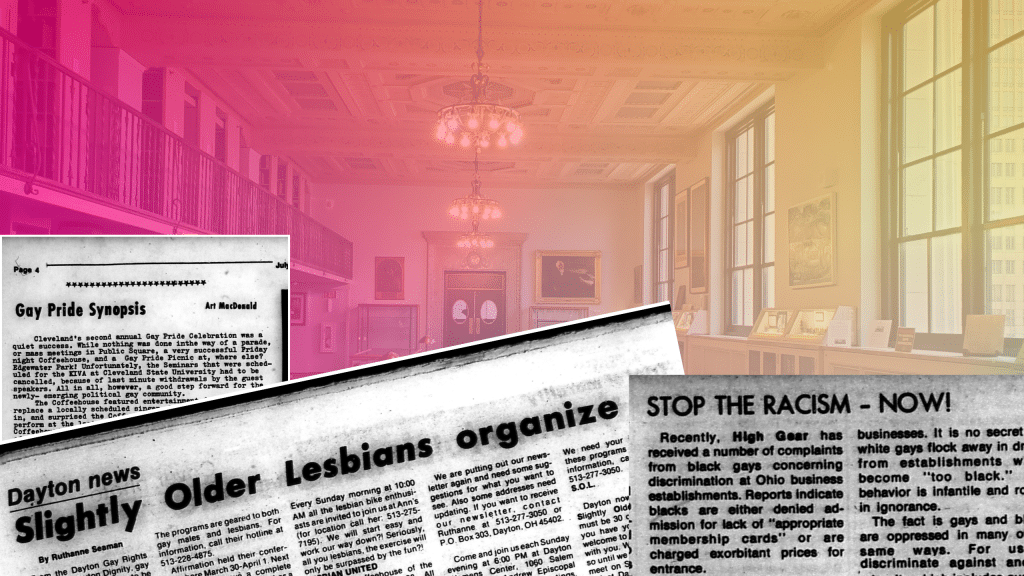
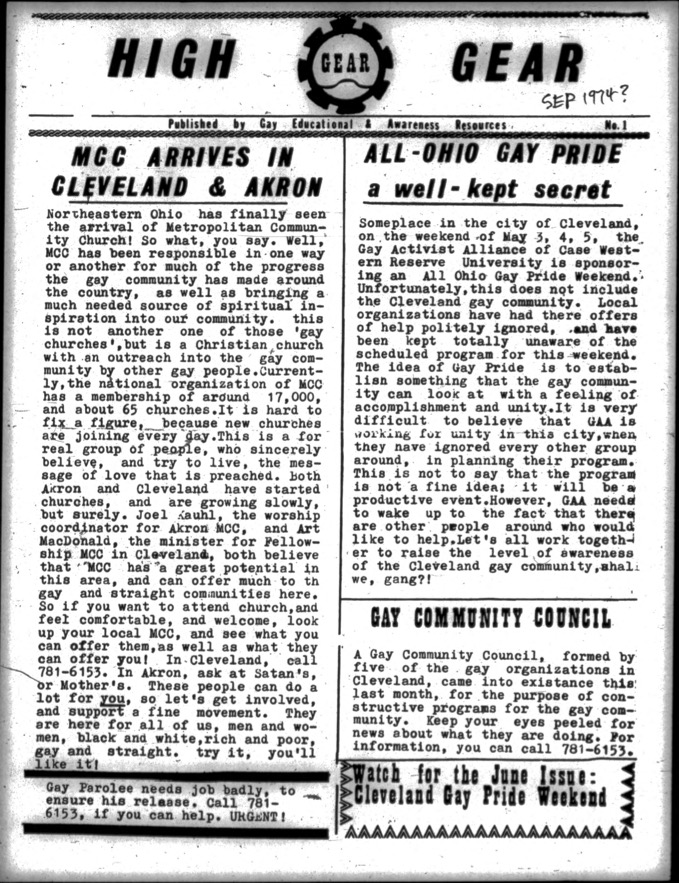
That task of remembering those stories just got a whole lot easier as the Cleveland Public Library (CPL) has digitized and made available High Gear magazine, a legendary LGBTQ+ Ohio publication that ran from 1974 to 1982.
One of the oldest LGBTQ+ publications in Ohio’s history, High Gear featured news from all around the state alongside maps of northeast Ohio bars, political cartoons and original artwork.
Sponsored by the Gay Education and Awareness Resources (GEAR) Foundation, these efforts led to the creation of what is now known as the LGBT Community Center of Greater Cleveland, one of the nation’s oldest LGBTQ+ centers about to celebrate their 50th year in operation.
The Buckeye Flame spoke with CPL’s Lisa Sanchez and Chatham Ewing to talk all about this access to Ohio’s LGBTQ+ history and why it is so very important today.
To listen, click play directly below or read our (edited) conversation beneath the audio link.
Talk a little bit about how you make the decision to digitize a publication.
Lisa Sanchez: Well, it’s a little tricky only because in any institutional environment — like a library or a museum — there are lots of people to talk to about, “Am I allowed to do this?”
A couple of years ago in my role as a library assistant, I said, “We have this material in the Center for Local and Global History. We have High Gear, a valuable resource. Can we put it online?” This question came from the project where a couple of years before, Cleveland Scene had been digitized and put online by Chatham and Subject Department Librarian Terry Metter.
So this process is mostly audacity, gumption and asking enough to where you can’t be ignored and someone will [respond], “Actually, that’s a pretty fine idea. We can get the ball rolling on that.”
I would imagine it takes more than an hour to complete this task. What actually goes into digitizing years and years worth of a publication?
Chatham Ewing: Well, you have to capture everything. You have to scan every single page. You have to pull together information about the magazine so that people can find it and use it. And you have to do all kinds of putting together and straightening and messing around with files in order to make them available.
When Lisa suggested this project, I was thrilled. One of the things we want to do is have a digital library that allows for a variety of different perspectives on Cleveland to come to the fore. It’s easy enough to do research just from the Plain Dealer. But when you have somebody sitting down to do research about our city or a kid doing his history day project, you want to have wonderful, rich diversity available so that they can talk about the city in ways that allow for greater understanding.
Lisa, you mentioned that High Gear is a valuable resource. Why is this such an important publication to grant access to?
Lisa Sanchez: It’s important because LGBTQ+ history is American history. It’s world history. But in the context of Cleveland, many of the folks who started High Gear are still around.
I contacted John Nosek who was one of the original founders of the GEAR organization and one of the original editors of High Gear. And it was really great to be able to talk to him because he said, “Oh yeah, there are no usage restrictions on this. Please make it available to whomever you can in whatever way you can.”

High Gear is a fascinating piece of Cleveland history because the GEAR Foundation went on to become the LGBT Community Center of Greater Cleveland. So this is living history. We are talking to people who are still alive, who still have valuable insight. It’s really valuable to show that LGBTQ+ folks are still here. We’re still contributing to the larger American fabric and to the larger fabric of Ohio and Northeast Ohio and Cleveland.
And we would be remiss to not mention the anniversary of all of this. It is the 50th anniversary of High Gear launching and the LGBT community center here in Cleveland, so that’s a big deal. Chatham, what do you hope people do with this access to High Gear?
Chatham Ewing: So I cut my teeth as a librarian in the 1980s in New York City. I worked at NYU and I helped Marvin Taylor build the collections that had to do with downtown New York. He was a leader in finding a way to teach NYU about how to document the community right there in Greenwich Village. One of the things that he always used to talk about —and one of the things that I’ve carried with me — was it’s really important for us to find ways to change and shape and think about the stories that need to be told and the voices that aren’t necessarily represented or brought forward in a way that they ought to be.
So what I hope that our patrons find [with High Gear] is a way of thinking about life in Cleveland that allows for them to see themselves, but also allows for them to understand that when you look at a publication that documents a community, you’ll see is that there’s an awful lot of ways in which a group that you might not consider to be yours is, in fact, just like you. That’s such an important moment for library collections and libraries and digital collections.
Lisa, was there anything that jumped off the page for you with High Gear that you definitely want folks to check out?
Lisa Sanchez: As a map collection librarian, it was very important to me to see some of the maps of venues that existed for bathhouses and gay clubs and LGBTQ+ safe spaces. We don’t have flat maps of those resources, because they’re not produced for tourism. They are produced for inter-community communication and the conveyance of information, and they are the only record that we have of these things presented in geospatial information. That was really important considering we’ve seen a tremendous clearance and a tremendous upheaval of the LGBTQ+ venue landscape in the last 20 and 30 years.

Chatham, how about for you? Anything that popped off the page that sticks with you?
Chatham Ewing: I think it’s awesome to be able to look in on what was going on several decades ago and how so many of the things that we still struggle with [today] are things those who came before us struggled with too. 🔥
IGNITE ACTION
- Take a few minutes (or hours!) and read through High Gear magazine that the Cleveland Public Library has made available here.
Know an LGBTQ+ Ohio story we should cover? TELL US!
Submit a story!

Pingback: The Buckeye Flame: Shift into High Gear as Ohio’s LGBTQ+ history just got a whole lot easier to access | ResearchBuzz: Firehose
Pingback: LGBTQ Ohio, Tulu Wiktionary, LitChemPlast, More: Wednesday ResearchBuzz, October 30, 2024 – ResearchBuzz