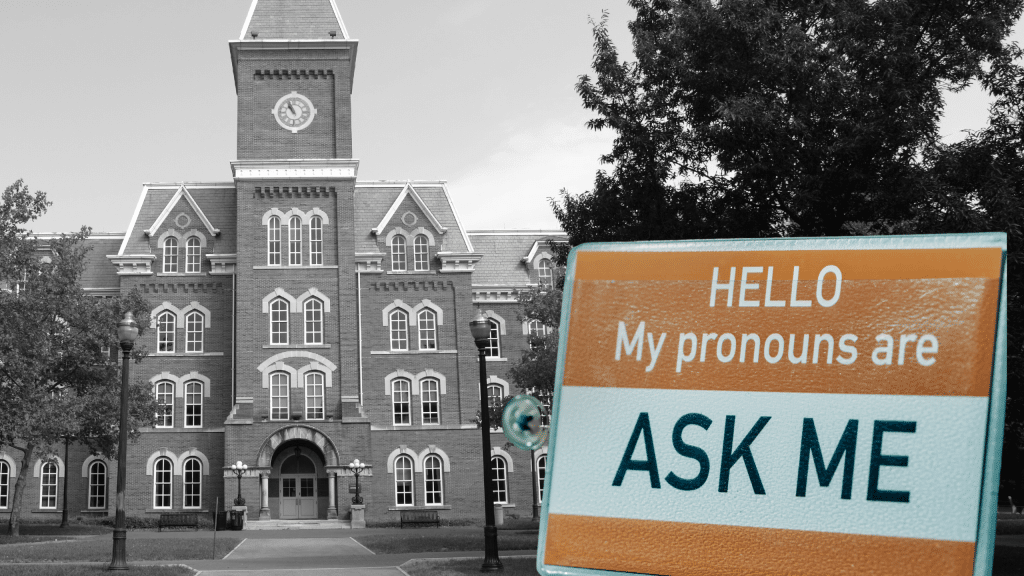
A new bill introduced in the Ohio House of Representatives would prohibit the state’s public colleges from asking for an applicant’s preferred pronouns in hiring and admission applications.
HB 686 was put forward by state Rep. Gail Pavliga (R-Portage County) on Nov. 7 before being referred to committee on Nov. 12. The bill already had a hearing in the House Committee on Higher Education on Wednesday, Nov. 20, where Ohio Republicans struggled to provide data showing how an applicant’s pronouns can cause bias.
Pavliga lost her bid for re-election in the September’s Republican primary. Her term ends at the beginning of 2025. Bills being so rapidly assigned a hearing is unusual in the state legislature, said Maria Bruno, former policy director at Equality Ohio and founder of Ohioans Against Extremism. Committee chairs have broad discretion to decide when and how a bill moves through the legislature, as does chamber leadership when it comes to the floor vote.
Between now and into December, the state legislature is in a lame-duck session – the period between Election Day and when newly elected candidates take office.
“Unfortunately, lame duck is the Wild West, but a bill getting introduced and receiving hearings with only a few weeks left of session would be considered a bill that could move,” Bruno said. “It doesn’t seem coincidental that the sponsor lost her [primary] re-election and won’t be back in January.”
Other bills have not received hearings, such as HB 225. Introduced in June 2023, HB 225 would designate June as Pride Month. It has still not received a hearing after being assigned to committee.
Pavliga declined an interview request from The Buckeye Flame.
What HB 686 does
HB 686 would only add two sentences to Ohio’s Revised Code:
“No state institution of higher education, as defined in section 3345.011 of the Revised Code, shall use any application for employment with the institution that asks for, or contains a field in which an applicant may indicate, the applicant’s preferred gender pronouns,” the bill reads. “A state institution of higher education, as defined in section 3345.011 of the Revised Code, shall not use any application for student admission that asks for, or contains a field in which an applicant may indicate, an applicant’s preferred gender pronouns.”
Pavliga, whose district includes Kent State University, said the goal of the legislation is to keep universities unbiased, according to reporting from The Columbus Dispatch.
“I just felt that being able to eliminate the pronouns really took away any bias off of somebody’s application, whether it be for employment or for acceptance at the college,” she told the newspaper.
The basis for her argument was stated in her sponsor testimony. Pavliga said she spoke to Republican young adults who said when they were asked for their pronouns during an application, they would decline to answer. Therefore, the field must be politically biased, because those who do answer must be Democrats.
Pavliga did not provide any data supporting this. Pavliga did not speak to Democrat young adults, according to her testimony.
Ohio Representative Joe Miller (D-Amherst) questioned the validity of Pavliga’s conclusions, asking for more data.
“Can you provide to the committee something other than anecdotal evidence?” he asked. “Because I’m a Democrat. My aide is a Democrat, and neither of us use pronouns in anything we do. So, are we there just trying to confuse people?”
Pavliga responded by saying that removing the fields would collect data. She did not explain further on how institutions could collect data when the field that would collect that data was removed from the application. She did not answer Miller’s question on what the data would eventually show.
“We are going to try to keep bias-free higher education,” Pavliga said. “Therefore, usage of things only things that are pertinent to a person’s readiness for employment, which would be their work history, their research, and their student readiness will be the data for which Ohio will now assess.”
Other states, like Arizona and Idaho, are “looking into legislation such as this,” she said.
“We would be a trendsetter across the [nation] and therefore we can gather that data,” Pavliga said.
But later in the hearing, state Rep. Tom Young (R-Washington Twp.) also said that data was not actually going to be collected, after all.
“We are not gathering data,” he said.
Pavliga also received questions on how the bill would affect the Common Application for students applying to Ohio’s state colleges. Pavliga and Young both said it would be a simple change, according to the staff that create the Common App.
“This is not the elimination of the Common App whatsoever,” Young said. “[Removing the pronouns field] is an option.”
When Rep. Beryl Brown Piccolantonio (D-Gahanna) pointed out that the pronouns question on the Common Application is optional, Young replied–without evidence or examples–that the question is not optional on employee applications.
Idaho’s state legislature passed a similar bill but with key differences: their bill prohibits educators from using a student’s preferred pronouns that do not match their birth certificate’s gender without written consent from their parents. It applies to K-12 and college students.
According to Idaho Capital Sun, it also gives teachers the right to sue their district if they are disciplined for using a student’s preferred name and pronouns.
HB 686 would hurt students and colleges: LGBTQ+ advocates
Asking for an applicant’s pronouns is like asking for an applicant’s honorific, said Amanda Cole, executive director of Plexus LGBT & Allied Chamber of Commerce, Northeast Ohio’s LGBTQ+-focused business organization. Almost 60% of Fortune 500 companies implement inclusive practices like pronoun fields in both applications and signatures.
By being respectful of someone’s pronouns, she said, people can feel “seen and acknowledged, they bring their best selves forward, enhancing both productivity and belonging.”
“Pronouns are not just a matter of personal identity; they play a crucial role in fostering respectful, accurate communication,” Cole said. “If Ohio’s universities cannot provide students and employees with a means to share their pronouns, our state’s institutions risk lagging behind on this foundational aspect of inclusivity, losing valuable talent and potential in the process.”
TransOhio Executive Director Dara Adkison decried the bill.
“(Ohio lawmakers) wish they could legislate us out of public spaces, but we’re not going anywhere,” Adkison said. “TransOhio will oppose HB 686 along with any other hateful legislation they come up with.” 🔥
IGNITE ACTION
- To access contact information for members of the Ohio House Higher Education Committee, click here.
- To access The Buckeye Flame’s full 2024 guide to Ohio’s LGBTQ+ legislation, click here.
- To access The Buckeye Flame’s full 2025-2026 Guide to Ohio’s LGBTQ+ Legislation, click here.
Know an LGBTQ+ Ohio story we should cover? TELL US!
Submit a story!