As Ohio’s lame-duck Congress sessions draw to a close, The Buckeye Flame spoke with GLSEN Executive Director Melanie Willingham-Jaggers about how bills like the “bathroom ban” and the Parents’ Bill of Rights would affect LGBTQ+ youth in the state.
Below is a link to the podcast episode and an edited transcript.
Ohio Governor Mike DeWine recently signed into law SB 104, what’s been called the “bathroom ban.” The tacked on bill targets transgender people in educational facilities from using multi person restrooms that match their gender identity. How will this affect trans youth K-12?
WILLINGHAM-JAGGERS: Every single child succeeds when they have supports around them. They are more likely to fail when they have barriers put in their way. And education is the cornerstone of our democracy. And every single child, every single learner, ought to have what supports they need in order to be successful in their educational career, period.
Now, if we are talking about how do laws that intentionally discriminate against and target children, is that bad? Yes, it’s bad. Whether it’s bathroom or curriculum, whether it’s access to facilities, or access to community and belonging – it is detrimental for children. Not only the children who are the targets, but the children seeing others being targeted.

When we are talking about very specific things – a piece of legislation, a particular policy – whereas we can kind of get into an argument around or look at the issue from all angles, wondering if it’s good or bad, I think we need to take a step back.
Is it legalized discrimination? Yes or no? Discrimination is bad. Is it targeting already targeted and marginalized communities? Yes or no? Already bad. Are we talking about the most vulnerable subset of children – an already highly vulnerable set of people in our community?
It’s bad on all accounts.
I don’t care what the law says. It’s not morally right.
I know Ohio is not the only one to have a ban like this. How has this ban fared in other states?
We have to look at the national climate, and unfortunately, this is a national climate that would make Bull Connor, Ward Connerly, Strom Thurmond, and other segregationists very happy, right, in the sense that you are codifying discrimination against Black people, small, marginalized, and already vulnerable populations, particularly in schools.
At GLSEN, we believe that education is the cornerstone of democracy. We also understand that young people come here to this life, to these schools, to our families, looking to people who have been here longer than them to figure out what we do here.
It’s not only detrimental and harmful to the people who are being targeted by the legislation. It’s deeply harmful because other people who don’t currently share this identity. [They] are seeing how people of that identity are treated.
Shame on all of us when we use our power, privilege and position to discriminate against others – particularly those who are less powerful than us – specifically when we have the job as adults and guardians and stewards of these larger institutions.

What you’re saying kind of leads into affecting those guardians with Ohio’s bill coming up right now, which is what’s been dubbed the Parents Bill of Rights. It would force teachers, staff, social workers, and even school counselors, force them to out LGBTQ+ students to their parents, along with notifying parents of sexually explicit content and curriculum, libraries – and this is super broad, it’s not even defined very well.
So what impact would this have on those guardians, on those teachers, trickling down to students?
One of my favorite thinkers (and) primary resources for how we might do education in a democracy is John Dewey. Dewey said that democracy is born anew every generation, and education is its midwife.
We understand at GLSEN that educators, administrators and people throughout the education system are both the midwives of democracy, and also its guardians. When we are tasking the midwives and guardians of our democracy with policing children, intentionally teaching them about the world that their parents want them to know, that’s [not] based in reality, and that is limited by the discriminatory political vision of those in power, we should be very worried about the long-term opportunities, prospects, the future of our democracy.
This is an attempt to foreclose on that. Young people ought to, education ought to, teach us all about the world as it is. It should put us in the world, connect us to it, connect us to other people who are in it, and position us to feel powerful and ready and skilled to take on the current challenges that are in front of us collectively, and to be in a good position to solve those problems once and for all, together with others, into the future.
That’s what education ought to do. Unfortunately, parents who don’t love their children because of their child’s sexual orientation, gender identity, that’s bad enough. No one deserves a bad parent. But now these terrible parents, right, are trying to warp, distort, and again, foreclose on what education is for the rest of us.
It’s a big enough job being a terrible parent, ask Elon Musk [as an example]. Now he not only wants to be a terrible parent to his kid, but now these parents want to be a terrible parent to your kid, to my kid.
That’s both ridiculous. What are parents rights, if not that the parent of the child gets to love their child and gets to support them, gets to see who they are and understand that their child is whole and perfect?
They are making sure that you can’t be a good parent to your own child. And that, to me, is the opposite of parents’ rights, right? It’s as if the virulent, angry-faced people in the background of the photo of Ruby Bridges walking into school, it’s as if they are the parents that get to determine who goes to school, who can use facilities, who gets to belong and what the world they teach their children and our children about.
I know that as collective conscience in our country, we understand that that was wrong, and history will bear out that same reality, that same truth, in not so long.
We will really have to answer for how we had either participated, colluded or stood by as people who have the job of governing in the best interest of all of us looked for the most vulnerable among us and the worst they could do to them.
How will this legislation affect GLSEN’s activities in Ohio?
Yeah, it’s a good question. We continue to stand firmly by educators. We continue to stand firmly by young people. We continue to stand firmly by parents and caregivers and concerned community members. We want to ensure that one, every kid can belong, can can go to school safely, and can learn.
What we also know from our research is that school climate matters for everyone. And here’s what I mean by that. If you go to a school, whether you are the target or not, you know that bullying, harassment. exclusion, disproportionate discipline is a thing that happens in the water. If that is a thing that happens in that school, you as any person of that school community, whatever your identity, you are going to, it’s a [worse] school climate than it needs to be.
You will have worse outcomes as a learner and as a member of that community than you otherwise would if bullying, harassment, exclusion, for whatever reason, was not done at that school.
What we’ve understood at GLSEN – we’ve been around for about 35 years, we’ve been doing research for about 25 years on the firsthand lived experiences of young people in schools. What we know from the data is that when you fix a school for queer kids, the impact of that actually is virtuous and impacts every single member of that school community and improve not only impacts, but improves sense of belonging, the sense of educational attainment both in schools and in that K-12 experience, but then also beyond it.
It makes our work bigger, right?
There are more children who are targeted for discrimination by people who ought to know better. That inherently increases the work that we are connected to, that we do and how we show up for people in each community.
I think there’s been similar legislation around this, specifically related to outing and sexually explicit books. So have there been effective strategies combating this type of legislation that you’ve seen?
[To] quote a colleague and a friend of mine, Dr. David Johns, who leads the National Black Justice Coalition (NBJC), he always says and reminds us that words mean things.
When we’re talking about educational materials, and we are talking about what is present in curriculum as decided by people who went to school to learn [how people] learn, what is age and developmentally appropriate to help young people understand, [and] what is a grade appropriate, developmentally appropriate way to talk about a very complex matter…in developmentally appropriate ways.
Let’s say seasons of the earth. What are the seasons on planet earth? [Schools] make sure that the young learner understands the key concepts, and it is teachers and educators broadly who are the experts here.
That’s number one. So number two, the idea that we are putting terrible parents in charge of curriculum that they have no idea about. We can tell that they don’t know anything about how children learn because they are rejecting their own children and their own children’s natural development as people.
It’s important for us to be grounded in the fact that what the “parents’ rights set of people” are doing is twisting words to make them mean what they don’t mean. They are creating a false problem in schools that does not exist.
Sexually explicit materials are not being taught to children. Period. Anywhere. That’s not what happens in schools. That’s number two.
Now number three. What we see as a successful and helpful intervention when this kind of foolishness, junk science, discriminatory propaganda is put forth is that when we meet it with facts at people who are actually parents, caregivers, community members, educators – hold the line when we refuse to back away when we refuse to cede any ground on these issues.
When we show up, when we refuse to let them take up all of the space without being, without it being contested. And when we understand and when the school board members and other decision makers understand that their terrible decisions about our children and the future of our democracy have consequences specifically.
That challenge their power, that’s when we see folks backing off of junk science, and unsubstantiated claims about what is happening in schools and what the effect of that is.

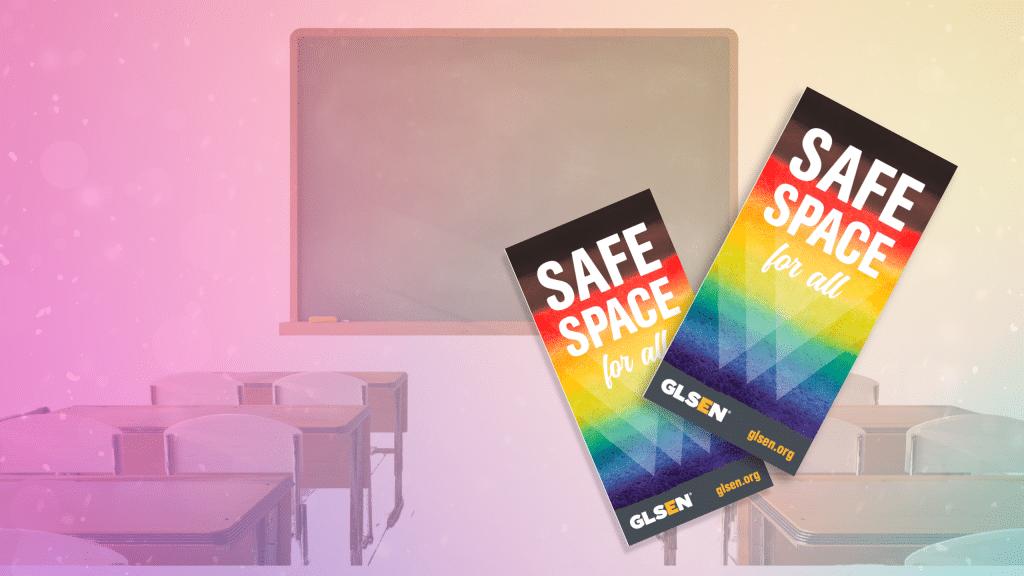
One thing that has been happening in some school districts here, and I’ve reported on this, is some school districts have been removing some of GLSEN’s resources from, specifically the safe space cards from their districts.
From what I understand, this has happened at other districts, and when a district does do this, what does it signal?
It signals that the people who are in charge would rather put barriers than put supports in front of children. It is meant to indicate that there is no safety of a child that’s guaranteed beyond what they understand and who they understand is deserving of that safety.
It excludes the majority of us. The other thing I would say is that it’s, what it shows is that there are people making laws who believe in legalized discrimination against children. What it further lifts up is this idea that enforcement – so we’re gonna, we’re gonna remove, remove a safe space kit, or remove a safe space sticker, or restrict bathroom or facilities access, or exclude young people from locker rooms and sports teams and play that we all know has positive, psychological, physiological, social, and leadership impacts – what that does is it, it opens up the opportunities for people who are motivated by targeting vulnerable populations.
It serves our children up to them on a plate. One of the early sports bands that was floated in Iowa, and I believe it passed a number of years ago, was this idea about gender confirmation. The idea that if a person was playing sports and they were suspected of being “transgender,” then any adult could verify a child’s “status” as a transgender person or not through physical inspection.
That is disgusting. When we’re talking about these laws, you ought not discriminate against children, or you ought not discriminate against people. But if you’re going to do it, how are you going to enforce it? And who’s going to be most interested in that enforcement? And what is that “enforcement” going to do to the person and communities?
It’s not only unfair and wrong – it’s predatory.
I think that we ought to take these people at their word. We ought to understand them for who they are. They are truly predators. They are truly people who believe in discriminating against marginalized children. We ought to take them at their word, and we ought to make them pay electoral consequences.
They ought not be in charge if this is what they think that leadership and governance looks like in a democracy.
What resources are available through GLSEN to help educators and families navigate the current state of things?
Here’s what I would recommend. Number one, I would love folks who are listening in to go to www.glsen.org/riseup. When you go to that website, what you will see is a map that shows you who has taken the “rise-up pledge” [and where].
The “rise-up pledge” really comes from our understanding that recognizes the importance of adults to be visible and beacons of light in these dark times.
Whether it’s a t-shirt, bumper sticker or a lawn sign, it’s deeply important as these young people – who are queer and trans, and also every other young person – as they are hearing the rights of a marginalized, small community being targeted as the political boogeyman of this moment, it’s so important for those kids, for all kids to see where support lies for them and for people who are like them.
Part two, we have a number of resources on our website, whether it is educator resources, curriculum guides, whether it is guidance on how to support young people and their leadership, how to start and hold a GSA, and any other number of resources for educators, administrators, parents, caregivers and for young people themselves.
I’m hoping that everyone who was listening to this understands that GLSEN is a resource. We are hard at work every single day to protect the dignity [of LGBTQ+ youth] and increase the belonging and support that every kid has access to in any school, any place, any room where learning happens.
When we fix it for queer kids, we fix it for everybody. 🔥
IGNITE ACTION
- To learn more about GLSEN, click here.
- To access The Buckeye Flame’s full 2024 guide to Ohio’s LGBTQ+ legislation, click here.
Know an LGBTQ+ Ohio story we should cover? TELL US!
Submit a story!