
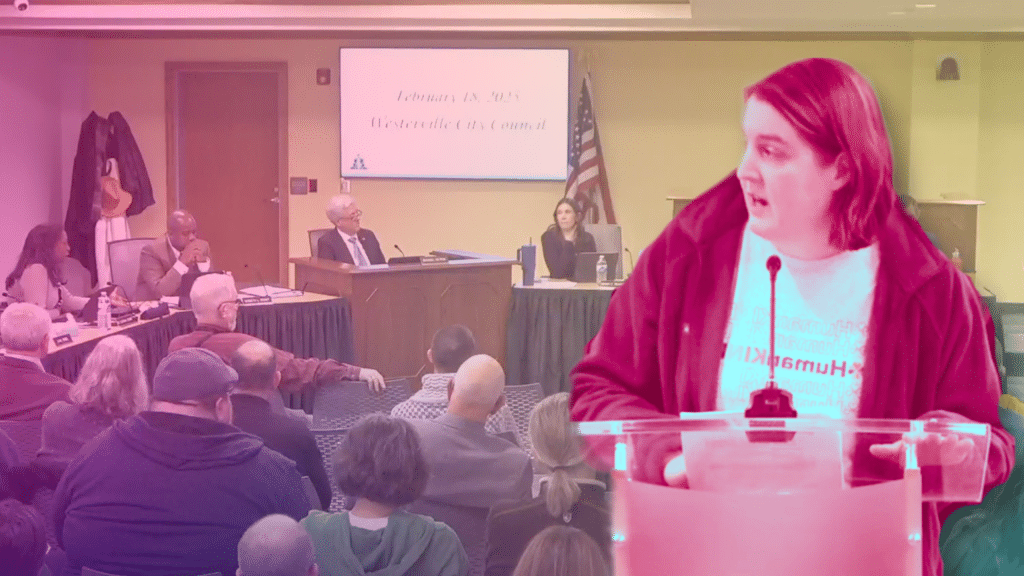
Westerville, Ohio, City Council voted on Tuesday, Feb 18 to pass an ordinance banning conversion therapy on minors – the 13th city in Ohio to do so.
The bill passed 5-2 in the Columbus suburb, with Council Chairman Michael Heyeck and Council Member Jeff Washburn dissenting.
The ordinance is similar to those passed by cities like Lorain and Akron. It bans mental health practitioners from practicing any form of conversion therapy, whether they are paid for their services or not.
Under the new ordinance, minors who undergo conversion therapy in Westerville can submit a complaint to the city within 180 days of their experience, though the legislation does not explain how the law would be enforced.
Conversion therapy, sometimes called reparative therapy or reintegrative therapy, is a set of widely condemned practices designed to change a person’s sexual orientation or gender identity.
Equality Ohio, a statewide nonprofit advocating for LGBTQ+ Ohioans, applauded the decision to end conversion therapy on minors in Westerville.
“Westerville’s decision adds to the growing movement to end conversion therapy in Ohio,” said Joseph Soza, Central Ohio organizer for the nonprofit. “While cities are stepping up to protect LGBTQ+ youth, we know the work isn’t done. “Until we achieve a statewide ban, Equality Ohio Organizers will be on the ground, working with local communities to pass ordinances like this and protect LGBTQ+ youth across the state. The momentum is building—let’s keep going until every LGBTQ+ Ohioan is protected.”
Council discussion
Much of Tuesday’s discussion centered on who the city would notify a complainant who is a minor that their complaint would be public record.
Heyeck brought up the concern during the second reading of the ordinance on Feb. 4. Westerville Diversity, Equity, Inclusion and Belonging Director J.R. Fourqurean spoke about the complaint process during the Feb. 18 meeting. Fourqurean said the city added a digital pop-up that would clearly notify a complainant of how public records work.

Council Lawyer Director Andrew Winkel clarified that the complaint process is functionally similar to a minor submitting a complaint around workplace discrimination or medical malpractice.
However, there was concern from the Council that the pop-up would deter complainants rather than inform them.
“It does kind of give me pause if it’s going to feel intimidating or like a warning,” Vice Chair Megan Reamsnyder said.
Despite believing the science that conversion therapy is harmful, Heyeck said he had trouble seeing why there needed to be legislation – “a practicality issue,” he said.
Every single major medical and psychological organization has said that conversion therapy both doesn’t work and does actual harm, like increasing anxiety, depression, and suicidality.
Conversion therapy is banned in 12 other municipalities in Ohio, covering roughly 25% of Ohio’s population. Senate Bill 71 was introduced in February with the goal of ending conversion therapy on minors throughout the state.

Heyeck gave a thought experiment where he compared a minor’s conversion therapy – a junk science – to a risky surgery, and the minor wants the surgery anyway, despite the risks.
“The minor is in need of surgery,” he said, hypothetically. The doctor provides the risk associated with the surgery. That surgery has some probability that the person won’t live, but it has a success and a benefit…What if the two parents don’t agree and the minor agrees? “If we don’t allow the discussion, the minor is the one who would suffer.”
Council Member Aaron Glasgow said Heyeck’s thought experiment misunderstood the dynamics that often lead to parents sending their kids to a conversion therapist.
Aside from the family dynamics, the ordinance would prevent the therapist from performing conversion therapy.
“This is a situation … where you have a child and a parent who advocates for the therapy, and the child is the person who doesn’t want it,” Glasgow said. “That’s who I think we’re protecting here.”
Public comment
Before the ordinance was passed, the council held a second reading on Feb. 4. Passionate public comment came from the community calling an end to the practice within their city.
Mary Gene Boteler, a retired Presbyterian pastor, told the council how she inadvertently sent her lesbian daughter to a conversion therapist at the recommendation of her insurance.
“During her first session, she said her parents were accepting of her sexual orientation,” she said. “The therapist expressed surprise and said, ‘I can’t believe your parents are really proud of who you are.’”
“He began a process of trying to change her,” Boteler said.
After Boteler’s daughter told her parents about the experience, Boteler and her husband were “livid.”
“We had trusted the recommendation of our insurance company,” she said “We had trusted the initials behind this therapist’s name. We are parents who have tried our best to protect our children, only to have this therapist abuse the very oath of his profession.”
Boteler compared conversion therapy to bloodletting and using leeches as medicinal technique, though added that conversion therapy can be “more harmful” and lead to “shame, self loathing, and even death.”
During the Tuesday, Feb. 18 board meeting, public comment included support from local LGBTQ+ organizations, a survivor of conversion therapy and a statement from former Ohio House Rep. Mary Lightbody, who sponsored last year’s ban on conversion therapy on minors.

There were multiple “Protect Trans Kids” shirts throughout the audience, as well as other supportive designs.
The first to speak on Feb. 18 was the founder of LOVEboldly, Heidi Weaver-Smith. Weaver-Smith thanked the council for considering the ban, but warned against focusing too much on the complaint process and jeopardizing the ban due to discomfort.
“I want to express my appreciation for your [Heyeck’s] concern about how this legislation could affect a minor’s privacy,” she said. “Bans of this type are supported by virtually every LGBTQ+ organization that advocates for LGBTQ+ organizations.”
Only one commenter pushed back against the ban. She said the ban was “exclusionary,” and incorrectly said there is no definition of conversion therapy in the bill.
Lightbody was not in attendance, but an audience member shared her statement: “In the current political climate, I fear that our state and federal leaders will not pass legislation to express compassion, respect, and legal protections for our LGBTQ+ youth. The Westerville City Council has an opportunity with this proposed legislation to provide a message of tolerance and support for all residents. They deserve to feel safe and protected in their home community, and this legislation will communicate that clearly.” 🔥
IGNITE ACTION
- The Buckeye Flame’s 2025-26 guide to Ohio’s LGBTQ+ legislation can be found here.
Know an LGBTQ+ Ohio story we should cover? TELL US!
Submit a story!



Pingback: After passionate public comment, Westerville becomes the 13th city in Ohio to ban conversion therapy on minors | Dailywise