Gil Kudrin was in Washington, D.C. last week lobbying Congress to protect HIV/AIDS funding for medication and services.
“At the same time, [the Trump administration] was at home in my own backyard trying to destroy the history of the work that I have devoted the last 35 years of my life to,” Kudrin said.
For decades, Kudrin has worked with Nightsweats & T-Cells, a screen-printing company that provides employment to those unable to find work due to discrimination around HIV/AIDS. A new Ohio historical marker commemorating this work was slated to be added by the Ohio History Connection, which has installed over 1,750 historical markers across the state since 1950 to help tell the state’s history as written by its communities.
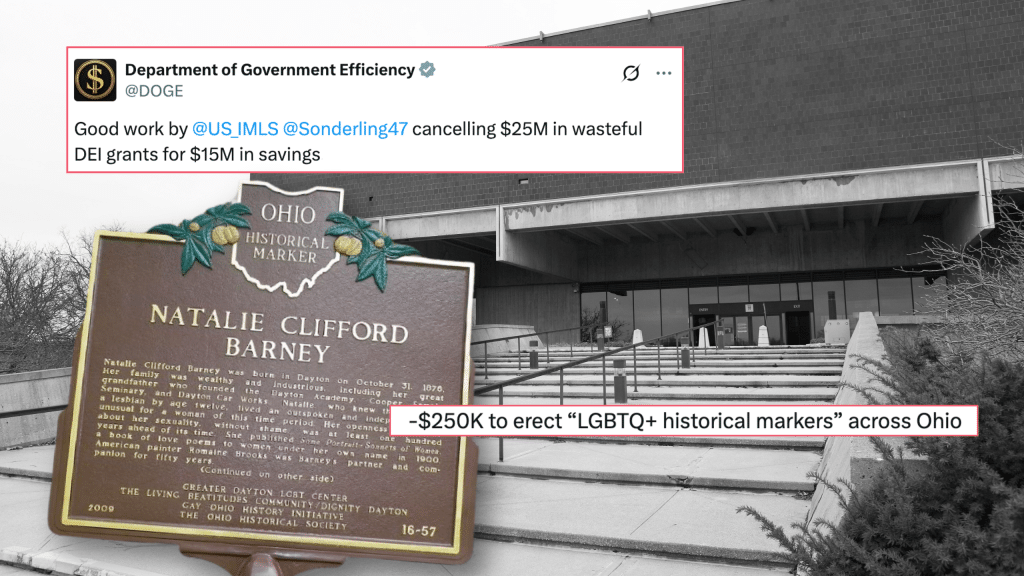
This new marker was one of ten LGBTQ+ markers to be added across the state, funded by a $250,000 grant from the Institute of Museum and Library Services (IMLS), a federal agency.
On April 1, posts on social media accounts of the Department of Government Efficiency (DOGE) and IMLS announced that the grant had been eliminated.
“The era of using your taxpayer dollars to fund DEI grants is OVER,” the post on the IMLS account read.
Kudrin was outraged.
“They cannot erase us,” Kudrin said. “Nightsweats & T-cells will live on in the hearts of the hundreds of thousands of people who have worn one of our shirts or benefited from one of the events that we have designed or printed for over the last 35 years.”
Ten pieces of history
Alex Ingley, manager of community engagement at Ohio History Connection, informed The Buckeye Flame about the cuts.
“The news of the grant’s termination as part of IMLS’ funded programs is deeply impactful, as I believe MDO’s human-centered engagement and celebration was in great service to the Ohio History Connection‘s mission of sparking the discovery of Ohio’s stories,” Ingley said in an email.
The ten new markers would have joined three existing markers that have been installed since 2009 in coordination with the Gay Ohio History Initiative.
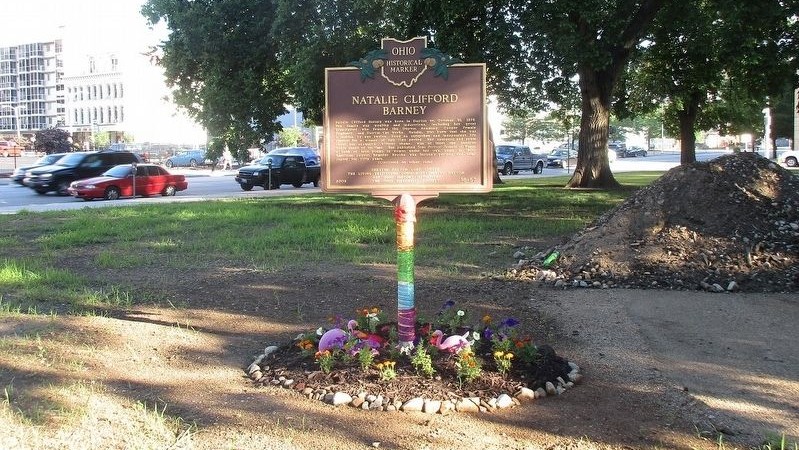
The ten historical markers would have commemorated:
- Crazy Ladies Center / Ohio Lesbian Archives, Cincinnati
- From 1979 to 2002, the feminist bookstore was a central hub for community organizing. The third floor housed the Ohio Lesbian Archives, which has amassed lesbian historical documents and objects since 1989.
- Pater Noster House, Columbus
- The Pater Noster House was a volunteer hospice and care center for people living with HIV/AIDS from 1985 to 2000. The nonprofit received national attention when LIFE Magazine published a photo of gay rights activist David Kirby on his deathbed at the hospice.
- Louis P. Escobar, Toledo
- Louis Escobar was the first out LGBTQ+ and first Latine individual elected to Toledo City Council in 1997. The marker would have been placed at the corner of Adams and 13th St in Toledo, dubbed “Louis P. Escobar Way,” and included a rainbow crosswalk.
- Nightsweats & T-Cells, Cleveland
- Nightsweats & T-Cells began as a screen-printing company in Kent that provides employment to those unable to find work due to discrimination around HIV/AIDS. Since their founding in 1990, a portion of the company’s proceeds have gone to HIV/AIDS research and community care.
- Edmonia “Wildfire” Lewis, Oberlin
- Edmonia Lewis was a Black mid-to-late-19th-Century sculptor known best for “The Death of Cleopatra.” Her work broke gender and racial norms, and she later joined a group of self-identified queer women artists in Rome.
- Dr. Dolores Noll, Kent
- Dr. Dolores Noll formed the first LGBTQ+ student organization at Kent State University and was the school’s first professor of gay and lesbian studies.
- Rev. Jan Griesinger, Athens
- Rev. Jan Griesinger was an out lesbian United Church of Christ pastor who co-founded the national organization Christian Lesbian OUT (CLOUT).
- The Rubi Girls, Dayton
- The Rubi Girls is a drag troupe that first came together in 1984. Their performances received national attention through raising millions for HIV/AIDS care and other LGBTQ+ resources.
- Akron’s Queer Spaces
- Akron had a thriving queer scene through bars and other businesses, though many of them moved to new locations over time. The historical marker would have honored many of them, from those long gone like The Lincoln Bar, to hangouts still in existence, like the Interbelt Nite Club.
- Ohio’s LGBTQ+ Press and Media, Site TBD
- A historical marker would have honored the decades of LGBTQ+ press and media throughout Ohio that were vital in keeping the queer community informed and connected.

‘LGBTQ+ people have always existed’
Since early 2024, archivist Tony Pankuch has worked with the Ohio History Connection to install the historical marker acknowledging Akron’s queer bar history. Last week, Pankuch said they were told this year’s stipend was guaranteed.
“There’s a tremendous amount of work that goes into creating this research, documenting it and filing the necessary paperwork before we can even get into the process of actually casting these markers,” they said.
But now all that work has been terminated, and Pankuch will not be getting paid.
Pankuch’s stipend is only one slice of the $250,000. They said Ohio History Connection used the grant to hire a full-time staff member dedicated to the project, along with stipends for other advisors.
And the amount of money is a drop in the bucket in terms of governmental funding, they said. Federal funding towards researching and teaching history was previously seen as a value to American society.
“Projects like these make up a miniscule amount of our federal government,” Pankuch said. “Our government previously has rightfully determined that it values our nation’s history.”
To Pankuch, the Trump administration’s decision sends a clear message: the LGBTQ+ community is “abnormal and threatening.”
“This is clearly part of a larger effort to erase LGBTQ+ people from any sort of formal recognition by our government,” they said. “Politically, this is just one piece of that much larger effort that’s happening in Washington.”
The Ohio Lesbian Archives (OLA) and Crazy Ladies Center would have received their historical marker this June, said Phoebe Beiser, co-founder of Ohio Lesbian Archives. Calling the cuts “disheartening,” Beiser reiterated the Crazy Ladies’ importance to the fabric of the community.
“From 1979 to 2002, Crazy Ladies served as more than a bookstore, a center for information, events, and space for groups like OLA, Stonewall Cincinnati, and multiple support groups,” Beiser said in a statement to The Buckeye Flame. “We mourn the attack on groups such as ours, doubly abhorrent since [LGBTQ+ people are] rarely studied in history classes, making LGBTQ+ people invisible once more.”
The news of the cuts drew a response from State Sen. Nickie Antonio (D-Lakewood) who criticized the administration. LGBTQ+ people are “a part of the fabric” of U.S. history.
“Let me be clear – there is no closet big enough to force all of us back into, and no government agency can erase our existence,” Antonio said in a statement. 🔥
Editor’s note: The Buckeye Flame was working with the Ohio History Connection on the text and location of the historical marker that would have honored LGBTQ+ Ohio publications.
IGNITE ACTION
- The Buckeye Flame’s Ohio LGBTQ+ legislation guide for 2025 can be found here.
- To register to vote or to check your voter eligibility status in the state of Ohio, click here.
- To find contact information for your Ohio state representative, click here.
- To find contact information for your Ohio senator, click here.
Know an LGBTQ+ Ohio story we should cover? TELL US!
Submit a story!