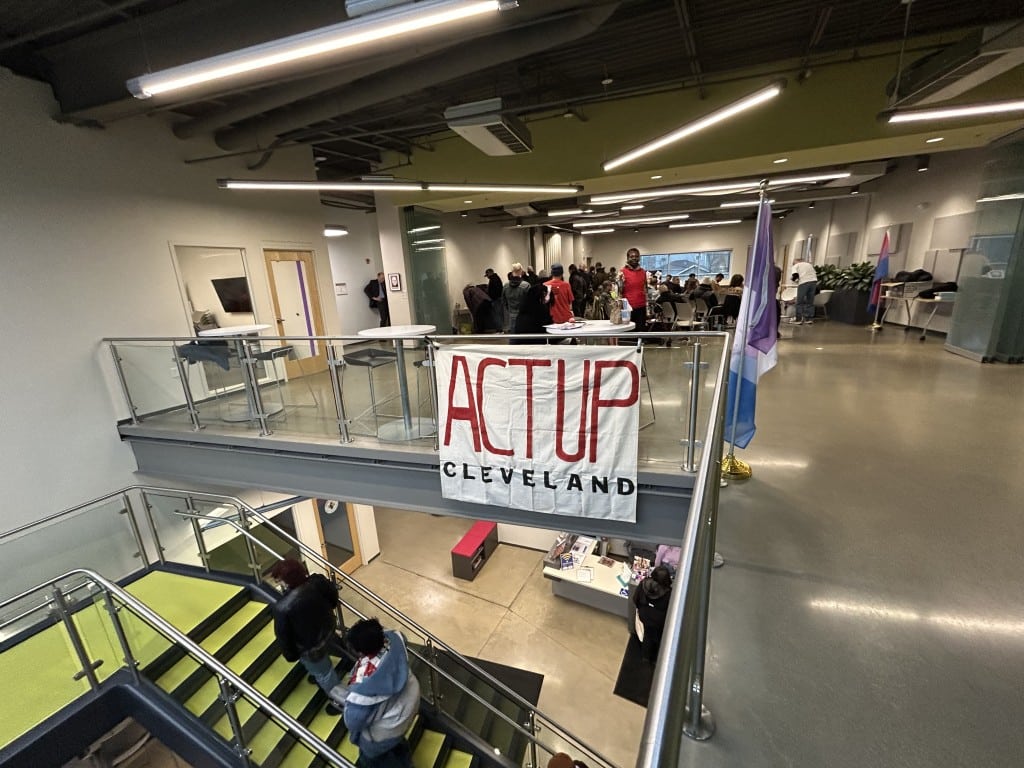
The AIDS Coalition to Unleash Power (ACT UP) Cleveland met at the LGBT Community Center of Greater Cleveland the second time in more than 20 years to discuss a strategic plan to stockpile antiviral medications ahead of proposed cuts to the U.S. Department of Health and Human Services (HHS) budget.
A leaked preliminary budget for the 2026 fiscal year, made public last week, outlines more than $40 billion in cuts to HHS, potentially gutting federal HIV/AIDS programs that serve roughly half of the 1.2 million Americans currently living with the virus.
Founded in the late 1980s, ACT UP is a nonpartisan group that advocates for access to health care for Americans living with the virus, often via direct action and public protest.
Gil Kudrin, a long-term HIV/AIDs survivor and ACT UP Cleveland spokesperson, said the group’s main priority is keeping life-saving antiviral medications accessible, so Ohioans living with the virus do not experience dangerous interruptions in care.
“We are a nonpartisan group that is coming together in love and rage to make sure that nobody dies of this disease,” Kudrin said. “If the government is canceling all the prevention programs, the best prevention programs we can have is getting meds into bodies – because we know that if you are undetectable, you cannot transmit this disease.”

Kudrin said members of ACT UP Cleveland and the AIDS Funding Collaborative are preparing to meet public health officials from Cuyahoga County and the City of Cleveland as soon as next week to co-create a strategic plan around the proposed cuts, hoping to purchase and stockpile antiviral meds via private philanthropic funds and medication rebates available through federal programs.
“What we are asking for is nothing extraordinary,” Kudrin said. “The strategic plan we’re asking for will hopefully never be implemented, but the time to write that plan is today – not the day we lose access to this medication.”
What is in the leaked budget?
Earlier in April, the National Minority AIDS Council (NMAC) released an analysis of the leaked budget, calling the preliminary draft “shocking.”
AIDS United Director of Advocacy Drew Gibson completed the formal analysis for the group’s Public Policy Council (PPC), concluding the budget “confirms many of our worst fears regarding the Trump Administration’s intentions to dismantle and shrink HHS.”
The budget slashes the HHS discretionary budget by a total of more than $41 billion and would formally eliminate:
- The Centers for Disease Control’s (CDC)’s Division for HIV Prevention, which helps prevent new HIV infections domestically and improves health outcomes for people living with HIV.
- The CDC’s Global Health Center, which helps mitigate and contain HIV outbreaks before they spread by tracking cases and analyzing global data around infectious diseases.
- Ending the HIV Epidemic (EHE), an initiative designed to target specific geographical areas in an effort to reduce new HIV infections.
- A handful of programs under the Substance Abuse and Mental Health Services Administration (SAMHSA), which integrates HIV/AIDS prevention services into pre-existing substance use and mental health services.
Defunding the Ryan White CARE Act
In addition,the budget would eliminate Part F of the federal Ryan White CARE Act, which funds AIDS education and training and dental care for Ohioans living with the virus, said Dr. Barbara Gripshover, medical director of the Special Immunology Unit at University Hospitals.
The budget keeps Part A, B, C and D programs, which provide a range of support services for people living with HIV and AIDS, including some prevention programs.
Funding via Part B is awarded to large metropolitan areas with high HIV rates – including Cuyahoga, Hamilton and Franklin counties. Part B also funds the AIDS Drug Assistance Program (ADAP) in every state, which provides life-saving antiviral medication to more than 290,000 people across the country.
Parts C and D of the Ryan White CARE Act support community-based organizations that care specifically for women and children living with the virus.
“We need to talk to our congresspeople and tell them what we don’t like about this budget,” Gripshover said. “That’s our chance to make a difference, too.”
‘This is an infectious disease’
Ryan White CARE Act funding currently totals more than $2.6 billion, but lapses in programming, prevention measures, testing sites and data collection have been linked to outbreaks of the virus in the past – most notably in 2014 when over 200 people were infected with the virus after former U.S. Vice President Mike Pence ignored the urgent signs of a growing HIV outbreak during his tenure as governor.
“We need this community on the same page – that this is not to be tolerated,” Kudrin said. “This is not to be treated as a political issue. This is an infectious disease.”
“For the first time in 44 years, we are just asking them to treat HIV like they would treat any other infectious disease,” Kudrin said. “HIV has never been looked at as a public health issue in this country. It has always been political. I think that is 100% unacceptable.”
‘We fought tooth and nail for this’
“Before federal funding – before the Ryan White CARE Act – we were the caregivers in our communities. We were the people who got our friends to the hospital, got a care plan set up for them, got doctors who would take care of them,” Kudrin said. “This was not something that was just given to us. We fought tooth and nail for this, and we are going to be back at the very beginning.”
Last week, AIDS activists delivered faux coffins to the steps of the U.S. State Department, representing the number of potential deaths caused by cuts to federal HIV/AIDS funding. Now, Kudrin has floated similar responses at the local level, particularly involving a specific type of “street theater” commonly performed at ACT UP demonstrations throughout the 1990s.
Kudrin said members of ACT UP Cleveland leadership are set to meet with the AIDS Funding Collaborative and public health officials from both the city of Cleveland and Cuyahoga County on April 29 to further discuss ACT UP Cleveland’s proposed strategic plan.
“We are not victims,” Kudrin said. “No decision should be made without us at the table. If you’re not at the table, you’re on the fucking menu.” 🔥
Editor’s Note: The next ACT UP Cleveland meeting is scheduled for Thursday, May 8, at the LGBT Community Center of Greater Cleveland, and will include an added option to attend the meeting virtually via Zoom. Attorneys will be present to assist attendees in arranging end-of-life documents, medical powers of attorney and other legal precautions for LGBTQ+ couples in the event that the U.S. Supreme Court overturns Obergefell v. Hodges, the case that legalized marriage between same-sex couples in 2015.
Ignite Action
- To follow ACT UP Cleveland on Facebook, click here.
- To learn more about the history of ACT UP, click here.
- To find a Ryan White HIV/AIDS Program medical provider in your area, click here.
- To find contact information for your Ohio state representative, click here.
- To find contact information for your Ohio senator, click here.
- If you are a young LGBTQ+ person in crisis, please contact the Trevor Project: 866-4-U-Trevor.
- If you are an transgender adult in need of immediate help, contact the National Trans Lifeline: 877-565-8860
Know an LGBTQ+ Ohio story we should cover? TELL US!
Submit a story!