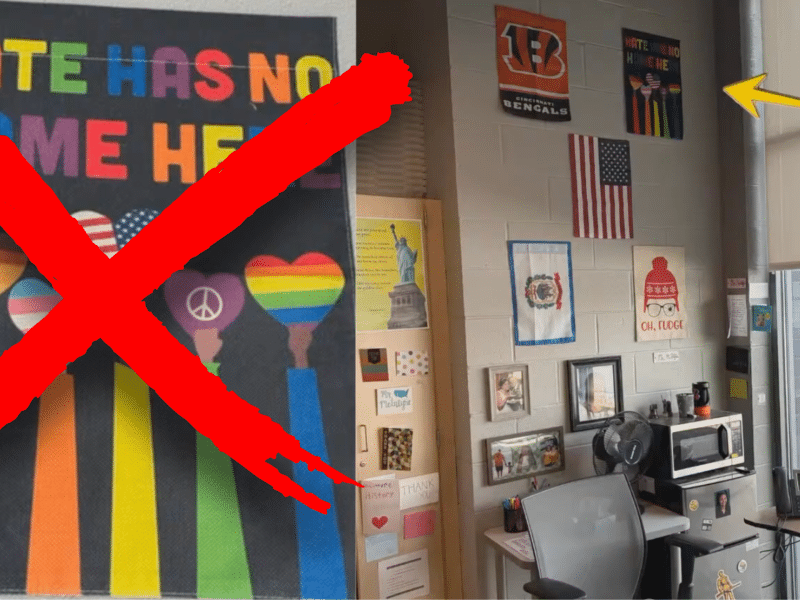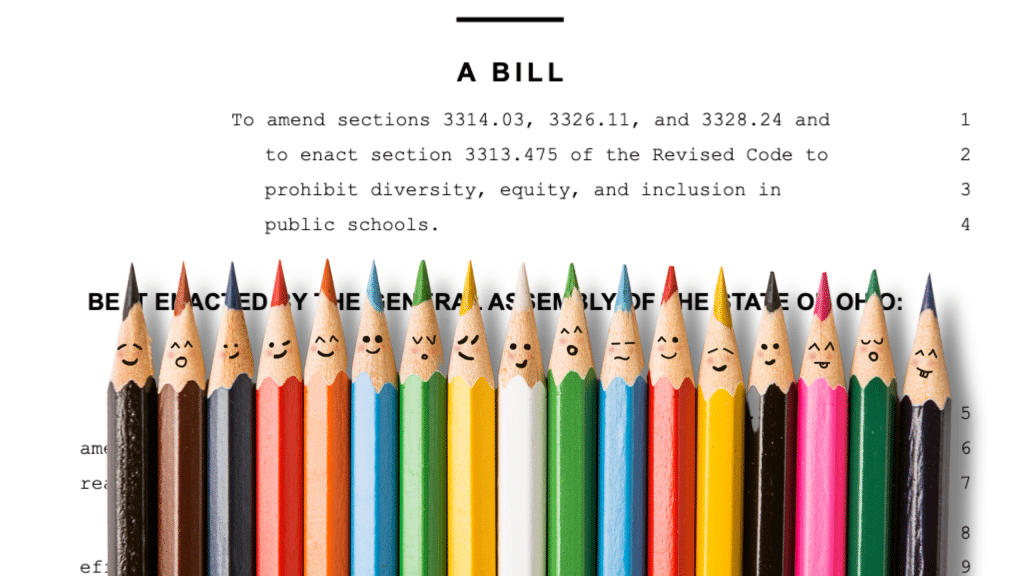
Republican lawmakers in Ohio are pushing through bills in both the state House and Senate that would ban diversity, equity and inclusion (DEI) in public K-12 schools and would also apply to hiring practices and staff workshops.
However, bills Senate Bill 113 and House Bill 155 do not define what DEI is, leaving educational advocacy organizations unsure how the legislation would affect public education in the state.
The Senate bill was introduced by sponsor Sen. Andrew Brenner (R-Delaware) on Feb. 25. On March 6, Rep. Beth Lear (R-Galena) and Rep. Josh Williams (R-Sylvania Twp.) introduced the House version of the bill. The proposals are identical, and each currently sits in the Education committee of its chamber.
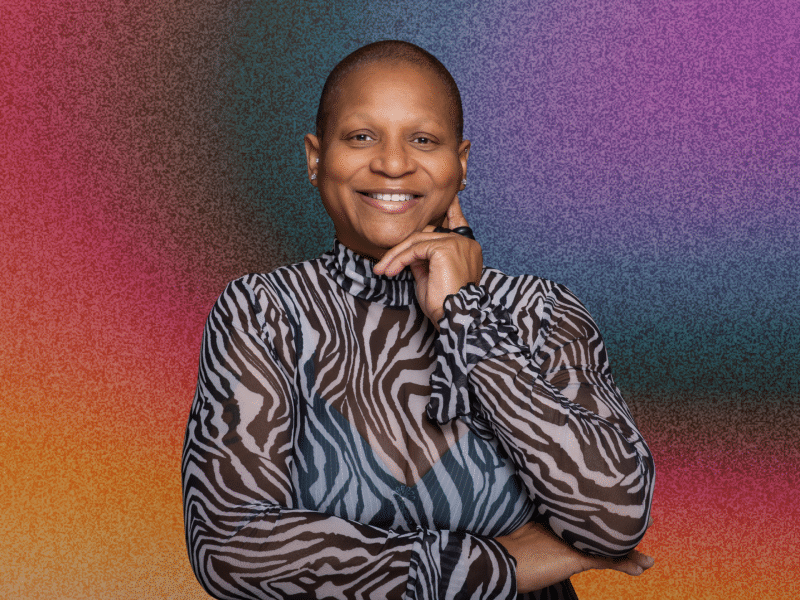
Responding to the news, Christina Collins, executive director of educational advocacy nonprofit Honesty of Ohio Education, said that at both the federal and state level, government is “trying to make schools hostile environments for LGBTQ+ students. This bill continues that and attempts to make schools even less welcoming, especially for LGBTQ+ students,” she said.
The Buckeye Flame reached out to sponsors of the two bills and did not receive a response before publication.
What SB 113 and HB 155 say
If SB 113 and HB 155 are passed and signed into law, 90 days after their effective date every Board of Education in Ohio would have to adopt and enforce policies that prohibit “diversity, equity and inclusion” in:
- Staff orientation or training courses
- The continuation of any existing DEI offices or departments
- Establishing new DEI offices or departments
- Using DEI in job descriptions
- Contracting with consultants or third-parties “whose role is or would be to promote admissions, hiring, or promotion on the basis of race, ethnicity, religion, sex, sexual orientation, gender identity, or gender expression.”
- Replacing DEI efforts with new initiatives that are similar
Boards of education would be required to establish a process for a student, parent or district employee to submit a complaint about possible violations of the proposed law.
Both bills partly pull language used in SB 1, which was signed into law on March 28. Neither define “diversity, equity, and inclusion.”

How could the bill affect teachers and students?
If an LGBTQ+ student wants to explore their identity safely, a teacher can be one of the first people they turn to. Shawn Jeffers, co-chair of the Greater Cincinnati branch of LGBTQ+ student advocacy organization GLSEN’s, said that the new legislation, if passed, could leave vulnerable students with less adults to trust.
“Teachers knew vulnerable students would be impacted by COVID; now we’re here,” Jeffers said.
To help teachers navigate discussions with LGBTQ+ students, organizations like Kaleidoscope Youth Center, an LGBTQ+ nonprofit based in Columbus, provides workshops to school staff. Amanda Erickson, senior associate director of programs and operations, said KYC’s lessons can help every student–and that in her reading, the language of the bill is too narrow to apply, especially if training is optional.
”What we’re really talking about at the end of the day is providing a safe learning environment for all of our students, which boils down to how to respect our students and how to make sure that they have the supports that they need,” she said.
Erickson encourages teachers to take those optional trainings – even if it’s on their own time.

“We are talking about diversity of family structures, differences in the way people dress and present themselves and the importance of respect for everybody around us, regardless of those differences,” Erickson said.
There is, however, little incentive for teachers to take trainings not required for their licensure, especially as these classes can be difficult to fit into teachers’ already-packed professional and personal schedules.
“If they go to a personal training on their personal time, then they get that knowledge, but it doesn’t actually help them,” Jeffers said.

What does each side say?
Not only does SB 113 make students feel like they can’t go to their teacher for problems, Jeffers said it doesn’t prepare students for the real world.

“ School is supposed to be about giving people information, so the child asks a question [and teachers have to say], ‘I can’t answer that for you,’” Jeffers said. “How does that prepare our young people to go out into the real world? The vast majority of our economy is a customer service economy, which requires us to have skills in being able to navigate or work with people across different identities and lines of difference. That has to be something we become skilled at.”
Michael Carney, a high school biology teacher who unsuccessfully ran for Hilliard City Council in 2023, said in his pro-SB 113 testimony during the Senate Education Committee’s SB 113 hearing on March 25 that requirements to call students by their preferred name and pronouns limited his ability to be truthful. “My lifework is to cultivate virtue and character,” Carney testified.
He also spoke of his objections to pronoun training from KYC.
“I was put on administrative leave while they tried to find out whether I was saying sex-based pronouns or first names, until, through my lawyer, they had to finally give me religious accommodation so I could say the truth,” Carney said during his Senate testimony.
According to reporting by The Columbus Dispatch, Carney was given his accommodation in 2023 to use “last names and gender-neutral titles and pronouns to address all students and staff/adults while within the scope of employment for Hilliard City Schools.”
Four days later, the memo from the district said he violated the accommodations plan, and he received a written reprimand. The memo also said Carney made statements to students who were born outside of the U.S. and/or were not fluent in English that “that caused embarrassment and singled them out in a way that was not appropriate.”
While SB 113’s passage seems likely in a Republican-controlled Statehouse, Collins said Honesty for Ohio Education has asked Boards of Education to not make policies before the bill’s legalization.
“Don’t preemptively discriminate against your students,” she said. “That’s what these bills are asking people to do – discriminate against students.” 🔥
IGNITE ACTION
- The Buckeye Flame’s Ohio LGBTQ+ legislation guide for 2025-26 can be found here.
- To register to vote or to check your voter eligibility status in the state of Ohio, click here.
- To find contact information for your Ohio state representative, click here.
- To find contact information for your Ohio senator, click here.
Know an LGBTQ+ Ohio story we should cover? TELL US!
Submit a story!