The Ohio city of Portsmouth is located in ruby-red Scioto County, but its city council has passed several progressive measures in the past five years. They include a COVID-19 mask mandate, establishing a local human rights commission and an anti-discrimination ordinance protecting the city’s Asian community.
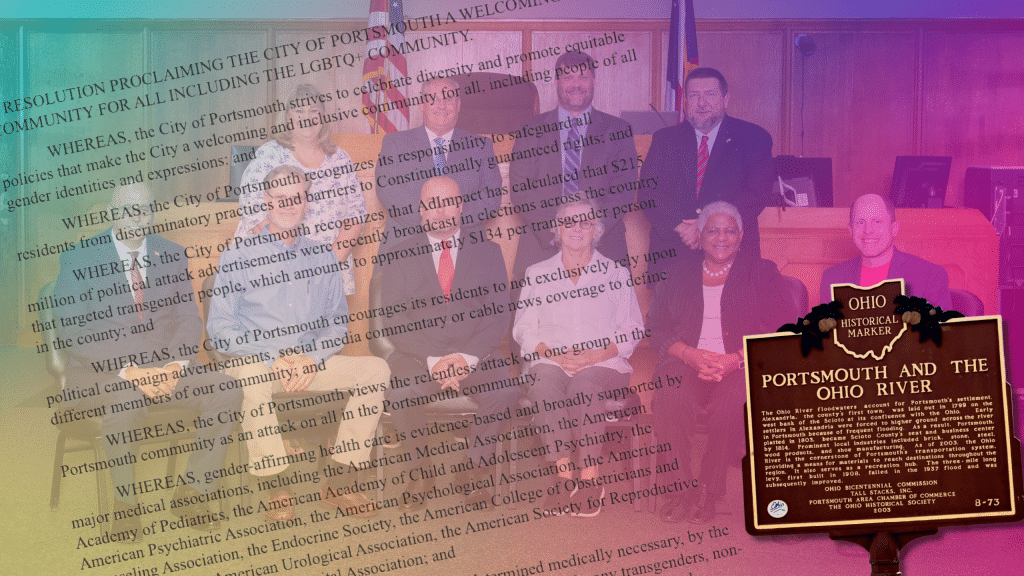
But a recent proposed resolution to declare Portsmouth welcoming to LGBTQ+ residents didn’t receive such a warm reception. It was defeated after residents expressed confusion over what the resolution did and misinformation on social media and the mayor’s and city solicitor’s imprecise statements about the legality of the resolution added to the confusion. The proposed resolution stated:
- Portsmouth “proclaims” itself “to be a safe haven for all including the LGBTQ+ community.”
- Portsmouth “acknowledges the rights of all persons to access lawful healthcare.”
- The resolution is “declared to be necessary to promote inclusivity, equality and justice for all.”
In the preamble, the resolution said the city stood in support with the city’s LGBTQ+ community and urged residents to be more critical with political messaging, such as anti-trans political ads.
On April 12, a group of Shawnee State University students introduced the resolution, which was modeled after the city of Athens, Ohio’s safe haven resolution. But on May 12, Council voted down the resolution by a 5-1 margin.
The lone “yes” vote came from the resolution’s sponsor, Ward 1 Councilman Sean Dunne, an associate professor of sociology at SSU. Dunne said the decision “alarmed” him, reflecting a sharp shift in Council politics and the proliferation of misinformation online.
Background
Landen Puckett, an SSU sophomore, presented the resolution to Council on behalf of the university’s Young Democrats student organization. He said that it was intended not only to make LGBTQ+ residents feel welcome, but also to help ensure they have access to necessary healthcare. Puckett added that he has queer friends in the city who have been stalked and harassed, so he and other peers were concerned that the city “wasn’t progressive enough when it came to social issues.”
“We came up with the idea that we should submit a resolution where the city of Portsmouth can have a proclamation and say that they are listening to their constituents [and] marginalized communities,” he said.

At a Portsmouth City Council meeting on April 14, multiple residents approached council members to express their support – some of them regular commenters.
Amanda Jacks, the mother of a transgender child, said she wanted Council to pass the resolution so her daughter could feel safe in her hometown.
“I didn’t want my child to be shunned by society,” Jacks said. “My child and children like her have every right to be affirmed in this country.”
Mayor Charlotte Gordon and Ward 2 council member said that City Solicitor John Haas – the council’s lawyer – would have to take a look at the resolution before a vote.
The first draft
On April 28, City Council heard several hours of public comment on the resolution, both for and against.
“The issue here is whether in Portsmouth we say that LGBTQ+ people have the right to gender-affirming care like any straight person in this town, and whether LGBTQ+ people are welcomed here,” resident Lori Swain said.
Craig Hudson, a pediatrician, compared lobotomies – a discredited surgery thought to help with mental disorders – to gender-affirming care, which has documented positive outcomes. He also cited the Cass Review – a U.K. study criticized by LGBTQ+ advocates and many in the wider scientific community – as evidence of the harm of gender-affirming care.
Despite some backlash, Dunne said he thought there was “room for a compromise of sorts.” He withdrew the resolution to work on a new draft with the original authors.
“I don’t think this is as divisive as [some] think – in fact, when you get off of social media and away from cable news, talk to people as people as we saw tonight, I think people are much more understanding of [the resolution],” he said.
Other council members disagreed.
Ward 5 Councilman Joey Sandlin said during the meeting that the resolution would cause conflict, singling out people and making them “feel more unsafe.”
“I would agree that this whole thing is an agenda to cause strife and keep this council from doing the business of the City,” Sandlin replied without evidence. “This is a social issue. This is a mental health issue. This is a public health issue.”
“I don’t believe this issue should be even at this council.”
Other council members expressed concern that the legislation focused on one group in the community and would make others feel left out.
During the discussion, Gordon asked City Solicitor John Haas about his thoughts on the resolution’s legality.
“Legally, the city has no business mandating what types of healthcare is provided to the citizens,” he said. “This [resolution] has gone too far in requiring certain medical procedures or medical care be given.”
The resolution said the city would “promote access to and protection of gender-affirming healthcare” and “encourage access to all evidence-based healthcare that promotes an individual’s physical well-being or mental health.”
Misinformation persists
After the April 28 meeting, Sandlin, who is a pastor, appeared on the online radio show Washington Watch with Tony Perkins. Perkins is the president of the Family Research Council, which the Southern Poverty Law Center lists as an anti-LGBTQ+ hate group for its decades of published work falsely linking homosexuality to pedophilia.
During the episode, the host and former Georgia congressman Jody Hice made an association between the “sanctuary city” wording and undocumented immigrants. The term has been used to describe cities that limit their cooperation with immigration authorities.
Sandlin told the host that he and others “have been fighting the good fight” by trying to stop Portsmouth from passing the resolution. He said the resolution’s language on gender-affirming healthcare would possibly contradict the SAFE Act, an Ohio law that bans gender-affirming care for minors.

“The problem is a lot in the community, including myself, don’t feel like there needs to be a special resolution toward any one group,” Sandlin said. “Our slogan for the city is ‘Where southern hospitality begins.’”
On a Scioto County Facebook page, residents speculated without evidence that Dunne was behind the resolution and used SSU students to propose the item. Other comments thought the city would lose federal or state funding if it passed.
Those comments circulated enough that council members at the April 28 meeting – even members who opposed the resolution – said that the misinformation on social media was getting out of hand.
The second draft
The second draft of the resolution changed the declaration of Portsmouth as a sanctuary city to a “welcoming and inclusive city for all including the LGBTQ+ community.”
The proclamation takes aim at negative political ads that target the trans community, asking residents not to rely on advertisements from political campaigns “to define different members of our community.”
On May 12, Portsmouth departed from their normal operating procedure and heard the resolution before the public had an opportunity to comment.
Dunne presented the revised draft.
“I did speak to people who raised some of those concerns … and they were much happier with this updated resolution,” Dunne said.
The changes in wording did not change council members’ minds. Council Vice President and Ward 4 Councilwoman Lyvette Barnes-Mosley said she did not want to vote on anything that specifies “any groups of people.”
“Being a woman of color, it hasn’t been easy for me,” she said. “But I’m a taxpayer. I roll up my sleeves and do the work, and people wound up respecting me and liking me.”
Councilman Packard said his ward was heavily against the resolution and called for a compromise.
Soon after, the council voted down moving the resolution forward to City Council by 5-1.

Mayoral objection
Mayor Gordon, who also serves as the Ward 2 council member, voted against the resolution because she was still concerned with its legality, she said in an interview with The Buckeye Flame.
“We cannot vote on healthcare issues,” she said.
According to Portsmouth’s city charter, City Council “may define, supervise, regulate, prohibit, abate, suppress and prevent all things detrimental to the health, morals, comfort, safety, convenience and welfare of the inhabitants of the City.”
“I just feel really strongly the government shouldn’t interfere in any way, shape, or form or comment on healthcare of individuals,” Gordon said. “That is between the individual and the doctor.”
When The Buckeye Flame presented the charter language to Gordon, she simply said the city solicitor advised them that it would be against the charter.
“He has been a city solicitor for a long time, so he knows the charter inside out,” she added later. “When he advises us that we can’t vote on something or that it goes against charter, we need to listen to him.”
She said she fielded calls from people against the idea of a resolution supporting only one part of a community. She said she believes the current anti-discrimination ordinance was enough, and that passing the LGBTQ+ resolution would lead to other groups asking for their own resolutions.
“ I think that in putting this forward, every community started feeling like, ‘Well, what about me?’,” she said.
In 2021, both Gordon and Barnes-Mosely voted in favor of an ordinance condemning anti-Asian discrimination specifically. It passed unanimously. According to the minutes from that meeting, Gordon said that passing the motion was about standing up to bullies and saying “enough is enough.”
Dunne worries the council’s “no” vote on the LGBTQ+ resolution will leave an open door to more hate in Portsmouth, he said.
“[The ‘no’ votes] emboldens those that are going to harass and discriminate against the LGBTQ+ community,” he said.
Puckett said he is not done pushing for the resolution. He has arranged meetings with city council members and religious leaders to explain why an LGBTQ+ safe haven resolution would be beneficial for a city struggling with a high poverty rate and lack of investment.
“We start to see people coming here when we start focusing on [tackling] social injustice,” Puckett said. 🔥
IGNITE ACTION
- The Buckeye Flame’s Ohio LGBTQ+ legislation guide for 2025 can be found here.
- If you are a young LGBTQ+ person in crisis, please contact the Trevor Project: 866-4-U-Trevor.
- If you are an transgender adult in need of immediate help, contact the National Trans Lifeline: 877-565-8860
- To register to vote or to check your voter eligibility status in the state of Ohio, click here.
- To find contact information for your Ohio state representative, click here.
- To find contact information for your Ohio state senator, click here.
Know an LGBTQ+ Ohio story we should cover? TELL US!
Submit a story!