
This article first appeared on Queer Kentucky and is republished here under a Creative Commons Attribution-NoDerivatives 4.0 International License.
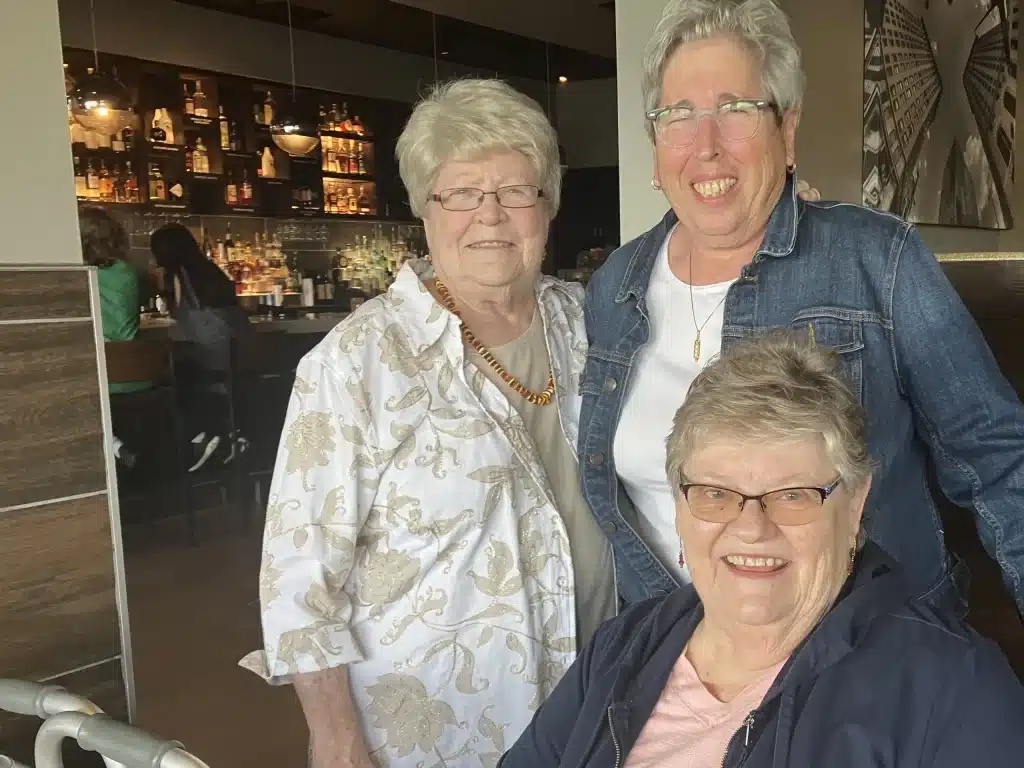
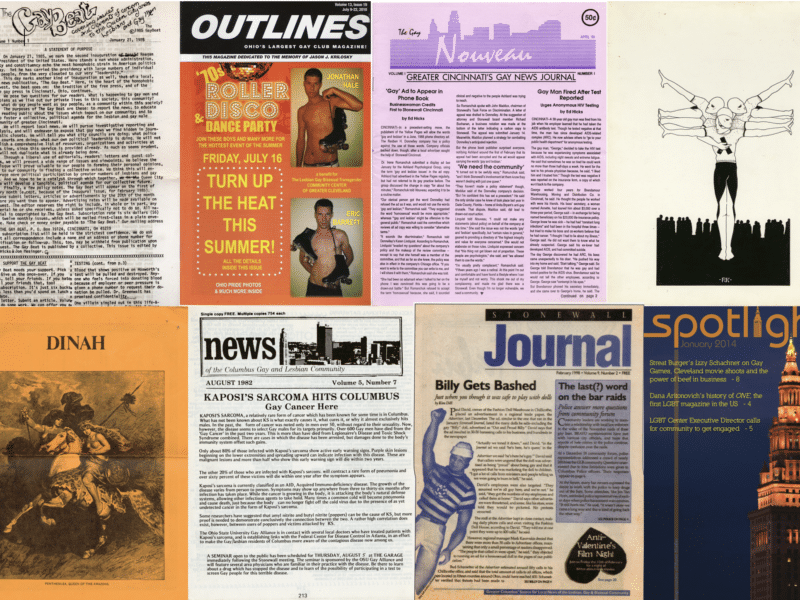
by Avery Plummer, Queer KentuckyTucked in the back of a 1982 issue of Dinah, an old Cincinnati lesbian community news publication, an article reads: “All About S.O.L.” SOL or, Slightly Older Lesbians, was a social group for women over 30 operating in Cincinnati in the 80s and beyond. The article goes on to define SOL as: “A group of older lesbians who meet for mutual support, the exchange of ideas, and for intellectual and social activities.” While several decades have passed since the last SOL meeting, the community it formed and nurtured still exists among past members who, by now, have dropped the word “slightly” from their titles. Recently, I had the opportunity to sit down with lesbian elders Karen Grote, Alayne Kazin, and Nora Whitworth to discuss their involvement in SOL beginning in the 80s.
While the group was mainly geared towards women 30 or older, exceptions were made.
“I was 26,” said Alayne Kazin, laughing. “But I had a partner who was 30, so I got in.”
Her partner, Karen Grote, had just returned to Cincinnati from Cambridge, Ohio, where they had met in 1979 while working as recreational therapists in a hospital. Karen had moved for a job and Alayne followed soon after.
“It wasn’t widely accepted at the time to talk about [our relationship],” Alayne said. Karen agreed. “I wasn’t out to anyone at the time,” she shared. “I worked at a Catholic hospital. I didn’t know how it would be received.” But joining SOL marked a turning point. “That’s when I first [officially] came out, to my SOL sisters,” she said. “I’d met Alayne a year and a half earlier, and that’s when I [first] really identified as a lesbian. Before that, I was married to a man. One thing that marriage taught me: I don’t need to be married to a man.”
Karen and Alayne, now together for 45 years, are still close with many of the women from SOL. One of them is Nora Whitworth, who worked at General Electric and was also closeted in her professional life. “We were all out working in the straight world,” Nora said. “There was a lot of fear.”
That fear shaped the early structure of SOL. Meetings began at members’ homes, but eventually moved to Crazy Ladies, a now closed Cincinnati feminist bookstore and community center, as the group expanded. “We felt safer meeting in a space where we knew who was coming and going,” Karen remarked.
Despite some of this initial fear though, SOL was centered around camaraderie and deep connection.
“We were [all] about potlucks and softball and going to concerts together,” Alayne said. “One of the things we’d do was rent cabins at state parks. We’d get three or four cabins and go away for the weekend. We’d hike, have campfires, communal meals. It was really about chosen family.”
This idea of chosen family was especially significant for many women in the group who had been disowned by their relatives. “Some people didn’t have family,” Alayne said. “So, we were each other’s.”
That mutual care extended far beyond the emotional. “Some of the women were tradespeople,” Karen said. “We had a house-painting party at Mary Jane’s one time.” Alayne added, “Or when someone moved, we’d all rent a truck and go help.” Nora fondly recalled, “We knew so much about each other’s lives, and that’s nice. I like that. As you can see, I’ve chosen these two and they’ve [become] my sisters. They have been for…how long?” “Over forty years,” Alayne noted, not skipping a beat. The trio credits SOL for showing them how to care for one another so deeply.
The group structure was simple but intentional. Meetings began with check-ins, followed by planned discussions. “If someone was going through something big, we’d give them more time,” Nora said. “It was never [explicitly] a mental health group, but that support…it mattered.”
Over the years, SOL helped many of its members come out more fully, grow into their identities, and feel less alone. “It had a lot to do with building my self-confidence as a woman and as a lesbian in a straight world,” Karen said. “Eventually I came out to anyone I wanted to…except my parents. I never did that.”
As SOL thrived, the culture around it began to shift. Some aspects of lesbian life (such as availability of lesbian literature) became more integrated into mainstream spaces, and groups like SOL and the women’s bookstores and feminist collectives that nurtured them began to dissolve.
“When we went into the mainstream, we lost a lot of power,” Nora said. “We almost need to come back and build groups [like SOL] for different ages.”
Alayne described a moment with a younger family member that highlighted this shift. “She asked me, ‘Why did we need women’s music?’ And I told her: it was by women, for women. It existed because we had nothing else to identify with. Resources came from within.”
That DIY spirit—the creation of infrastructure out of necessity—resonates today, especially in a political climate where LGBTQ+ rights continue to be under threat.
“Young [LGBTQ+] people are still being oppressed,” Karen said. “They’re being killed, still. The trans community especially is being targeted. And the suicide rate remains high because people don’t have the support systems they need.”
“There’s a need again,” Alayne added. “For mental health spaces, for community, for connection.”
Even after decades, the bonds created through SOL endure. “We try to see each other once a week,” Nora said. “It’s nice to know [these two] are only a phone call away.”
Now in their seventies and eighties respectively, the trio reflects on SOL with bittersweet nostalgia. “Quite a few [members] have passed,” Nora said. “We keep saying we need to get younger friends. We’re all slowing down…and when your friends slow down, you slow down too. You gotta get some dynamic energy going again.”
“I’m still kicking butt,” she added with a grin. “Just not kicking as high.”
And their advice for future generations?
“Build something,” Karen said. “Support each other. Make friends. Be part of something bigger than yourself.”
Because in the end, as Alayne put it, “It was just about being together. It was your own group, and that was the nicest part. People who knew you. People who accepted you. That mattered then. And it still does.” 🔥
Know an LGBTQ+ Ohio story we should cover? TELL US!
Submit a story!



Pingback: August 23 – Dykes and Lesbians
Pingback: August 23 update 2025 – Dykes and Lesbians