
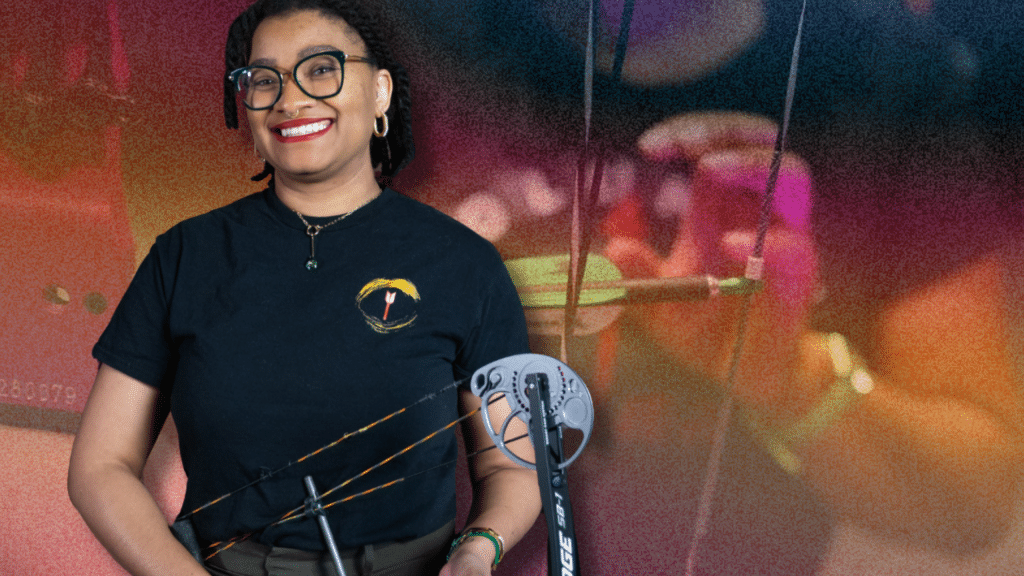
When Antoinette Wooden picked up a bow and arrow for the first time more than a decade ago, she had no idea it would change the trajectory of her life.
Wooden grew up on the south side of Columbus, Ohio. As a young adult, she moved to Kansas City, Missouri, but returned to Ohio when a small business she started in Kansas City“absolutely failed.”
“That’s when I discovered how much I love archery. It was really out of the blue,” Wooden said. “I saw a Groupon for archery, and I just fell in love with it.”
Around the same time, Wooden received a mental health diagnosis with symptoms that wouldn’t subside using traditional treatments:
“That’s when Columbus Archery was born.”
What is archery wellness?
After she was diagnosed with bipolar II disorder with auditory psychosis, Wooden started looking for ways to manage her symptoms.
“Medication wasn’t helping,” she said. “That’s where archery came in.”
Instantly, Wooden was stunned by the improvements she experienced practicing archery through controlled movement and breath work.
“It’s about being able to connect emotional intelligence tools and regulation with the archery itself,” she said. “Whether that’s with connecting mental health or grief management.”
Over time, archery also became an effective way for Wooden to build community and transfer skills and tools that could help others, too. Now, she embraces and teaches the concept of “archery wellness.”

“We’re able to have people come in a group, talk about connection, self-doubt or grief management and what that looks like to get it out through archery,” Wooden said. “They’ll work on moving from writing about these big feelings and journaling to putting them into action and figuring out what that looks like.”
“It’s not our job to diagnose people,” she added. “Our job is to give people the language to be able to take the next steps.”
Columbus Archery partners with licensed therapists via the National Association in Mental Illness (NAMI)’s Franklin County chapter to help connect archers with ongoing mental health care and culturally competent providers.
“We focus on different emotional regulation tools,” Wooden said. “We try to get people to kind of come to terms with understanding how therapy works and introducing it to a community that may not have access or resources,” including Black and brown LGBTQ+ Ohioans.
Centering Black and queer archers
The bow and arrow are prehistoric tools made and utilized by Black and brown people across the globe for centuries. However, Black and brown people have been historically excluded from archery, both as a professional sport and as a respected art form.
“It can feel a little bit lonely,” Wooden said – describing her own experience as a Black and queer archer over the years. “There’s just not that many Black and queer people that are doing archery, unfortunately. This is Black History Month, and it’s kind of hard to find Black archers, Olympic archers, that have been doing this for a long time.”
The Archery Trade Association (ATA) estimates about 80% of the United States’ 5.4 million competitive archers are white.
In 2017, Dallas Jones became the first Black archer to win a national title. In 2021, Makenna Proctor became the first Black woman to compete for the United States at the World Archery Championship, where Team USA took home bronze.
“There are so many great archers out there that don’t have access to a space or to the equipment,” Wooden said. “I’m trying to change the whole narrative that [says] this is not a sport for Black people.”
“This is a sport that was given to us by Black and brown people so long ago,” she added. “So why aren’t more Black and brown people doing this?
Making archery accessible
To remedy the sport’s racial, gender and class-based inequity, Wooden designed a pay structure that allows some people to access archery services at a discounted rate, while others compensate for the difference.
“Our income module is based on state assistance,” Wooden said. “If people have Medicaid, SNAP, anything along those lines, we offer them a very heavily discounted rate. Then there are people who can pay at the normal rate and that offsets the two.”
Wooden says Columbus Archery is a “socialist company,” with a specific focus on the communal element of the sport – and the social, emotional and psychological benefits community care can provide.
Bridging the gap
Currently, Wooden is looking for new sponsors to contribute to Columbus Archery’s youth program, which is available for archers between 12 and 17.
“It’s a three-week program where kids are introduced to archery safety, grief management, understanding their big voices and how they can use their big voices to advocate for themselves,” Wooden said.
After that, young archers are also “put through a pipeline” that connects them with archers in Columbus Archery’s program for elders over age 55.
“Our 15 to 17-year-olds can start taking those skills that they learn in their summer camp and utilizing it in our elders program,” Wooden said. “They start mentoring and guiding a lot of the elders and bridging that intergenerational gap that we have.”
‘We’ve had to start over’
As a result of the Trump administration’s efforts to eliminate diversity, equity and inclusion (DEI) policies in both the public and private sectors, Columbus Archery faced a major financial setback, Wooden said.
The company was approved for a U.S. Small Business Administration (SBA) grant – described by the federal government as “limited small business grants for scientific research, community promotion of entrepreneurship, and exporting.”
The grant was later rescinded.
“We put in a lot of our application as being Black, Black and queer and dealing with mental illness,” Wooden said. “Those are a lot of red flags to the underwriter team, so we’ve had to start over.”
Since then, Wooden has adapted. She is still working to open a more permanent brick-and-mortar space to house Columbus Archery, while hosting pop-up archery programming at community spaces all over the city – including the COSI Center for Science and Industry, the YMCA and the Boys and Girls Club of America.
‘Archery has really saved me.’
For adults, Columbus Archery’s mobile community events include “Art and Pop Archery,” where archers use foam-tipped arrows to pop paint-filled balloons attached to a canvas.
Additionally, Wooden offers a “Bows & Yoga” event, where certified Yoga instructors partners with trained archers to help participants connect to the bodies through movement.
Another workshop for adults focuses on starting over.
“We just talk about how no matter how many times you start over, it’s OK,” Wooden said. “I have had to start over so many times in my own life. But what does it look like when you pair it with community? When you pair it with asking for help?”
Practiced in community and with intention, archery has been a transformative force in Wooden’s life.
With Columbus Archery, she hopes to share that power with others.
“These are all things that I’ve learned while being in archery and talking to my mentors. I feel like I have a lot to share with people in that,” Wooden said.
“Archery has really saved me. It’s helped me become the person that I am today: I lead with courage. Everybody at my table? I’m making sure that they’re OK.” 🔥
Ignite Action
- To learn more about Columbus Archery or to book a community event, click here.
- To learn more about the National Alliance on Mental Health (NAMI) and the services and resources they offer, click here.
- To learn more about sponsoring Columbus Archery’s youth archery programming , contact Antoinette Wooden at antoinette@columbusarchery614.com.
- To listen to Wooden’s podcast, “Black and Bipolar,” click here.
- If you are a young LGBTQ+ person in crisis, please contact the Trevor Project: 866-4-U-Trevor.
- If you are an transgender adult in need of immediate help, contact the National Trans Lifeline: 877-565-8860
Know an LGBTQ+ Ohio story we should cover? TELL US!
Submit a story!




Pingback: Roundup of links for 12 Feb. – gleanings