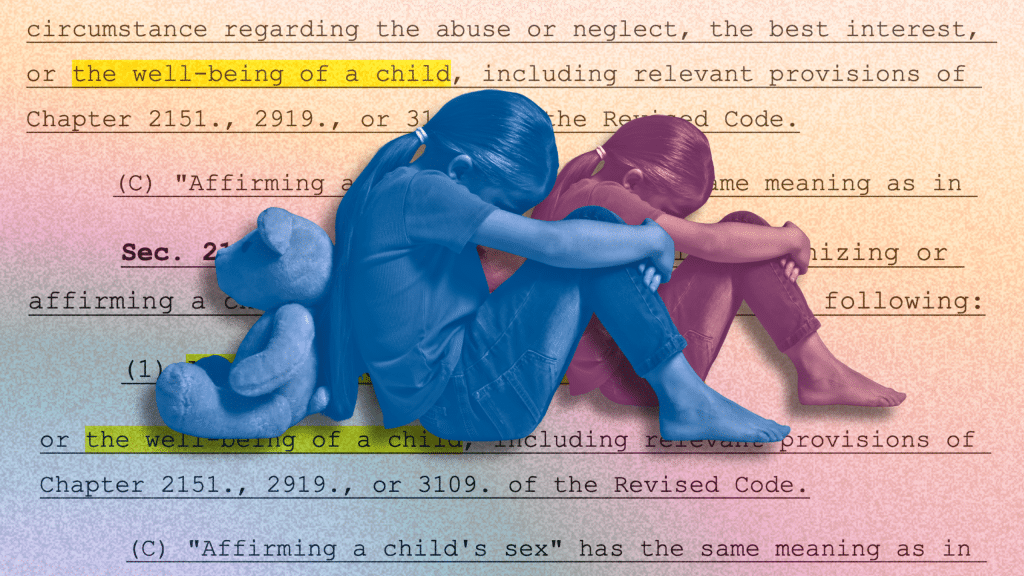
A group of Ohio Republican lawmakers introduced a far-reaching bill aimed at “protecting” parents who do not affirm their trans children.
The bill redefines “affirmation” as a parent’s right to only acknowledge a child’s sex at birth, including the right to:
- Only use the child’s legal name given at birth.
- Only use pronouns consistent with the child’s sex assigned at birth.
- Seek out mental health services to rid their child of their trans identity.
- Decline to consent to any physical or mental health services for the purpose of gender transition.
HB 639 (“The Affirming Families First Act”) was introduced on Tuesday by Reps. Joshua Williams (R-Sylvania Twp.) and Gary Click (R-Vickery), both sponsors of myriad anti-LGBTQ+ legislation. This latest bill has not yet been assigned to a committee.
If passed, the bill would also:
- Prevent parents from being charged with abuse and neglect if they refuse to recognize their child’s trans identity and only recognize the child’s sex assigned at birth.
- Prevent public children’s services from establishing a case plan requiring that a parent facilitate a “social or medical intervention counter to affirming a child’s sex [assigned at birth]”.
- Prevent state agencies from taking any action against a parent if the only complaint is that they are denying their child’s trans identity.
- Prevent state agencies from withholding any information about a child’s gender identity to their parents.
- Prevent courts from taking into consideration that a parent is not affirming their trans child when allocating parental rights and responsibilities for the care of children.
- Prevent state agencies from collecting information about a minor’s LGBTQ+ identity without parental permission or maintaining a database of parents who deny their child’s LGBTQ+ identity.
The bill also requires that any contractor of the state may not provide any instruction, training, materials or curricula that says the following:
- The act of affirming a minor’s sex constitutes abuse or neglect, creates a risk of abuse or neglect or creates an unsafe environment;
- Gender transition for a minor is a sound, evidence-based treatment for gender dysphoria or that gender transition reduces the risk of suicide in minors struggling with gender dysphoria
- Psychological and mental health treatment that affirms a child’s sex constitutes conversion therapy.
- A child will be at greater risk of self-harm if they are placed with someone who does not affirm their trans identity.
LGBTQ+ organizations across Ohio issued statements in response to the bill – including CEO and executive director of Equality Ohio Dwayne Steward, said the legislation would “enshrine discriminatory anti-LGBTQ+ principles into nearly every aspect of Ohio’s child welfare and family law system.”
Steward also called the legislation “out of touch with everyday Ohioans.”
Ohio representative is ‘fighting a war’ on affirming families
Click and Williams hosted a press conference on Tuesday unveiling HB 693, alongside representatives from the Heritage Foundation and Center for Christian Virtue, an anti-LGBTQ+ designated hate group.
Throughout the conference, legislators and lobbyists used skewed evidence and anti-LGBTQ+ dogwhistles to support the bill.
Laura Hanford, senior policy analyst at the Heritage Foundation which helped draft the bill, praised the Republican lawmakers.
”Bravo to these legislators for introducing what is now the most comprehensive bill in the country to address the weaponization of child protective systems against families,” Hanford said.
Williams said that sponsoring this bill helps him “fight human trafficking” while also appearing to sarcastically refer to the 2S in “LGBTQIA2S+” as “two-spirit,” despite the term belonging to Indigenous Americans – who are disproportionately likely to be targeted by human traffickers. It is unclear how the legislation would fight trafficking.
Williams provided only one example of a child in Ohio being taken away from their parents because they were anti-trans. In 2018, a judge granted custody of a 17-year-old in Hamilton County to his grandparents because of his anti-trans parents, he said.

But Williams only told part of the story. The 17-year-old’s parents subjected the teenager to conversion therapy. According to the Cincinnati Enquirer, he was forced to sit in a room and listen to Bible scriptures for more than six hours at a time, a Cincinnati Enquirer article also reported. The grandparents’ attorney said the teenager told them that his father “chased [him] around the house” and he “lived in terror,” according to WCPO Cincinnati.
The event “triggered suicidal feelings” in the teenager, according to CNN. The attorney representing the parents told the news organization that lawmakers should ban gender-affirming healthcare for minors.
Six years later, Ohio legislators passed the SAFE Act, which prohibited minors from receiving gender-affirming care.
Williams also lambasted Cuyahoga County for keeping a database of foster children who identified as LGBTQ+ as part of a program to place foster children with affirming foster parents. He also criticized the county’s contract with an agency called “Affirm.Me” which explained in part why gender-affirming care helps trans children recover from trauma.
Part of the program taught parents about transgender identities and what that means.
“They were going to retrain our parents to be accepting,” Williams said. “These allegations are concerning and should be taken seriously.”
Both Williams and Click cited an article from right-wing news outlet the Daily Caller that said Cuyahoga County’s database “[suggested] parents and caregivers who do not affirm a child’s sexual orientation or gender confusion are unsafe and may need to have their children removed from their home.”
While the database does keep track of kids in the child welfare system who self-identified as LGBTQ+, nowhere does the article provide evidence that the database led to anti-LGBTQ+ parents losing custody of their children. The intervention that occurred was a program to teach parents how to affirm their children and help workers place queer children with affirming foster families.
Children could only be removed from their parents under specific conditions, according to Affirm. Me’s 2022 report. The child needs to be already engaged in the child welfare system and on a permanency plan, and they need to experience:
- Substantiated abuse or neglect related to sexual orientation, gender identity or expression (SOGIE)
- Prior custody episode(s)
- Young person engaging in high-risk behaviors (e.g., self-harm, harm to others, substance use, truancy, running away)
- Adoption disruption or dissolution
- Investigator has already filed for custody
Under the text of the bill, it is unclear how stopping social workers from identifying abuse or neglect related to LGBTQ+ identity would affect children. It is also unclear whether Cuyahoga County workers ever even engaged in this specific program.
At the end of the conference, Click said the law would not protect parents who are physically abusive.
“You cannot physically abuse your children just because they do something you don’t agree with,” he said.
The bill would prohibit workers to place children with affirming foster families, or collect data about LGBTQ+ children. The Center for Community Solutions highlights in a 2024 report why data collection is important to the welfare of the queer community.
“If you don’t exist in the data, you don’t exist in the policies or funding decisions,” said Gulnar Feerasta, managing director of the LGBT Community Center of Greater Cleveland in the report.
Williams also claimed that Cuyahoga County collected data and did not tell parents. On the contrary, the policy tells workers to ask children only 13 years or older SOGIE questions, and asks permission from the child at the end of their discussion to share the collected information, including parents.
Later in the conference, Click and Williams both said that they believed affirming a child’s gender identity was akin to child abuse, though the legislation does not codify that.
“These people are motivated to abuse our kids and convince them that there’s a reality that is outside a biological reality,” Williams said. “We’re fighting a war here.”
David Mahan, senior policy director with the Center for Christian Virtue, said conversion therapy bans would punish parents, despite the 16 laws in place in Ohio only punishing practitioners.
Mahan said therapists who do not support a child’s transition is a “normal practice of getting them to align with reality” and claimed there were multiple studies recommending against supporting a transgender person, without citing any. Every major medical and psychological organization in the world rejects conversion therapy practices, citing increases in anxiety, depression and suicidality.
Intersex Ohioans
Previously, Republicans have denied the existence of intersex conditions, which can include combinations of sex chromosomes, hormones and primary and secondary sex characteristics that don’t fit the binary definitions of male and female.
However, HB 693 appears to acknowledge intersex people, who make up an estimated 1.7% of the general population.
The bill defines a “male” person as “but for a congenital anomaly or intentional or unintentional disruption, the reproductive system that at some point produces, transports, and utilizes sperm for fertilization.”
A “female” person is defined as “anyone who naturally has, had, will have, or would have, but for a congenital anomaly or intentional or unintentional disruption, the reproductive system that at some point produces, transports, and utilizes eggs for fertilization.”
LGBTQ+ organizations respond
Columbus-based LGBTQ+ advocacy organization Kaleidoscope Youth Center (KYC) released a written statement opposing the legislation.
“Trans youth deserve dignity and respect,” the statement reads. “The passage of HB 693 would only contribute to the further dehumanization and disregard of young people’s agency, lived experience, and mental and physical well-being.”
LGBTQ+ affirming Christian advocacy group LOVEBoldy, also released a statement in stark opposition to the bill.
“This bill is not about protecting families. It’s about authorizing harm,” said executive director Rev. Dr. Ben Huelskamp. “Studies continue to show that Transgender youth who are affirmed by adults at home, school, and in their faith communities have lower incidences of mental health concerns and higher levels of empowerment and self-confidence.”
Equality Ohio’s Dwayne Steward also noted the bill would increase instances of abuse in the foster care system.
“House Bill 693 would create an irrefutable right to transgender conversion therapy, block judges and child protective services from responding appropriately to abuse involving LGBTQ+ kids, threaten occupational licensure for doctors, teachers, and therapists who use gender-affirming language and prevent child placement agencies from collecting data to make sure queer kids in the child welfare system are placed in safe homes,” Steward said.
Steward also noted the disproportionately high number of LGBTQ+ youth living in foster care as a direct result of their gender or sexual identities.
“It’s common sense that queer kids should be placed in homes that accept queer kids,” Steward said. “It’s also common sense that one of the reasons LGBTQ+ kids are overrepresented in the child welfare system is because many of them are rejected by their families because they’re LGBTQ+.”
“As an adoptive father myself, I know first hand that Ohio’s child welfare system is based on a simple principle: what matters most is what’s best for the child,” Steward said. “HB 693 undermines evidence-based child welfare protections and, if passed, this bill would lead to increased trauma, victimization and abuse of Ohio’s kids.”
Of the roughly 390,000 children currently living in the foster care system, an estimated 30% are LGBTQ+. According to a 2021 study conducted by The Trevor Project, LGBTQ+ youth in foster care are four times as likely as their straight and cisgender peers “kicked out, abandoned, or running away due to treatment based on their LGBTQ identity.” 🔥
Ignite Action
- To learn more about how to support LGBTQ+ youth living in foster care, click here.
- To learn more about intersex people and intersex conditions, click here.
- To register to vote or to check your voter eligibility status in the state of Ohio, click here.
- To find contact information for your Ohio state representative, click here.
- To find contact information for your Ohio state senator, click here.
- If you are a young LGBTQ+ person in crisis, please contact the Trevor Project: 866-4-U-Trevor.
- If you are an transgender adult in need of immediate help, contact the National Trans Lifeline: 877-565-8860
Know an LGBTQ+ Ohio story we should cover? TELL US!
Submit a story!