
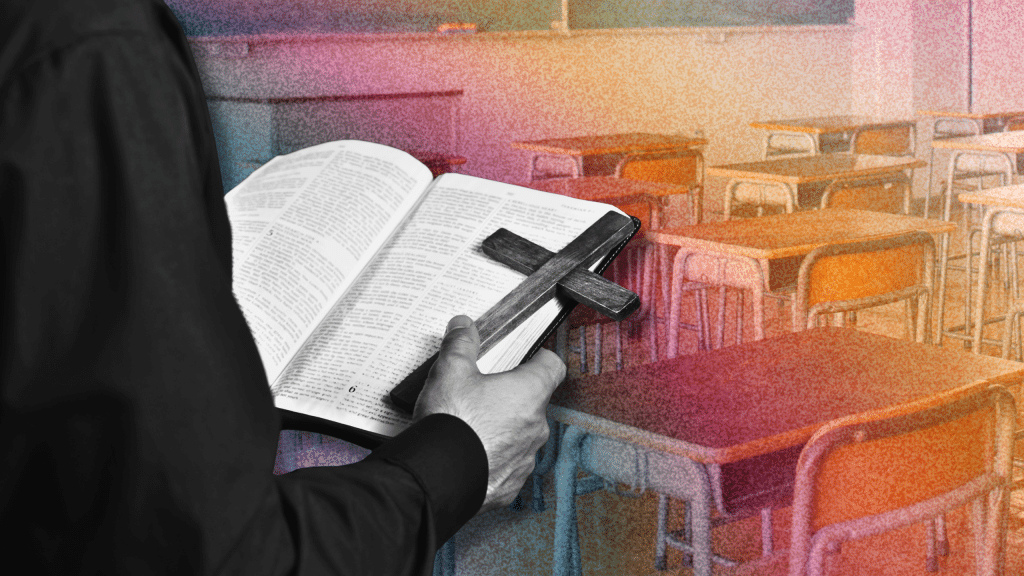
During Ohio House Bill (HB) 531’s second hearing before members of the House Education Committee on Wednesday, several local chaplains testified in support of the bill – which would allow untrained, unlicensed and uncertified chaplains to minister in Ohio public schools.
Under the bill, chaplains would still be required to register with and submit a criminal background check to the Department of Education and Workforce (DEW). However, chaplains would not be required to hold any license or certification with the State Board of Education.
The bill – sponsored by conservative Christian and long-time Southern Baptist pastor Jonathan Newman (R-Troy) – would also require Ohio public school districts to hold a public debate and vote regarding the policy before the start of the 2026 school year.
If adopted, the bill would require a student’s parent or legal guardian to give permission in order for the student to speak with a volunteer chaplains.
While similar legislation has garnered public support from far-right, anti-LGBTQ+ lawmakers, the country’s largest chaplain regulatory body does not support it – citing concerns around “appropriate education, training and experience that professional, board certified chaplains have.”
Texas, Florida and Louisiana have also enacted similar bills, which experts say could all place LGBTQ+ students at risk.
Christian influence on display
Eric Tober – who introduced himself as a “Pastor in the Dublin community” and chaplain for the Dublin Police Department – provided extensive public testimony in support of the bill.
The Illinois native studied at Trinity Evangelical Divinity School, which closed in 2023, and the Bob Jones Bible University, which was not accredited until 2017.
Since 2019, Tober has served as Lead Pastor at The Ark Church in Dublin, part of the Evangelical Free Church of America (EFCA).
“Many students are struggling with issues that would overwhelm all of us,” Tober told members of the Ohio House Education Committee. “The need for healthy relationships with a mother or father substitute – that’s critical.”
“I believe that the addition of a mature, volunteer chaplain would give many students the needed father or mother figure that is often missing,” he added.
Tober – who described himself as “more of a mental health representative” in his role as a chaplain – does not hold any mental health credentials or certifications from any state licensure board in Ohio.
In 2020, Tober penned an essay published by the Center for Christian Virtue (CCV) – the Columbus-based anti-LGBTQ+ hate group and the primary driver behind the state’s current ban on health care for transgender youth.
In 2021, Tober was listed as a Pastor Ambassador for the anti-LGBTQ+ hate group.
Tober’s own church has supported anti-LGBTQ+ and anti-LGBTQ+ policy and legislation in the past.
In a 2016 post titled “Thinking Biblically About Transgenderism and Pastoral Care of LGBT Persons and Their Families,” EFCA executive director and director of theology and credentialing Greg Strand called gender dysphoria a “psychological disorder and dysfunction (and perhaps also as a deeper spiritual disorder).”
Tober also provided public testimony alongside Rep. Newman in 2020 against the “Ohio Fairness Act,” which would grant LGBTQ+ Ohioans full legal protections under Ohio law.
Additionally, conservative Christian Rep. Rodney Creech (R-West Alexandra) – who was removed from his committee assignments last year and told to resign after a family member accused him of climbing into bed with a child while partially clothed and erect – is listed among the bill’s cosponsors. Creech has publicly denied the allegations.
‘Substitute mothers and fathers’
“The need for substitute mothers and fathers is critical,” Tober repeatedly told committee members when asked to describe the role of volunteer school chaplain.
“I envision – when I read this – you could take retired pastors from across the state of Ohio, who sometimes feel like [they] are no longer valuable. Put them in a role where they’re volunteering and where they can use their experience to come and – maybe even as a grandfather or grandmother type figure – and provide that relational support that is often just a smile, it can be an encouraging word,” Tober said.
“For me, I’d put ten chaplains in a school, and we’re still not even getting there because there’s such a great need,” Tober added. “I think it would be a great tremendous blessing – a great good – for everyone involved.”
Other Ohioans more explicitly praised that the bill would allow Christianity more fully in public schools.
Mindy Penn is the mother of two who told committee members she is concerned that her children are not taught coping skills rooted in Christian teaching at the public school they attend.
“The techniques currently offered focus primarily on the child regulating or fixing their own emotions,” Penn said, describing drawing and painting exercises her children were taught at school. “When stressed they are encouraged to practice breathing exercises.”
“While I understand the intent behind these activities, they are not rooted in any religious principles,” Penn said. “They do not point the child toward a higher power.”
James Kerr, military veteran volunteer chaplain for Pierce Township Police Department in Clermont County, also testified in support of the bill.
“School psychologists and counselors are not equipped to speak to the spiritual concerns of students when tragedy comes,” Kerr said. “We’ll let someone else teach math if you’ll let us have the opportunity to speak to the soul.”
Chaplain association opposes the bill
In a 2024 written statement, the Association of Professional Chaplains (APC) and the Board of Chaplaincy Certification, Inc. (BCCI) directly opposed similar legislation designed to place volunteer chaplains in public schools.
“[APC is] concerned that the proposed legislation does not require the ‘chaplain’ to have the proper professional credentials to serve in such sensitive environments like the public school system,” APC said.
“Those who work in education, especially public primary schools, are typically required by most states to have extensive education, supervised work experience, and state issued licenses, in order to serve these institutions,” the statement said. “Chaplains serving schools, particularly public education where they will encounter vulnerable children with diverse faiths and backgrounds, should be scrutinized with requirements similar to teachers, social workers, and school counselors.”
“In our evaluation, a short online training course is insufficient for what is needed to serve as a professional chaplain,” APC concluded – noting the association’s rigorous practical and ethical standards for membership and certification status.
Typically, chaplains certified by BCCI have already earned a master’s degrees in theology, philosophy or psychology, along with 2,000 hours of supervised “clinical pastoral education.”
The Ohio bill would not require all chaplains to receive equivalent training or certification.
Some chaplains are certified by their own denominations, which typically includes a background check.
However, the Catholic Church, in particular, has a centuries-long documented history of protecting priests and other clergy who systematically rape, sexually assault and sexually abuse what journalists estimate to be thousands of children since the 1950s.
When Texas passed similar legislation allowing chaplains to minister in public schools in 2024, the American Civil Liberties Union (ACLU) fought against it, claiming it violates students’ and families’ right to religious freedom.
“Allowing public schools to establish paid or voluntary positions for chaplains will inevitably lead to evangelizing and religious coercion of students,” ACLU senior staff attorney Heather L. Weaver said. “And, because chaplains are typically not trained or certified to provide educational or counseling services to youth, students are likely to receive inadequate mental health support that, in some cases, may be harmful.”
Ignite Action
- To find contact information for your Ohio state representative, click here.
- To find contact information for your Ohio state senator, click here.
- If you are a young LGBTQ+ person in crisis, please contact the Trevor Project: 866-4-U-Trevor.
- If you are an transgender adult in need of immediate help, contact the National Trans Lifeline: 877-565-8860
Know an LGBTQ+ Ohio story we should cover? TELL US!
Submit a story!





Pingback: Roundup of links for 7 Mar. – gleanings