
The importance of finding and creating spaces for Black Queer Joy in Ohio [COMMENTARY]
“Black music and arts have always been modalities and vehicles for resistance, speaking truth to power and storytelling.”
By Avery Ware
Here we are, on the brink of Q4 for 2026. An altogether politically, socially, economically and even spiritually damning year for many communities. Late-stage capitalism and hyper-inflation have left our communities in peril. Our third spaces are dwindling and the ones we do have are harder to afford or find the time to consistently visit. Our current political climate is robbing us of joy. And even more so for marginalized communities.
Black and queer communities deserve safe spaces where our joy and humanity are centered. But what does joy in the midst of so much mess even look like? Where can we find, build and sustain it? Answering these question may seem difficult – impossible, even – but history has provided us with a roadmap.
Black joy in the face of white supremacy, Christian nationalism and institutional racism is how we resist, reclaim our humanity, preserve our histories and maintain our culture(s) that is simultaneously being devalued and plagiarized. Black folks do this in so many ways; some that are obvious and others that force us to reimagine what Black joy can look like, feel like and manifest into.
For example, the Black Church and Black spirituality have also been a cornerstone of Black joy and resistance. With the rise of Christian nationalism, it is important to delineate that the church I’m referring to does not include wielding an oppressive interpretation of the Bible to control civic life here and abroad. That is an ideology I wholly disavow.
As a former church kid, I know firsthand that the Black Church is certainly not some utopia, especially for queer folks. But, it is not one-dimensional either. It can be a space of physical, political and spiritual refuge. It’s where many of us learn how to sing, orate and be in service to others. As Barbara A. Holmes says in her book Joy Unspeakable, “its traditions are deeply ensconced within the historical memory of the wider society and can be found in Coltrane’s riffs, Malcolm’s exhortations, the social activism of the Black Lives Matter Movement and the presidency of Barack Hussein Obama.” The songs, shouting, dancing and community are an expressive form of joy that has been foundational to our resistance.
Black joy (and resistance) not only can exist in physical spaces, but in oral traditions, too. This is not unique to Black communities; Indigenous and other oppressed groups come to mind. Oral history and storytelling are necessary for our communities because our histories are actively strapped, sanitized and don’t-tell-full narratives. There’s nothing like listening to the elders of your family talk about their life experiences – what they survived, how they endured, how they loved. Even in nightlife communities, I love listening to the elders tell me how nightlife has changed. Many survived the HIV/AIDs epidemic – these are stories the history books will never tell. It’s on us to preserve! One can better understand oneself when full histories are shared.
And, of course, there are the cookouts, house parties, card parties, rent parties, block parties, family reunions, the church fish fry, etc. where our music, food, traditions and joy are on full display. There is nothing like being in shared space with folks of shared experiences.
Community is self-care. Community is mental health care. I think of our enslaved ancestors who didn’t all speak the same language or have the same customs and still found joy and creativity, created language and one of the world’s best cuisines, started a tradition of music that is emulated all over the world and utilized imagination to create art forms that were once criminalized but can now be found on VH1 and MTV. The creation, perseverance, wisdom and ability to adapt and resist are the shoulders that we stand on – and why Black joy and resistance are necessary.
Black music and arts have always been modalities and vehicles for resistance, speaking truth to power and storytelling. There’s a moment in “Sinners,” right before Sammie goes on stage, where Slim (Delroy Lindo) explains how the blues was birthed from Black communities’collective struggle. That lineage followed to the origins of hip-hop and how it started as protest music to state-sanctioned violence and white supremacy.
Similarly, drag is fundamentally an art form that challenges rigid gender norms and [can] critique racial hierarchical systems. A critical analysis of the iconic documentary “Paris is Burning” illustrates the politics around policing Blackness, gender and sexuality cannot be disconnected and must be challenged. Currently, right here in Ohio, we’re in the middle of the battle of the drag bill, which is actually a Trojan-horse bill to attack (and ultimately eliminate) transness.
On Saturday, Sept. 5, 2026, at ThirdSpace Reading room, The ReMx: Blk Pride on 105 is a reflection on these histories. It is a space of reverence, remembrance, community and joy where you can find Black spirituality, progressive politics, food, music – and, of course, drag! It sets out to honor the Black radical traditions that have kept us safe and sane, and provided the fortitude to continue to live boldly. 🔥
Avery Ware is the founder and project director Mx. Juneteenth: A Black & Queer Liberation Celebration, a community arts, entertainment, and resource festival.
Know an LGBTQ+ Ohio story we should cover? TELL US!
Submit a story!
Author

Related Articles
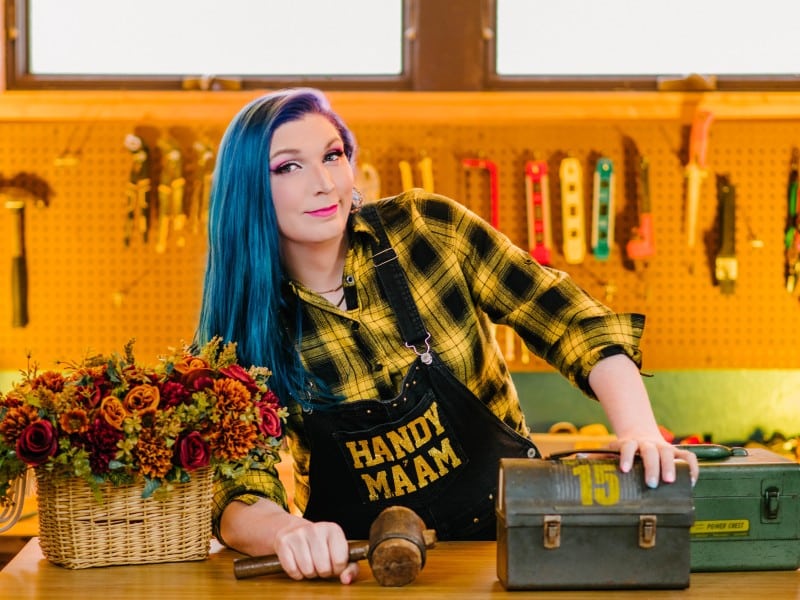
The Trans Handy Ma’am is taking her tools on tour, promoting new book with stop in Ohio
Mercury Stardust’s home maintenance content helps LGBTQ+ people live with dignity. Now she’s taking her book on the road.

Audio This News is So Gay (10/7/26): Diving Into the Gap Between Anti-LGBTQ+ Laws and Their Consequences
Featuring: H.L. Comeriato (The Buckeye Flame) and Kae Petrin (Trans Journalists Association)

Audio This News is So Gay (9/30/26): Unpacking When Queer Media Attacks Other Queer Media
Featuring: Dana Piccoli (News is Out) & Graham Gremore (Queerty)
