
Trans blacksmith forges connections to her body and community in rural Ohio
‘It’s a dying art and a very meaningful and welcoming space, especially to queer folks’
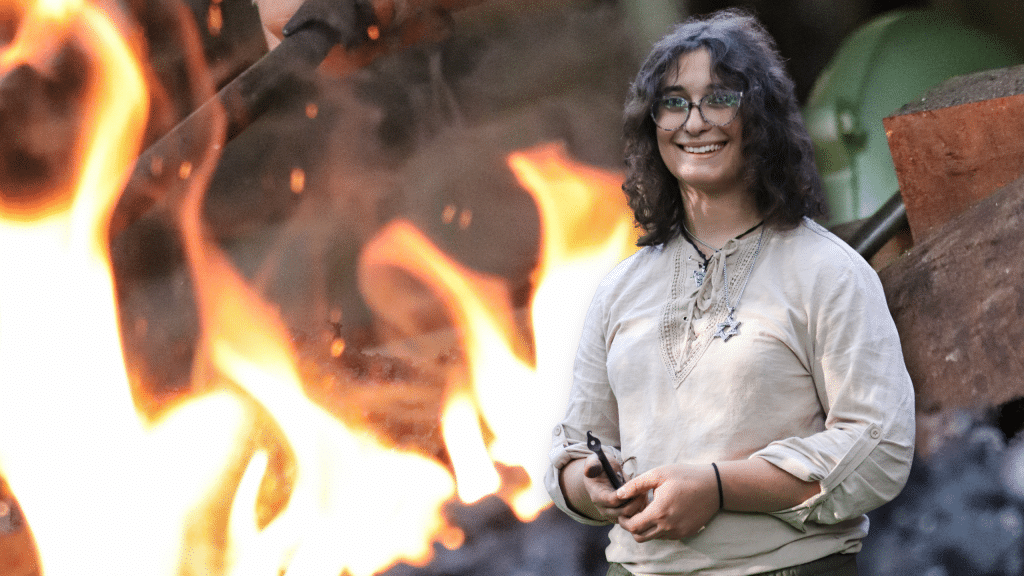
Watching a blacksmith work was a young Rose Solomon’s favorite activity every year at the Geauga County Fair. Whenever she had spare time between showing her rabbits as a 4-H kid or firing arrows at the archery range, she would sneak off to the blacksmith’s shop to watch a man with thick forearms peppered with burn scars raise his hammer and strike glowing metal with delicate precision, the recognizable “ding!” echoing.
She was fascinated by how the metal moved. It’s supposed to be sturdy, solid – but a smith made the metal flow like clay. She watched until she was 12 years old, then she went up to the smith and asked how she could do what he did. He pointed her towards a shop in Burton, Ohio.
Solomon came out as transgender at 13, and her family moved to Shaker Heights so she wouldn’t experience bullying in middle school. But when she came out to the blacksmithing group, they just asked if she could still hold a hammer.
Now at 24, she said the craft has connected herself to her body in a positive, gender-affirming way while also providing community and a way to express her creativity.
“I got a little bit older and started seeing how the world kind of sucks at times,” Solomon said. “Being able to swing a hammer and hit things [and] transform that into creative energy, that was a big draw that kept me going.”
‘It feels like I’m allowed to have traits that would otherwise make me dysphoric’
Solomon has steadily progressed through the archaic levels, from apprentice (a beginner) to journeyman, on her way towards becoming a master. Apprentices typically learn eight basic skills – like drawing out metal and welding in a forge – alongside fundamentals, like building strength and control in one’s body. Back when blacksmiths were commonplace, an apprentice would learn those skills in a master’s shop. When they completed their training, they would journey to other blacksmiths to learn specific techniques – hence “journeyman” – though it’s not usually done anymore.
When she’s not demonstrating the craft at a summer camp for trans kids, Camp Lilac, or fairs, Solomon works on crafting tools for her next project. If she’s stuck, she’ll bring the problem to her blacksmithing group for advice and to learn any new techniques.

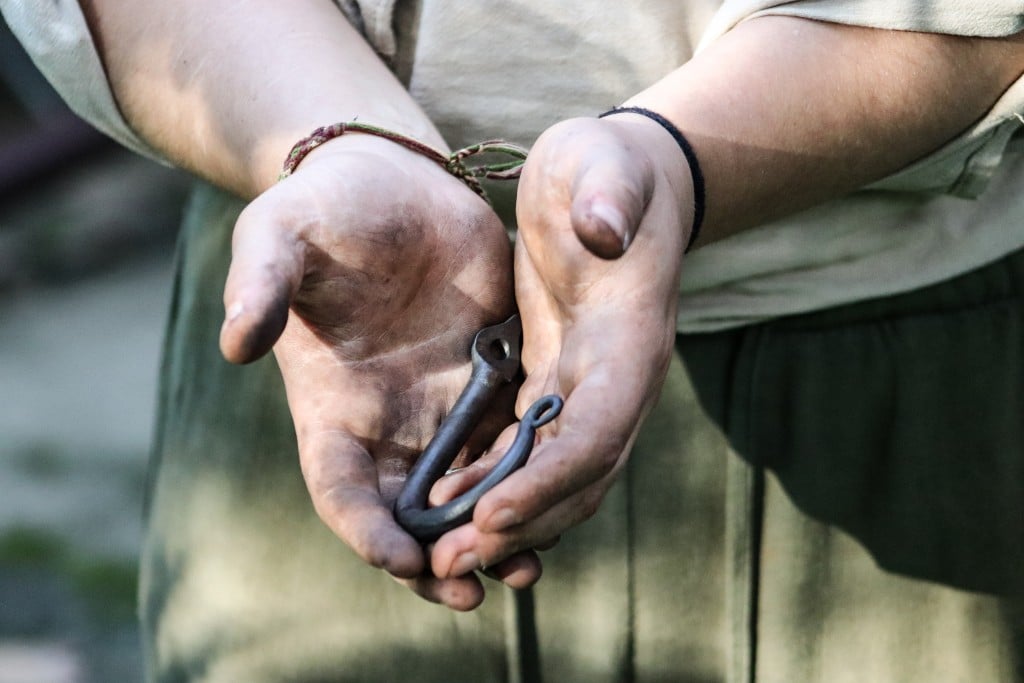
She has begun to sell her artistic metalwork on her Etsy. Her artwork suffuses organic patterns, like leaves and flowers, with metal, and can be useful, like a hook in the shape of a leaf.
The inspiration comes from growing up with woods in her backyard, she said.
“My dream project is a tree, with every branch, [every leaf and] the trunk twined together and fire-welded,” Solomon said. “Depending on how ambitious I get, making the leaves out of something like copper or bronze.”
Connected to the body
Solomon emphasized how smithing is a dying art. There are techniques described in history books that no blacksmith knows how to do anymore, like smelting wrought iron. Today, steel is more readily available. Iron, which is prized for artistic pieces, is resourced only through old metal objects, thanks to the modern steel industry deprecating the need for wrought iron in production.
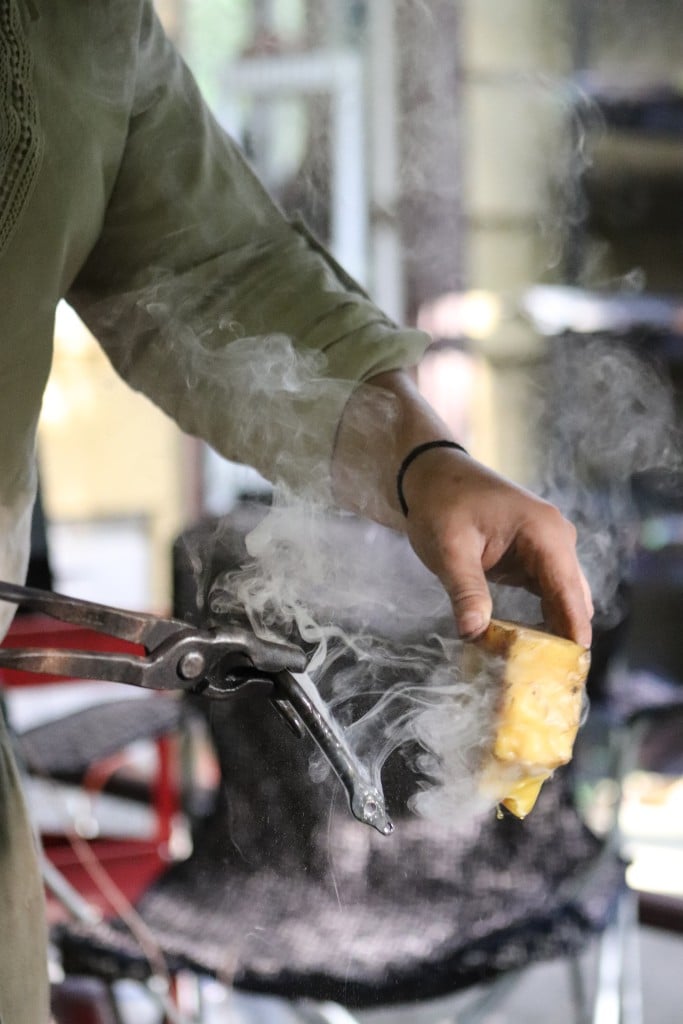
Though anvils are still produced today, they use steel instead of wrought iron and don’t quite have that distinctive “ding.” Handmade anvils, like Solomon’s from the 1800s, aren’t too hard to find in Ohio since the state was a hotspot for the coal and steel industry.
“If you’re out on the West Coast, you’re going to pay twice as much and find half as many,” she said. “Here, you just go to a barn sale, and their grandfather’s grandfather sat around the fire making nails all winter, so they’ve got an anvil sitting in the corner.”

Smithing is not just a creative outlet. The trade also connects Solomon to her body in a positive way.
Trans people are “a lot more aware of our bodies,” she said. That awareness is often negative, but the physically-demanding trade affirmed her body more as it transformed Solomon. She was proud of the muscle she was building, and the burn scars on her arms.
“That was, in particular, powerful, like getting my first burns during really important projects,” Solomon said with a smile. “I’ve never felt happy about a scar on my body [until then].”
She also was happy with how her forearm muscles and shoulders broadened from blacksmithing, not from male puberty.
“It feels like I’m allowed to have traits that would otherwise make me dysphoric, but they don’t because of how I got them,” she said.
Smithing is historically inclusive
Solomon’s trans identity has cultivated a love of community that learn and rely on one another, which also attracted her to blacksmithing, despite popular media representing the craft as hypermasculine until recently.
Historically, women have long worked in blacksmithing. Many roles had to be filled in a blacksmith’s shop, so anyone able-bodied in the family needed to work.
Today, most blacksmiths are men, but the community does not shut out women as long as they can “swing a hammer,” Solomon said.
“No one’s going to exclude someone from the community just for an identity point,” she said.
A chunk of the big names in the community have family lineages that go back centuries. Others have a head of the family that was trained by a famous blacksmith. But many don’t have a family connection at all.
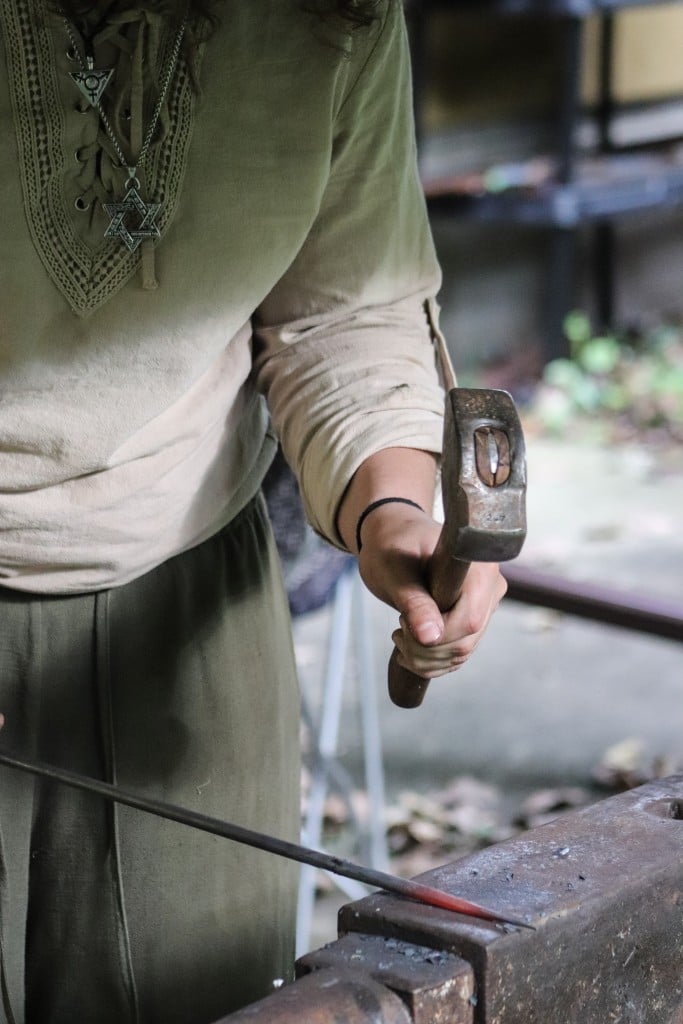
Solomon doesn’t have a family lineage, she said. Throughout the Middle Ages in Europe, Jews were prevented from becoming blacksmiths, aside from North Africa. As Judaism prizes passing heirlooms from generation to generation, Solomon hopes to pass down the tools she makes and uses down as well.
“Creating is probably the closest I get to spirituality,” she said.
Cultivating understanding
Out trans smiths are new to the community, but their presence is growing, Solomon said. In 2015, a trans blacksmith, Willow Zietman, wrote about her experiences in the smithing community for the LGBTQ+ online publication Autostraddle. Zietman also competed on TV in the reality game show “Forged in Fire” in 2023.
The convention has had influencers like Anvil Anna, a woman smith and farrier who has sported purple hair, who are “highly respected” members of the smithing community – many of whom are old white men, Solomon said. Another big name, Dave Custer, highlights his Christianity on his Instagram and is “thrilled any time he sees a girl compete,” she said.
Solomon thinks being out and trans in these spaces has cultivated more understanding, she said. Though members of her usual smithing group might vote conservative and “think they’re anti-trans people, until there’s one in their club.”
That intermingling between communities should happen more, she said.
“It’s a lot harder to be anti-trans people when you’re hanging out with one every week, ” Solomon said. “It’s the kind of community that feels like it should not be as accepting as it is.”
Alongside her dream project, Solomon would love to start a queer smithing group in Ohio to teach other LGBTQ+ folk. She also wants to eventually join a mentorship program offered by the Society of Inclusive Blacksmiths. The national organization has supported and highlighted historically underrepresented people in metalworking, including LGBTQ+ people, since 2011.
Solomon wants interested LGBTQ+ people to “come here and learn,” she said.
“This is absolutely a craft more people should get into,” she said. “It’s a dying art and a very meaningful and welcoming space, especially to queer folks.” 🔥
IGNITE ACTION
- Rose Solomon operates under Lavender Forge, which can be found on Instagram and Etsy.
- To learn more about the Society of Inclusive Blacksmiths, visit the organization’s website.
Know an LGBTQ+ Ohio story we should cover? TELL US!
Submit a story!
Author

Related Articles
Lesbian-owned campground in rural Ohio wants to be a connective community space for LGBTQ+ visitors and locals alike
‘We think it’s crazy that we’re doing this, but we love it.’
How the lack of LGBTQ+ storytelling in rural Ohio inspired a rising queer influencer
Gav Galvan amplifies queer history to help those like him who grew up without it.
First-time Prides in Ohio saw their hometowns in a new kaleidoscope of colors this year
‘We opened up a safe space for at least one person to attend.’
