
Dayton drag performers The Rubi Girls receive Ohio Historical Marker despite Trump’s funding cuts
The legendary drag troupe received an official historical marker as state lawmakers debate a public drag ban
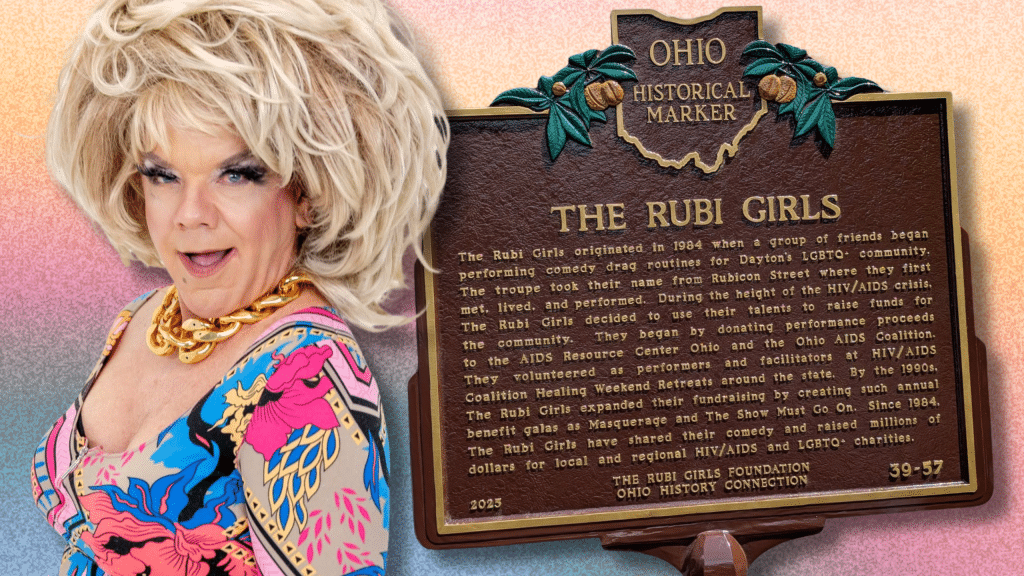
On May 3, members of iconic Dayton drag troupe The Rubi Girls accepted an official Ohio Historical Marker from the state historical society. The irony of the moment was not lost on the performers as state legislators are trying to outlaw public drag and gender performances.
Ohio History Connection (OHC) unveiled the marker outside the Rubi Clubhouse in Dayton’s South Park neighborhood.
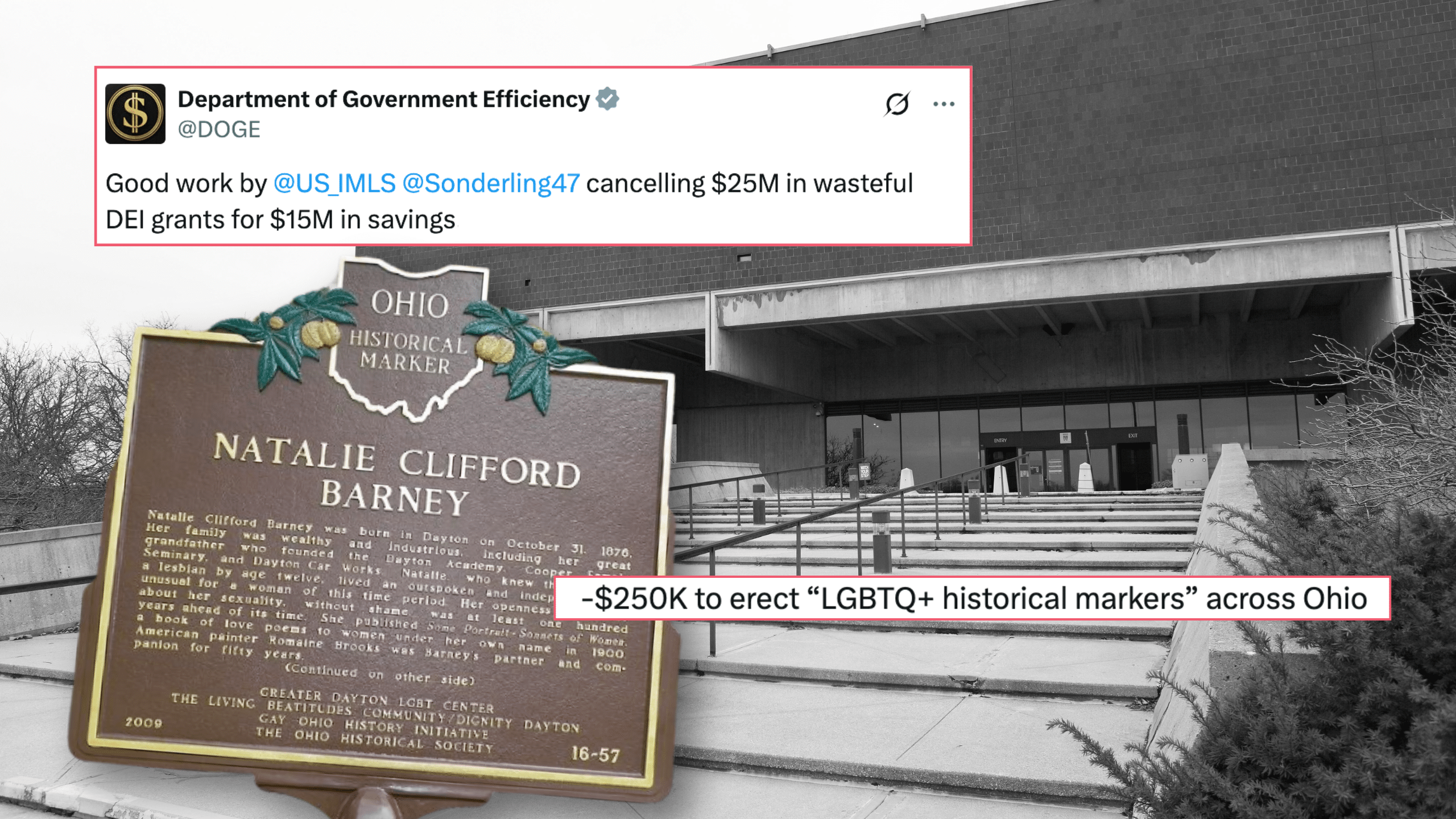
The marker – which honors the nonprofit troupe’s $4 million in fundraising contributions to local and regional HIV/AIDS and LGBTQ+ organizations across the Miami Valley and beyond – was one of 10 LGBTQ+-related markers that had its funding terminated last year by the Trump administration. But the marker came to fruition anyway thanks to lucky timing, said Tim Farquhar, a Rubi Girls founding member.
“Ours was the last marker up for consideration before [the Trump administration] stopped funding for diversity, equity, and inclusion markers,” Farquhar said. “We were able to push it through.”

Farquhar, who performs in drag as Fonda Peter, called the historical marker an “extreme honor for the Rubi Girls … But it comes at such a critical time in our state’s history, as officials in the state of Ohio are trying to ban drag in many public places and honestly attack the transgender community.”
State lawmakers are in the midst of debating Ohio House Bill (HB) 249 – which would ban drag and gender performances in most public spaces.
“We’re raised millions for our community,” Farquhar added. “And they’re trying to ban the thing we’re doing to raise that money.”
Rubi Girls Executive Director Josh Stucky said the marker symbolizes the troupe’s story of joy, community and resilience in the face of adversity and anti-LGBTQ+ sentiment.
“The marker represents those folks who touched our lives, yet lost their battle to HIV/AIDS, [and] the voices and faces of the hundreds of charities we have supported over the last 42 years,” Stucky told The Buckeye Flame. “That should be the story in the Ohio [Statehouse], not the one they have chosen to spew!”
The Rubi Girls are born
The four founding Rubi Girls first performed for friends in the attic of a rented condo on Rubicon Street in 1984.
“We never really started off this whole situation to be philanthropic, or to do something good for the community,” Farquhar said “It started off because none of us had any money. We were college students and we wanted something fun to do.
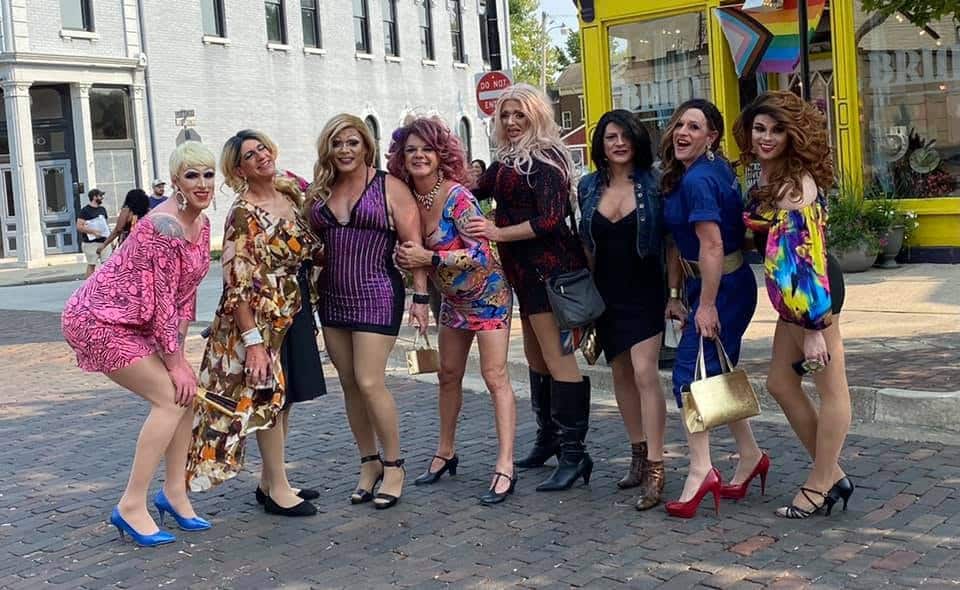
“There were four roommates. One of them went down to the Halloween party as Jolene the cowgirl and came home. We’re like, ‘Who are you?’ And he’s like, ‘I’m Jolene the Cowgirl!” Farquhar said.
“Two weeks later, because we were broke, Josh said, ‘Go upstairs and put on bed sheets and bath towels and act like we’re in a drag. We’re gonna start doing lip sync.’”
“We did it as something fun, and it grew and it grew, and next thing you know there’s 20 people sitting in your living room,” Farquhar added. “Now you’ve gone to the thrift store to pick up some clothes instead of bed sheets and bath towels. Eventually, we got to the point where we went and bought wigs and then we started using makeup.”
Ultimately, as the AIDS crisis ravaged LGBTQ+ communities across the country, the founding Rubi Girls decided to funnel the money they earned as drag performers back into Dayton’s LGBTQ+ communities.
Ohio Historical Marker: The girls make herstory
In April 2025, the Trump administration’s Department of Government Efficiency (DOGE) rescinded a $250,000 grant to create 10 new LGBTQ+ Ohio Historical Markers across the state.
Since 1950, OHC has installed over 1,750 historical markers across the state, partnering with historical societies, local history groups and local governments to help tell the state’s history as written by its communities.
In order to qualify for the marker, the Rubi Girls underwent five years of info gathering, archival research from historians and archivists with OHC. The group also secured sponsors to cover the cost of the marker’s installation and maintenance, along with several other necessary upgrades, like installing security cameras at Wayne Avenue clubhouse where the group rehearses.
Stucky said the marker not only commemorates the Rubi Girls’ financial contributions to the Miami Valley area, but also the ongoing experience of “sisterhood” between the Rubi Girls themselves – particularly as lawmakers attempt to ban public drag and gender performance altogether.
Ohio’s public drag ban
If passed, HB 249 “The Enact the Indecent Exposure Modernization Act” would ban drag and gender performances outside of “adult cabaret” venues or in any public venue where a minor may be present.
The bill’s primary sponsor, conservative Christian Rep. Josh Williams (R-Sylvania Township), has falsely accused LGBTQ+ Ohioans of sexual grooming and pedophilia as a group.
“We’re not grooming your child,” is Farquhar’s response..“You can’t groom a child in a seven-minute Donna Summer song. Trust me, you cannot do that.”
“They are claiming that they are trying to protect children, but it has nothing to do with protecting children,” he said. “If you really wanted to protect children, when religious figures were molesting children, you would’ve stepped up. When children are being shot in schools, you would’ve stepped up.”
Farquhar said the bill could disrupt the troupe’s performances and overall fundraising efforts by making it more difficult for them to move between venues while in drag.
“We get ready at our clubhouse. We actually have an old van that was donated to us for free, and [the exterior] is plastered with hundreds of pictures of us in drag. That’s what we drive to our events when we go to a show or go do a fundraiser,” he said. “Being seen in drag in public could be a felony based on the age of the child or if there’s [a child present].”
‘We gave from our heart’
Despite an ongoing spike in anti-LGBTQ+ legislation and sentiment, Farquhar said he’s proud the Rubi Girls have donated to many types of nonprofits with different missions.
“We give to organizations for housing. We give to organizations for food. We give to organizations for pets. We donate to the arts. We donated to over 100 different organizations last year,” Farquhar said.
“When you walk by that marker, I want you to know that when we gave an organization money, we know that their principles and their core values align with ours,” he said. “But sometimes some of the people who are receiving the benefits of that money might not feel the same way that we do or have the same social outlook.”
“That’s okay,” he added. “We gave from our heart, and we gave to everyone who needed it. That’s what’s important to me.” 🔥
Ignite Action
- To learn more about The Rubi Girls, or to find them at upcoming events and performances, click here.
- If you are a young LGBTQ+ person in crisis, please contact the Trevor Project: 866-4-U-Trevor.
- If you are an transgender adult in need of immediate help, contact the National Trans Lifeline: 877-565-8860
Know an LGBTQ+ Ohio story we should cover? TELL US!
Submit a story!
Author

Related Articles
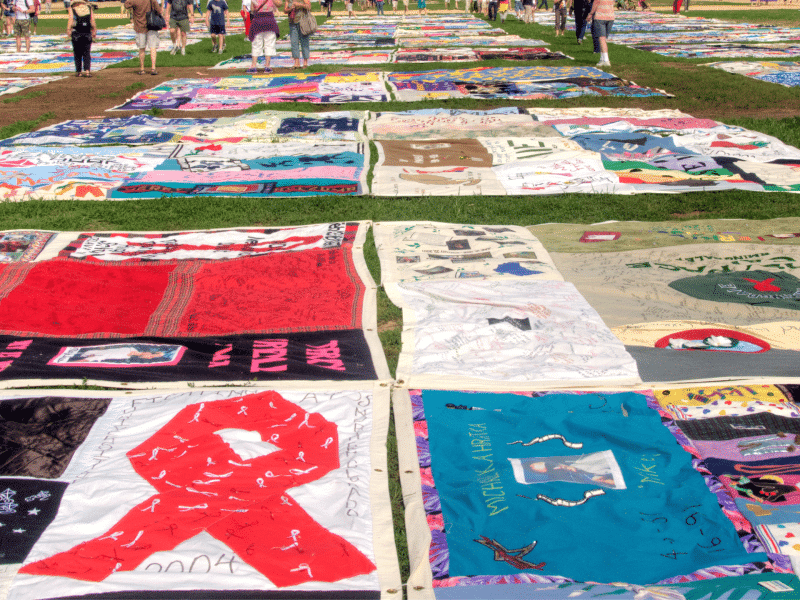
Six AIDS Memorial Quilt panels arrive in Dayton for ‘Wall Power’ exhibit
The panels are a powerful addition to the Art Institute’s ‘Spectacular Quilts’ show
Pump The Beat!: Ohio’s ballroom scene as a queer community haven
For many people in the scene, ballroom is the foundation for their social and personal lives, and keeps many folx healthy, happy and safe.
How the lack of LGBTQ+ storytelling in rural Ohio inspired a rising queer influencer
Gav Galvan amplifies queer history to help those like him who grew up without it.

Comments (1)
Comments are closed.