
A Gospel of Their Own: How BIPOC LGBTQ+ Ohioans are navigating faith spaces
The church can be a source of deep pain, while the faith, music and spiritual traditions formed there can remain deeply meaningful.
This year, when the gospel hit “Melodies From Heaven” began playing at Cleveland Pride’s SpeakOut stage, Sahara, one of the MCs, watched the crowd transform.
Minutes earlier, the crowd had been throwing itself into the joy of twerking and voguing, then suddenly, that same energy took another form: People paused in memory, voices rising together as they sang. The joy hadn’t disappeared; it had shifted, from movement and celebration to something that was also communal, yet spiritual and deeply familiar.
Sahara had planned ahead for that moment and hoped for that joy.
She had been cleaning her house streaming music when the gospel standard “Revelation 19:1” came on. She thought gospel music might be a wise choice for Pride this year, but maybe not that song so after some consideration she asked Siri to play Kirk Franklin’s “Melodies From Heaven,” the song Black folks affectionately renamed “Rain Down on Me.”
As she listened, she thought, “This is gonna do what it needs to.”
Sahara says she feared the reception of the song choice at Pride, but that fear was quickly eased as the crowd immersed itself in the experience Sahara had lovingly curated.
“It was healing to see people singing and praising with their whole chests,” Sahara said.
“It was a reset in a world of chaos,” she said. “In that moment nothing mattered, just us, just the moment.”
The scene offered a contradiction that is familiar to many LGBTQIA+ people of color: The church can be a source of deep pain, while the faith, music and spiritual traditions formed there can remain deeply meaningful.
A complicated history with church
Sahara grew up knowing church. She also grew up hearing that being gay was a sin and wondering whether God might change her. At one point as a teenager, she listened to Kirk Franklin’s “Smile,” crying in her car and hating herself for who she was. She explains how growing up, your autonomy can be tested. In her case, one way of being tested was being forced to go to church. Then her senior year of high school, she stopped attending.
That wasn’t Sahara’s last experience in a religious institution.
After transitioning, she eventually found a church she enjoyed attending with her then-husband. But when the pastor preached negatively about transgender women in sports and bathrooms, Sahara, a proud transgender woman, stood up and left. Her ex-husband and best friend followed.
She has not returned to church since, except for funerals or baptisms/christenings.
Faith after the hurt
“Now I have church at home,” she explains. “I pray and have faith at home.”
Part of that faith was given to her by her grandmother, a little Puerto Rican Catholic Christian woman who, Sahara said, always prayed for her safety, never for her to change. When Sahara thinks about faith, she thinks about what her grandmother taught her: that God is real.
That relationship has remained even when her relationship with the church has not. Gospel music can bring her back to her grandmother. Prayer can happen at home. Worship can happen at Pride, surrounded by people who may carry their own complicated histories with the church.
That may help explain why religious connection remains so persistent among queer people of color, worship and praise has no true designated time and place. Williams Institute research found that 46.5% of Black LGBTQ+ people raised Christian remained Christian, compared with 22.3% of white LGBTQ+ people.
When leaving doesn’t mean leaving God
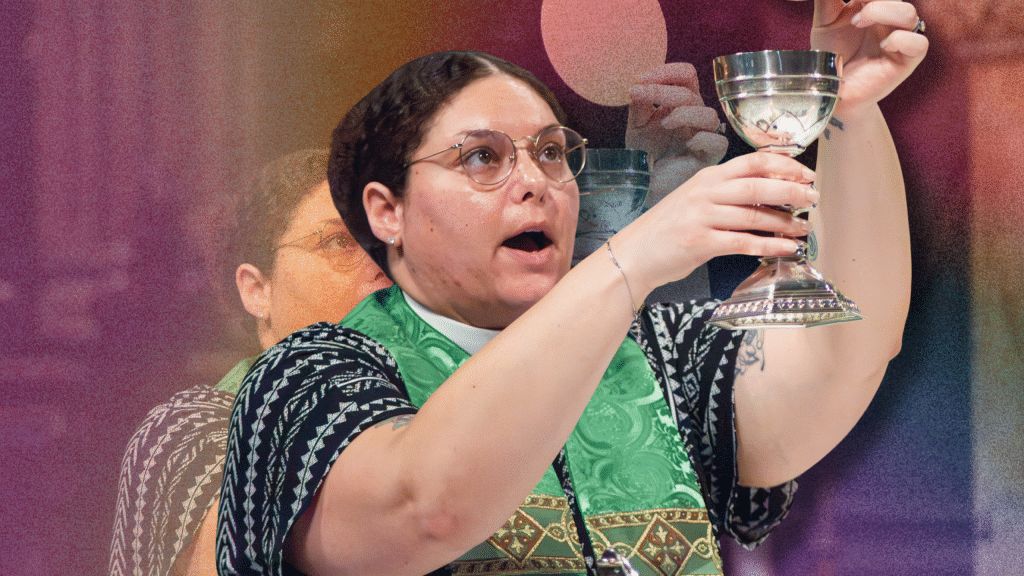
For the Rev. Megan Allen-Miller, who serves as priest associate for Community Outreach and Pastoral Care at Trinity Cathedral Episcopal Church in Cleveland, the distinction between leaving church and leaving faith is an important one.
“I don’t believe most people leave because they’ve lost faith or don’t care about a relationship with God,” Rev. Allen-Miller said. “I think many leave because they’ve lost trust in institutions that failed to reflect the love of the God they still long to know.”
For LGBTQ+ people of color, Rev. Allen-Miller said, that loss of trust can be compounded by racism within religious spaces and discrimination within LGBTQ+ spaces. People can find themselves navigating multiple identities in communities that ask them to separate one part of themselves from another.
“Too many have been asked to choose between their faith and their identity, between belonging to the church and being honest about who they are,” she said. “And no one should have to make that choice.”
Leaving, then, can be complicated. Churches are often tied to family, culture, traditions and support systems. Walking away from a church can mean walking away from much more than Sunday worship.
“As painful as it can be to stay, it can be equally as painful to leave,” Rev. Allen-Miller said.
And leaving the building does not necessarily mean leaving the wounds behind.
Rev. Allen-Miller has seen people carry shame, anxiety, grief and spiritual displacement for years after leaving faith communities. For some, the harm comes from what she calls “bad theology,” or religious interpretations that have turned scripture into a source of rejection.
Healing can take many forms. Some people turn to therapy or spiritual direction. Others rebuild trust through new relationships or begin deconstructing and reconstructing their faith, asking not for absolute certainty but, as Rev. Allen-Miller put it, “What do I personally believe, and how does that inform and impact my life?”
Healing is not a practice we all approach the same, she said. Healing may mean rediscovering a prayer or gospel song that once carried meaning, but hearing it differently. It may mean stepping away from church for a season or permanently.
“The hope shouldn’t be that people who were harmed by the church come back,” Rev. Allen-Miller said. “It should be that they find their way back to their truest self and experience a flourishing life in whatever way that looks for them.”
Still, some people do return.
Finding a way back, on different terms
“A short pithy answer to what has changed is, most often, they have,” Rev. Allen-Miller said.
She says people who return have often already begun questioning and reconstructing their faith. With social media and greater access to information, they can research churches before walking through the doors and look for evidence of accountability rather than simply accepting claims of inclusion.
They may not be looking for a perfect church. They are looking for one where they can ask hard questions, have their gifts celebrated and experience belonging without having to earn it.
“When those things are experienced, people often discover something that was true all along,” Rev. Allen-Miller said. “They never had to choose between God and who they are.”
For some queer people, staying can also be a form of resistance.Rev. Allen- Miller described it as “faithful protest”: remaining engaged because a relationship with God still matters, even when the institution surrounding that relationship does not.
That protest, however, cannot be carried only by the people who have been harmed.
Rev. Allen-Miller said churches must acknowledge what they have done, listen without defensiveness and make tangible changes. Repentance, she said, is not only an individual practice.
“It’s not about just saying, ‘I’m sorry,’” she said. “It’s about saying, ‘I’m sorry, how can I/we make this right?’ And then actually living into different choices moving forward.”
At the cathedral, a queer colleague of Rev. Allen-Miller’s has partnered with the LGBTQ Center of Greater Cleveland to lead “church-hurt” support groups where people harmed by faith communities can share their experiences and find support. Miller also said queer clergy in her diocese began gathering regularly about two years ago to build relationships and support one another as the social climate became harsher and more judgmental toward BIPOC and LGBTQ+ communities.
The BOPOC LGBTQ+ presence, she said, is itself a form of “faithful protest” within the church: refusing to allow past and present harm to be ignored.
Creating spiritual safety requires more than declaring that “all are welcome.” Miller believes churches must listen to people’s stories, share leadership and make inclusion visible in worship, ministries and decision-making. For BIPOC LGBTQ+ people that also means recognizing that race, sexuality, gender, culture and faith cannot always be separated into neat categories.
A spiritually healthy church, she said, does not ask people to leave parts of themselves at the door.
Reclaiming what was never theirs to take
Sahara has arrived at a similar conclusion outside the walls of a church.
“We know church before we know words,” she said. “We can recognize a hymn before we can say our own name.”
At Pride, gospel became a way for Sahara and others to reclaim something that had never belonged exclusively to an institution. Faith could exist in a living room, around a table, in a car, at Pride or in the middle of a celebration. It could be practiced without surrendering the parts of themselves they had fought to keep.
“Faith is not one-size-fits-all, and praise and worship cannot be fit into one size box,” Sahara said. “Do what works for you and what makes you feel closer to God.”
Miller finds hope in people who refuse to let religious trauma determine their worth or the rest of their lives.
She sees BIPOC LGBTQ+ Christians living their faith with courage; young and older queer people demanding space; and congregations willing to listen, repent and grow.
“The church has always been shaped by people who challenged it to live more fully into the Gospel,” Miller said. “I believe that’s happening today.” 🔥
Know an LGBTQ+ Ohio story we should cover? TELL US!
Submit a story!
Author

Related Articles
Black, Out, and Proud to host Melanated Health Forum centering Black LGBTQ+ health and wellness
Melanated Health Forum makes room for uncensored wellness conversations for Black LGBTQ+ people in Columbus
Pump The Beat!: Ohio’s ballroom scene as a queer community haven
For many people in the scene, ballroom is the foundation for their social and personal lives, and keeps many folx healthy, happy and safe.
Black Poets Fest in Columbus builds a home for Black artists – LGBTQ+ definitely included.
‘This space belongs to us, without confusion or apology.’
