
Appeals court hears arguments from Ohio teacher suspended for having books with LGBTQ+ characters in her classroom
New Richmond teacher Karen Cahall’s case started nearly two years ago
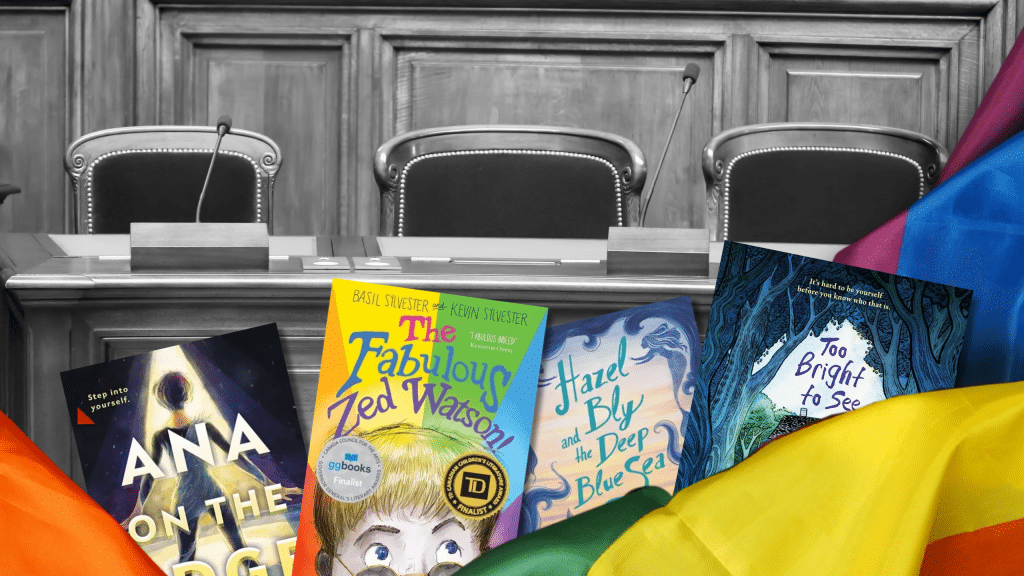
Nearly two years after an Ohio third grade math and science teacher was suspended for having books with LGBTQ+ characters in her classroom, her case against her school district has reached a federal appeals court.
Karen Cahall was suspended for three days without pay in November 2024 for having the books “Ana on the Edge,” “The Fabulous Zed Watson,” “Hazel Bly and the Deep Blue Sea” and “Too Bright to See” in her classroom reading bins.
A parent alerted the superintendent of New Richmond Exempted Village School District about the books in an email. The district then decided that Cahall violated its “controversial issues” policy by making the books available to students without a principal’s prior review. The district then threatened Cahall with further action—including termination—if she continued to house those books in her classroom.
Cahall, a teacher in the district for more than 30 years, filed a lawsuit against the district challenging her suspension.
Last year, U.S. District Court Judge Douglas Cole dismissed Cahall’s lawsuit. He argued that Cahall must have known the books were controversial because they were placed in the bins after teachers were banned from displaying LGBTQ+ flags, stickers and pins.
Cahall then appealed to the U.S. Sixth Circuit Court of Appeals. Three U.S. Sixth Circuit judges listened to lawyers for Cahall and the school district give their oral arguments on Oct. 22.
‘What’s controversial to one person is not necessarily controversial to somebody else’
Cahall’s counsel, Mark Herron, argued that the word “controversial” is too vague for teachers to understand, “invites viewpoint bias” and the district acted without due process.
“What’s controversial to one person is not necessarily controversial to somebody else,” Herron said.

Cahall told The Buckeye Flame two years ago that she knew the books were controversial “to some people.” Herron, however, emphasized that the four LGBTQ+ books were placed in among “a hundred other books in multiple bins in her classroom”
And in an era where science is not taken seriously and evidence is constantly questioned, Herron said the word “controversial” can be used to describe almost any dispute these days. The way that the district uses the word was targeted at Cahall for supporting LGBTQ+ causes, he said.
“You have a policy that is being used in this case [as] a sword against Cahall to silence, maybe, an unpopular opinion with segments of the community,” Herron said.
Herron argued the books were not instructional since they were only made available by the teacher passively – Cahall didn’t encourage students to read books with LGTBQ+ characters.
Herron further argued that the district has failed to define the word “controversial.”
“I draw a parallel to what Justice Stewart said, ‘I know it when I see it,’ but that just is not a workable standard under this type of policy,” said Herron.

District argues that ‘reasonable licensed teachers’ would understand the policy
The school district’s counsel, Tabitha Justice, argued otherwise. The books counted as “resource materials” according to the district’s administrative guideline 2520A titled “Selection of Instructional Materials and Equipment.”
Since the policy’s title uses the word “instructional,” she said a “reasonable licensed teacher” would understand that everything under that policy – which would include Cahall’s books – are “potentially instructional materials.”
“ The title says instructional use, but the policy is actually directed towards the selection of resource materials for students,” Justice said. “A reasonable licensed teacher in the state of Ohio understands and knows that any materials you bring into the classroom are potentially instructional materials.”
Justice argued that the “controversial issues” policy was not “unconstitutionally vague” because it included a process for teachers to follow, didn’t ban materials outright and attempted to define “controversial.” The district defines the word as “ a topic on which opposing points of view have been promulgated by responsible opinion or are likely to arouse both support and opposition in the community.”
The case is currently awaiting a decision from the panel, but no date has yet been set.
Last April, Cahall founded a nonprofit called the Rainbow Classroom Advocacy Fund to directly support teachers, parents and students uplifting LGBTQ+ inclusion in education.
According to Courthouse News Service, U.S. Circuit Judges Joan Larsen, Julia Gibbons and Kevin Ritz sat on the panel. The judges were appointed by presidents Donald Trump, George W. Bush and Joe Biden, respectively. 🔥
IGNITE ACTION
- To learn more about the Rainbow Classroom Advocacy Fund, visit its website here.
- To learn more about GLSEN’s Rainbow Library program, click here.
- To access Kaleidoscope Youth Center’s list of GSA groups across Ohio, click here.
Know an LGBTQ+ Ohio story we should cover? TELL US!
Submit a story!
Author

Related Articles

Booked Solid: You’re overdue to meet these LGBTQ+ BIPOC librarians doing the work in Ohio
LGBTQ+ BIPOC librarians are helping communities find stories, resources and histories that matter across the state.
Ohio gets a failing mark on sex education policy from national group
Ohio’s curriculum stresses abstinence as a general policy and requires only some instruction about sexually transmitted infections.
How one Ohio college class assembled a city’s untold LGBTQ+ history
Akron didn’t have a central collection of LGBTQ+ history. Two professors and a cadre of students are changing that.
