
How one Ohio college class assembled a city’s untold LGBTQ+ history
Akron didn’t have a central collection of LGBTQ+ history. Two professors and a cadre of students are changing that.
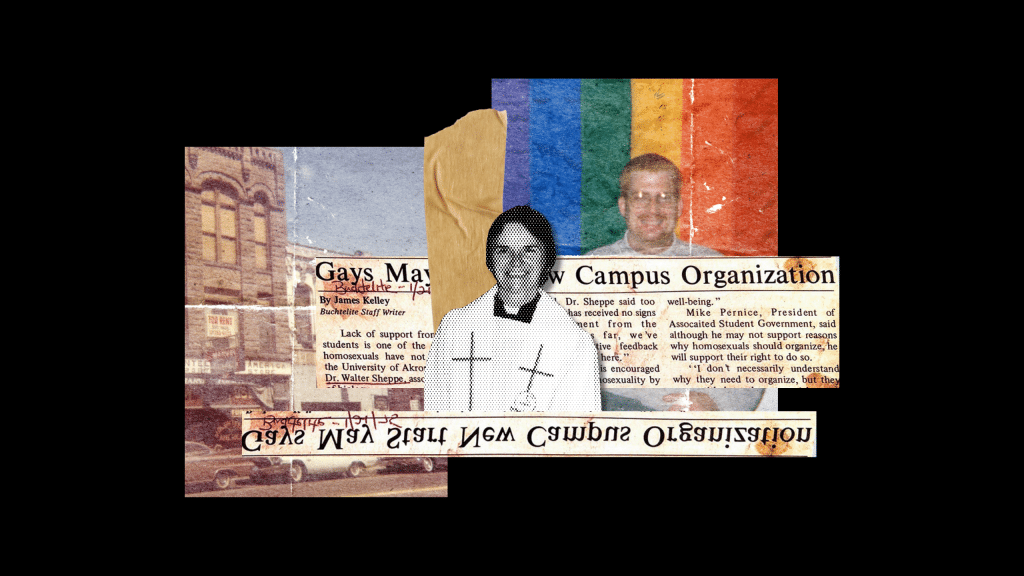
When it comes to documenting Ohio’s LGBTQ+ history, the “big C” cities of Cincinnati, Cleveland and Columbus have made great strides, with local queer history housed in spaces like the Ohio Lesbian Archives, the GOHI Project and the Western Reserve Historical Society.
Outside of the those cities? LGBTQ+ history has largely gone uncollected. Including in Akron.
“Akron just doesn’t have a central collection of LGBTQ+ history,” said Tony Pankuch, education and outreach coordinator at the Cummings Center for the History of Psychology, a museum and archive at the University of Akron.
Akron’s lack of an LGBTQ+ archive is a deeply personal matter to Pankuch. As a former University of Akron history major who came out when they were an undergrad, Pankuch sought out LGBTQ+ history to help them construct who they were as a person and feel less alone.
“Accessing our history can help LGBTQ+ individuals connect with ancestors who were effectively having the same experiences and feelings,” Pankuch said. “And it can be especially important to have ancestors who are local, to know that you aren’t the first generation in your particular state or region or city who is experiencing this identity.”
Pankuch wanted LGBTQ+ Akronites to have their own history archive so that they could feel more grounded in the local community and know that their “roots in the city go just as deep as the rubber industry or anything else that Akron is known for.”
The problem was figuring out how to pull off collecting that history all in one place.
[UN]Classing things up
In 2024, Pankuch brought the dilemma a few doors down on campus to Hillary Nunn, a professor in the English department.
For years, Nunn had been teaching “[Un]Classes,” hands-on, problem-centered, community-engaged courses that bring together a team of students, faculty, and community partners to examine, question and problem-solve across disciplines.
Nunn warns – and empowers – students in the syllabus of an [Un]Class that rather than following a tightly prescribed syllabus, students “should expect an [Un]Class course to change and respond as the team examines and attempts to problem-solve on their topic of focus.”
Pankuch thought the [Un]Class format would be perfect to explore creating an Akron LGBTQ+ archive. Nunn agreed.

“I was teaching another [Un]Class on local history about Howard Street [a center for Black life in Akron] and students gravitated toward questions of LGBTQ+ history in that particular context,” Nunn said. “That helped us realize there was indeed a problem to be solved here.”
In Fall 2024, Nunn and Pankuch offered “Digital Humanities in the Archives: ‘Out’ of the Archives: Exploring Akron’s LGBTQ+ History.”
Seventeen students enrolled in a semester that Pankuch described as a “smashing success.”
Students took the class for a variety of reasons: some drawn in by the promise of a nontraditional classroom experience, some signing up due to their love of history and some for more personal reasons.
“A few of the students were actually in the LGBTQ+ community and wanted to know about things that came before them, especially when they are living through a time where they’re feeling like there are more [anti-LGBTQ+ legislative] restrictions being placed on them than just a few years ago,” Nunn said.
During the semester, students broke up into groups to research different LGBTQ+ history topics determined by the class: bars and nightlife, trans history, LGBTQ+ history on campus, LGBTQ+ Akron landmarks and other non-bar social spaces.
They then spent the semester researching and compiling LGBTQ+ Akron history: working with the Akron Public Library collections, scouring the internet, learning how to use archival newspaper databases, and being guided by guest speakers with special knowledge of local history.
Roadblocks to research
While there were myriad moments of elation throughout the semester whenever the students discovered a new piece of history, they did encounter some challenges along the way.
First was determining what actually constituted Akron: What were the geographic boundaries of the research?
“We were always trying to figure out what sorts of interplay there was between Akron and Cleveland, Akron and Kent, Akron and Canton,” Nunn said. “I’m not sure we ever were able to definitively answer that question.”
There were also logistical issues students had to overcome.
“These students have ingrained habits of looking online and finding an answer quickly,” said Nunn. “So having to structure their research time to go to the library, locate materials and make their way through paper copies was a challenge to them.”
The search process itself required some adjustment for the students as they had to learn outdated terminology to find the history they were seeking, like searching for “female impersonator” to find examples of drag.
“They had to read against the grain of historical documents,” said Nunn. “Somtimes they literally had to type in what would now be considered slurs in order to find comprehensive coverage of the LGBTQ+ community.”
When they did find examples of LGBTQ+ history, the subjects were often white.
“They definitely struggled to find materials that had people of color in them, as there just weren’t always a lot of examples of out people of color in the clippings,” said Panuch.
Finally, the students had to overcome their own fears of interacting with other humans. While they proved adept at locating materials in the library, speaking to actual community members proved a more formidable task.
“We tried to encourage students to talk to people in the community, but they were a little shy and reluctant and clearly more comfortable in the archives,” said Nunn.
A Very Special Gathering
By the end of the semester, the students had created a website to house all of their found LGBTQ+ Akron history, to complement the collection housed at the The University of Akron’s Archives & Special Collections.
Students also worked through their shyness and reluctance to create an opportunity to present some of their findings at Cocktails Akron, a local gay bar.
“That event warmed my heart,” said Pankuch. “We had a really great turnout, including people who showed up not knowing what they were about to get into but were just early for a drag show that was happening an hour after [our] event.”
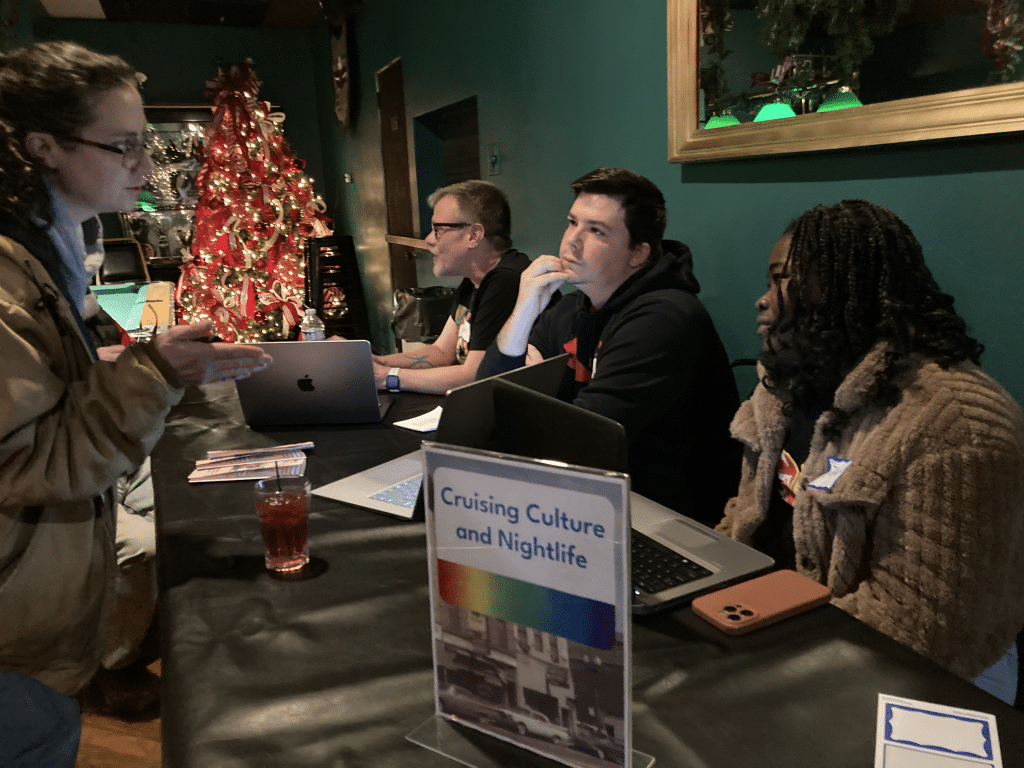
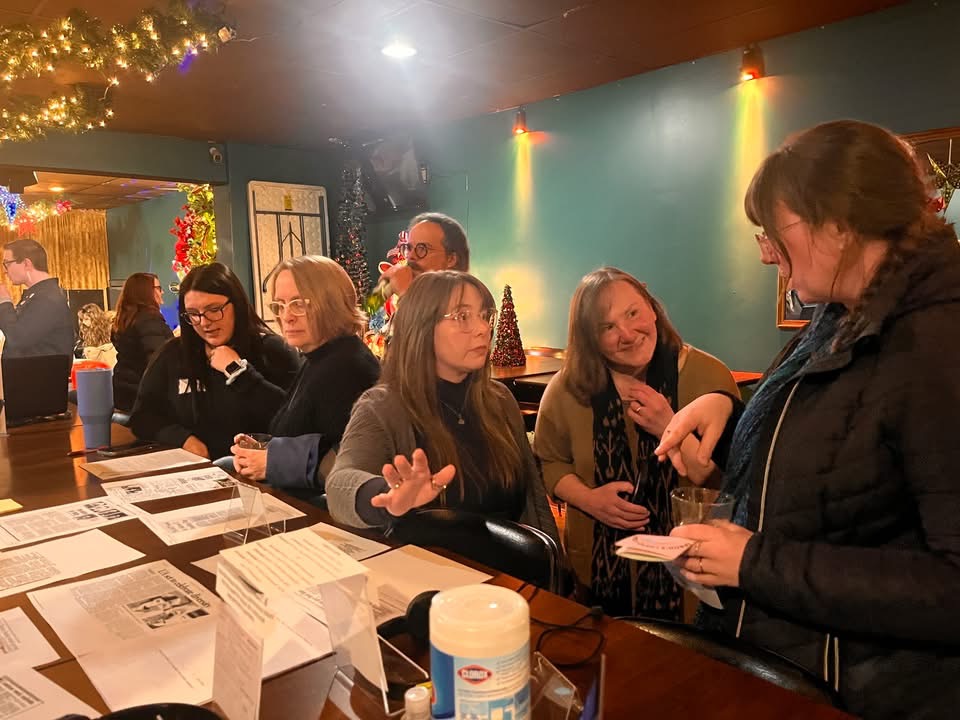
Students covered the tables with scans of historical documents they secured and engaged the attendees in dialogue with the Akron LGBTQ+ history they uncovered. In return, the patrons shared the Akron LGBTQ+ history they experienced firsthand.
Elders relayed the harrowing experience of living through the pinnacle of the AIDS crisis and shared that back then, too, they were playing with gender–which came a surprise to some of the students.
The event was transformative. Professors said the students were overwhelmed by how much their work mattered to the attendees. The students also realized the value of actually talking to people.
“Their reactions were what spurred us to move on to the next next step and think about how to continue this work after the semester ended,” said Nunn.
Collecting voices
Soon after the course ended, Pankuch and Nunn were approached by the university’s Office of Development with the opportunity to apply for a grant from Akron’s Gay Community Endowment Fund (GCEF).
“That jumpstarted us to build something solid that will last,” Pankuch said.
In April 2025, they received a GCEF grant to continue the work by adding an oral history project: conducting as many interviews as possible to build an archive of voices speaking on Akron’s LGBTQ+ history.
They have hired and trained a group of 6 students and recent graduates to conduct the interviews. To date, they have recorded 19 interviews of their target goal of 25 and are hoping to launch the collection – including full transcripts of the interviews – for history seekers to access on their website sometime during this fall 2026 semester.
The interviewers have encountered some of the same challenges that arose in the [Un]Class, namely locating the experiences of LGBTQ+ Akronites of color. But they are determined to keep conducting outreach and exploring connections to build the most diverse array of voices possible.
They have also had to navigate the unexpected but welcome problem of some interviewees seemingly with no end to their trove of stories.
“One of the interviews was six hours,” Nunn laughed. “Sometimes people just love telling stories, and they will just tell you every story they have. It’s delightful when it happens.”
After the oral history project launches, Pankuch and Nunn will measure success both by the number of individuals accessing the interviews as well as how the interviews are actually used by the local community.
They have been conducting outreach at various events – Pride celebrations, LGBTQ+ gatherings and tabling at local LGBTQ+ establishments – and have made a point of centering the conversations at those tables on stories of Akron’s LGBTQ+ history. They are hopeful that the website will help even more people realize that the Rubber City has as much of an LGBTQ+ story as Ohio’s big C cities.
“We want to make sure that everyone walks away with some knowledge that LGBTQ+ history really does exist here in Akron and it is truly worth remembering,” Pankuch said. 🔥
This work was supported by the Gay Community Endowment Fund of the Akron Community Foundation.
IGNITE ACTION
- Contact the Akron LGBTQ+ Archive at LGBTQarchive@uakron.edu if you have stories, photos, documents, or other materials related to Akron’s LGBTQ+ history.
- The Akron LGBTQ+ Archive will be hosting an Open House on Sunday, September 13, from Noon-2:30pm at the Akron-Summit County Public Library, Main Branch (60 S High St, Akron, OH 44326), Meeting Rooms 1 & 2.
- Visit the Akron LGBTQ+ Archive website here.
Know an LGBTQ+ Ohio story we should cover? TELL US!
Submit a story!
Author

Related Articles

WE’RE HIRING! – The Buckeye Flame is seeking a Development Director
This position is pivotal to the growth and sustainability of our vital, scrappy queer newsroom and plays a key role in shaping our future.
Queer Craft Society helps LGBTQ+ Columbus through loneliness epidemic via crafting kinship
While crafting is far from a new hobby and is often passed down through generations in marginalized communities, a current wave of craft meetups is on the rise.
Ohio LGBTQ+ Performance Opportunity Guide
LGBTQ+ individuals not only need space to gather, but also need opportunities to express themselves!
