
How an Ohio vending machine has become a harm-reduction lifeline
Caracole in Cincinnati introduced the machines in Ohio as an always-open, judgment-free doorway to connection, care and education.
By Suzanne Bachmeyer, director of prevention, and Leah Majesky, prevention supervisor, Caracole
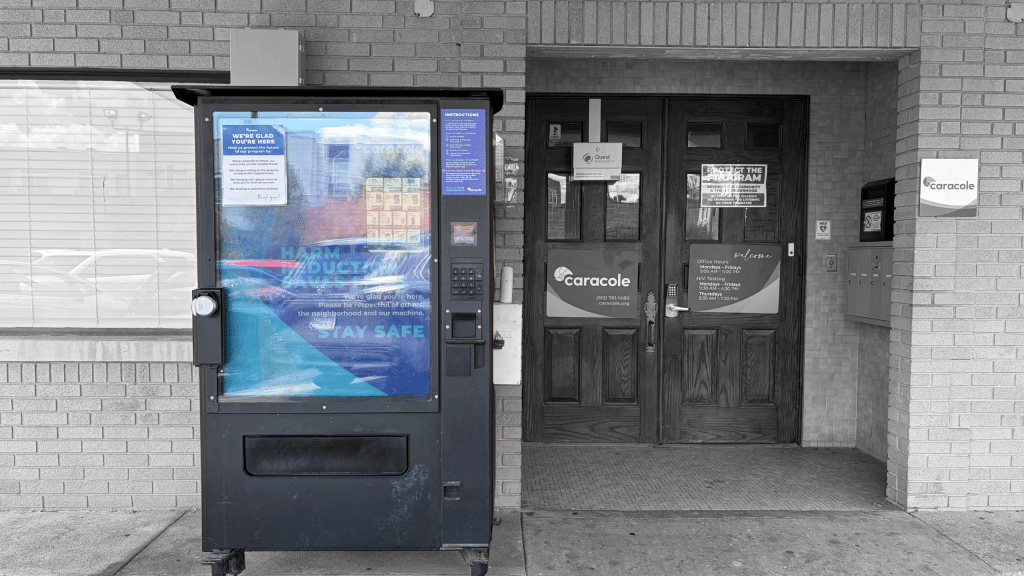
In March 2021, at the height of the COVID-19 pandemic, a vending machine appeared outside Caracole’s Northside office in Cincinnati.
It looked like any other vending machine, but instead of snacks or soda, it quietly dispensed lifesaving supplies: naloxone to reverse overdoses, fentanyl test strips, safer-injection and safer-smoking kits, condoms and pregnancy tests. All free, and all with a low barrier to access.
This harm-reduction vending machine was the first of its kind in Ohio and one of the first in the United States. For people who use drugs – especially those navigating stigma, criminalization, transportation barriers and marginalization – this machine became an always-open, judgment-free doorway to connection, care and education.
What began as a pandemic-era experiment supported by innovative funders has since become a nationally recognized model for evidence-based public health. Today, harm-reduction vending machines are saving lives across the country. But that progress is now under threat from funding cuts to lifesaving programs.
A global idea, localized for Cincinnati
Harm-reduction vending machines were not born in the United States. The concept had already been proven in countries including Denmark, Austria, France, Germany, Italy, the Netherlands, and Switzerland, where research has shown they complement in-person syringe service programs and help reduce the transmission of infectious diseases like HIV. To date, there have been no findings of adverse community impact related to harm-reduction vending machines.
In early 2021, Caracole—with support from the Interact for Health foundation—brought the idea home to Cincinnati.
Launching during a crisis
The timing was urgent. COVID-19 had disrupted many in-person services, as overdoses and new HIV diagnoses surged to record highs. The machine offered a fully contactless way to deliver supplies around the clock to people who needed them most.
“Our harm-reduction vending machine was a way to make resources easily accessible so people could protect their health without fear or judgment,” said Caracole CEO Jeniece D. Jones, JD, MPA.
The pilot program opened to clients in March 2021. Registered participants could access the machine 24/7 using a unique ID. Supplies ranged from naloxone and fentanyl test strips to personal protective equipment and sharps containers.
The machine does not currently dispense syringes. However, the goal – then and now – is to continue expanding what is available based on community needs, client feedback and public health best practices. Items added since launch include safer smoking kits, various test strips and HIV self-test kits.
“Every evidence-based intervention matters in the effort to end the HIV epidemic,” says Jones. “With the machine, we are helping reduce risk, improve access and strengthen connections to the services that support long-term health.”
Evidence in action
The harm reduction vending machine is more than an innovation – it’s a lifeline.
Clients can access naloxone to prevent fatal overdoses, use test strips to determine what is in the drug supply and get safer use supplies to reduce the risk of HIV, Hepatitis C and other infections.
And it’s working.
Within months, hundreds of transactions were recorded. Many came from individuals who may have never visited an in-person syringe service program due to stigma, fear or other barriers.
Caracole’s approach reflects the success seen in other cities. In Las Vegas, for example, the Trac-B Exchange – the first program in the U.S. to operate harm-reduction vending machines – reported more than 25,000 transactions serving nearly 3,000 clients within its first few years.
From local pilot to national model
The launch drew media attention, from local coverage in The Cincinnati Enquirer, Spectrum News 1 Ohio/KY and TV news affiliates to national coverage in The Wall Street Journal, The Washington Post and on harm-reduction forums. Public health agencies across the country began reaching out to learn how the model could work in their communities.
In the years since, harm-reduction vending machines have appeared in cities and rural areas nationwide. Public health experts have cited Caracole’s program as an example of how innovation, client involvement, community trust and strategic funding can quickly scale an evidence-based solution.
Today, hundreds of these vending machines operate across the U.S., providing supplies tailored to local communities, from naloxone and syringes to food and other essentials.
These programs rely on a mix of funding sources – state opioid-response grants, opioid settlement funds, private foundations and community donations. In Cincinnati, Caracole’s partners have included Interact for Health, the Ohio Department of Health, the University of Cincinnati and Hamilton County Public Health, as well as others committed to saving lives through harm reduction.
Most recently, ViiV Healthcare provided multi-year funding to advance this work and support the shared goal of ending the HIV epidemic.
Why this matters: the human impact
Behind every interaction with the machine is an opportunity for human connection. A mother who picks up naloxone that could save her son’s life. A man who, after years of reusing and sharing injection equipment, begins using safer supplies and avoids a life-threatening infection. A young woman who gets an HIV self-test kit tests for the first time and then seeks out support and education from Caracole staff.
These moments are the quiet victories of harm reduction – not always visible, but deeply meaningful in the fight against stigma, overdose and HIV.
The threat ahead
Despite strong evidence supporting their impact, harm-reduction programs – including efforts like Caracole’s vending machine – now face a real threat: potential funding cuts to HIV prevention, syringe service programs and naloxone distribution, along with a shift toward more punitive approaches to drug use.
If this funding is reduced, programs like this – and the lives they help save – are at risk.
That could roll back years of progress in the fight against the opioid crisis and the HIV epidemic, leading to more preventable deaths, increased transmission of infectious diseases and fewer people able to access services and care.
“Ending the HIV epidemic requires persistence and sustained investment in what we know works. Every HIV test, naloxone kit, safer-use supply and connection to care brings us closer to that goal,” said Jones. “But that progress is fragile. If harm-reduction funding is cut, we risk reversing hard-won gains and leaving communities with fewer tools to prevent new infections and save lives.”
A call to protect public health innovation
Harm-reduction vending machines are proof that innovation, compassion and access can save lives. They bridge the gap between prevention and treatment, meeting people where they are and providing resources to help them stay safer.
At their core, these programs are about more than supplies. They create opportunities for connection, trust and support, often serving as a first step toward care.
Protecting access to these programs is essential to continuing that work. As government funding becomes less certain, donations play a critical role in keeping local harm reduction vending machines like Caracole’s stocked and accessible to our community. 🔥
Suzanne Bachmeyer (she/her) has worked at Caracole for 18 years with a focus on housing first, harm reduction and HIV prevention. She is currently the director of prevention at Caracole and supervises a team providing HIV and HCV testing, syringe services, PrEP and PEP assistance, outreach and holistic harm-reduction services. Suzanne wholeheartedly believes in seeing the complete person, treating people with dignity and respect, and meeting people where they are.
Leah Majesky (she/her) is a Certified Health Education Specialist (CHES) focused on HIV prevention and harm reduction. As Prevention Supervisor at Caracole, she oversees the organization’s harm reduction initiatives and PrEP assistance program. Her experience includes HIV and hepatitis C testing, linkage to care, syringe services, naloxone distribution and harm reduction vending machine implementation. Leah is passionate about person-centered care and reducing stigma surrounding HIV and substance use.
Caracole is Greater Cincinnati’s nonprofit devoted to positively changing lives in the fight against HIV/AIDS. For people living with HIV, we provide housing, case management and pharmacy services to improve health and well-being. Our prevention services focus on outreach, testing, education and harm reduction to help people reduce their risk for HIV. The work we do to end the HIV epidemic is central to a healthy community. Volunteer, donate or find out how we can help you or someone you love at caracole.org.
Know an LGBTQ+ Ohio story we should cover? TELL US!
Submit a story!
Author

Related Articles
Ohio gets a failing mark on sex education policy from national group
Ohio’s curriculum stresses abstinence as a general policy and requires only some instruction about sexually transmitted infections.

Sponsored Sponsored content HPV and Anal Cancer: What LGBTQ+ Ohioans need to know about risks, screening and prevention
Many people don’t know anal cancer screening is available and some healthcare providers may not bring it up during a visit.
HIV decriminalization supporters to hold first-ever Advocacy Day at Ohio Statehouse
Ohio still has six laws on the books that criminalize living with HIV. And the laws are actively enforced.

Comments (1)
Comments are closed.