
For Cleveland artist Nehemiah Spencer, trauma became part of the story but never the story of his art
Star of the short film “Fire Lily,” Spencer returns to his hometown as dancer in bloom
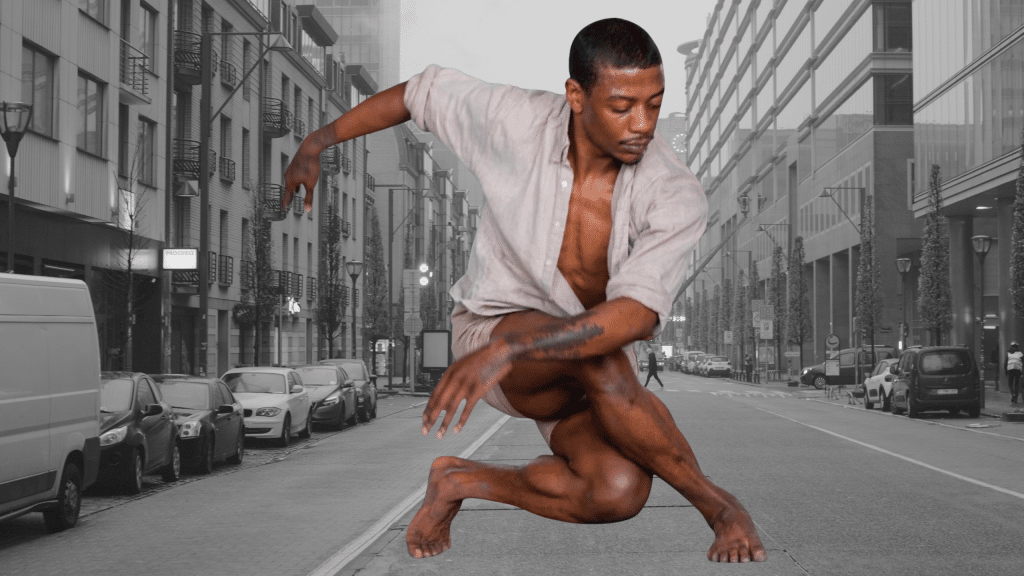
Nehemiah Spencer arrives at the interview fresh from the screening of “Fire Lily,” a film he starred in that was written and directed by British filmmaker Phil Dunn. The advance premiere was held Aug 6 at Atlas Cinema, the Shaker Square location in Cleveland, Ohio.
Spencer is in a white button-down crop top emblazoned with the question, “Do you love me?”
The shirt offers a series of answers arranged in alphabetical order, all eventually leading to yes. It’s a fitting introduction to a dancer, choreographer and educator who has spent years learning to love himself openly and on his own terms.
For Spencer, a professional dancer, that visibility has always been connected to movement.
“I was in kindergarten when I fell in love with the arts,” he says. By third grade, he had chosen dance. Before that, he was an actor, receiving callbacks for the role of young Antwone in the film “Antwone Fisher.”
His first dance teacher, Sabrina Gregory, treated Spencer as though his talent was innate. Smirking fondly, he recalls particularly enjoying the backbends, splits, tricks and stunts.
“I think dance gave me a place for me to move more fluidly,” he says. “I embraced myself more through dance.”
Learning to Be Seen
Growing up in Cleveland’s Glenville neighborhood, Spencer says he didn’t always see gay Black men like himself represented in a way that was praised or admired. Prince, Michael Jackson and Leroy from Fame helped him imagine a world where men could be flamboyant and still be embraced, worshipped even.
That freedom expanded when he left for college. At the North Carolina School of the Arts, Spencer began experimenting with how he presented himself without his parents there to make decisions or judge him.

After being rejected from Juilliard once, Spencer auditioned again and was accepted with a full scholarship. He remembers turning 21 at Webster Hall and dances when he talks about discovering a place where he could finally exist without hiding.
“New York was everything,” he says. “You ain’t have to hide yourself to exist in New York.”
Returning to the roots
But Cleveland kept calling.
“Cleveland is always, always home,” Spencer says. “I don’t think I ever fully left Cleveland.”
He returned to pour into the community that had supported him, building a career as a dancer and educator. In 2012 he founded the Nehemiah Project , a dance program dedicated to community outreach servicing the youth in Northeast Ohio. He has taught students from elementary school through college and currently dances and trains with the Dancing Wheels company.
What Survives the Fire
The Terrance Greene trial was central to Spencer’s life, as Greene was central to Spencer’s story as a dancer.
Greene taught Spencer at Cleveland School of the Arts and was Spencer’s teacher and abuser.
Greene, 57, was convicted by a jury of 65 felony counts following a week-long trial, including rape, sexual battery, kidnapping, felonious assault, disseminating matter harmful to juveniles, and gross sexual imposition. Prosecutors described Greene as a “monster” and asked the judge to impose consecutive sentences to send a message about the severity of his conduct.
Spencer was connected to the case through his experience as a survivor and his involvement in bringing attention to the abuse and its aftermath, making the trial part of the larger story of his survival and refusal to let his trauma define his life or art. The experience required patience, faith and trust in his support system, but it also changed his relationship with his own voice.
“Before the trial, I thought resilience meant showing up when it matters,” he says. “After the trial, it means we have to train our minds. It is a practice. I saw people’s true colors. I learned that some of my detractors were friends or colleagues of Greene who were staunchly on his side. And I had to embrace forgiveness not because what happened was okay, but because we still have to live, work and grow in the same community.”
The trauma followed him into his work. He became hypersensitive to touch and more conscious of how physical contact could be interpreted in dance and teaching. He also struggled with the professional consequences of having his name associated with the case.
But Spencer refuses to let the experience become the defining feature of his life.
“I did not want my life to stop at the abuse,” he says.
That determination is at the heart of “Fire Lily,” a short film inspired by the flower that blooms after devastation. Spencer sees the fire lily as a symbol of what can emerge after experiencing great trauma.
“When people see fire lilies blooming, people think they’re beautiful,” he says. “They’re a symbol of hope.”
The film was shot the week before Thanksgiving last year, while Spencer was preparing for surgery and performing with one of his personal heroes, Diane McIntyre, at Playhouse Square. The production also meant filming in freezing conditions. Even with the cold and the impending surgery, Spencer pushed through, determined to finish the story he had committed to telling.
The work culminated in the advanced screening Giving Spencer the chance to see “Fire Lily” with an audience for the first time.
“Fire Lily” follows LeRoi, a Black dancer played by Spencer, who is wrongfully detained by a police officer before the film shifts into a surreal exploration of poetry, music and dance. The film is produced by Academy Award-winner Kim Magnusson, Alesha Dixon, Theresa Godly and Joyce Allen of Women in Film & Television Ohio.
No stranger to film work, Spencer starred in “The Shadow Between Us,” a documentary which received a Central Great Lakes Emmy Award in 2024. Still, opening night brought a whirlwind of nerves. He wanted audiences to leave with something, an answer, a question, anything that made the film register.
But the experience also allowed Spencer to see his artistry differently. A stage performer at heart, he was able to watch his work on screen and recognize something he had worked hard to create.
Making Room for What Grows
Spencer is anticipating his blossom coming soon.
He is making room for therapy, becoming a dance student again, a larger public presence, his partner and his art. He laughs when he talks about making room for a balcony and a garden, too.
He has found joy onstage again. Once, he says, he tried to be a perfect dancer. Now he understands that dancing through imperfections can connect more deeply with an audience.
His students helped him rediscover that possibility. Through them, he saw that the world was bigger than what he had survived.
That is what Spencer hopes people take from “Fire Lily”: Devastation does not have to be the final chapter.
“There are new beginnings,” he says. “There are rebirths and ways to create from the things that burnt you out, and making room for things to grow again.”
For Spencer, resilience is not about returning to who he was before.
He offers his warm laughter again before exclaiming “I done worked too hard to give up now, sometimes resilience really looks like starting over,” he smiles. “Starting better.” 🔥
Ignite Action
- To learn more about the short film “Fire Lily,” click here.
- If you are experiencing sexual abuse, please call the Ohio Alliance to End Sexual Violence (OAESV) at 216-282-1559 or text at 216-232-2066.
- To access an interactive map of Ohio’s rape crisis centers, click here.
- If you are a young LGBTQ+ person in crisis, please contact the Trevor Project: 866-4-U-Trevor.
- If you are an transgender adult in need of immediate help, contact the National Trans Lifeline: 877-565-8860
Know an LGBTQ+ Ohio story we should cover? TELL US!
Submit a story!
Author

Related Articles
Black, Out, and Proud to host Melanated Health Forum centering Black LGBTQ+ health and wellness
Melanated Health Forum makes room for uncensored wellness conversations for Black LGBTQ+ people in Columbus
Pump The Beat!: Ohio’s ballroom scene as a queer community haven
For many people in the scene, ballroom is the foundation for their social and personal lives, and keeps many folx healthy, happy and safe.
Black Poets Fest in Columbus builds a home for Black artists – LGBTQ+ definitely included.
‘This space belongs to us, without confusion or apology.’
